PLO Assessment
All academic programs are expected to regularly engage in assessment of program learning outcomes (PLOs). PLO assessment offers faculty a consistent opportunity to reflect on and discuss student learning in order to improve program curriculum and pedagogy. The PLO Assessment Report serves as a record for current and future faculty of student learning outcomes achievement, assessment practice and program improvements. Below is an overview of the PLO assessment process; for more details, see our Guide to Preparing for Assessment.
The Program Learning Outcome Assessment Report Form is due on or before June 30th each year.
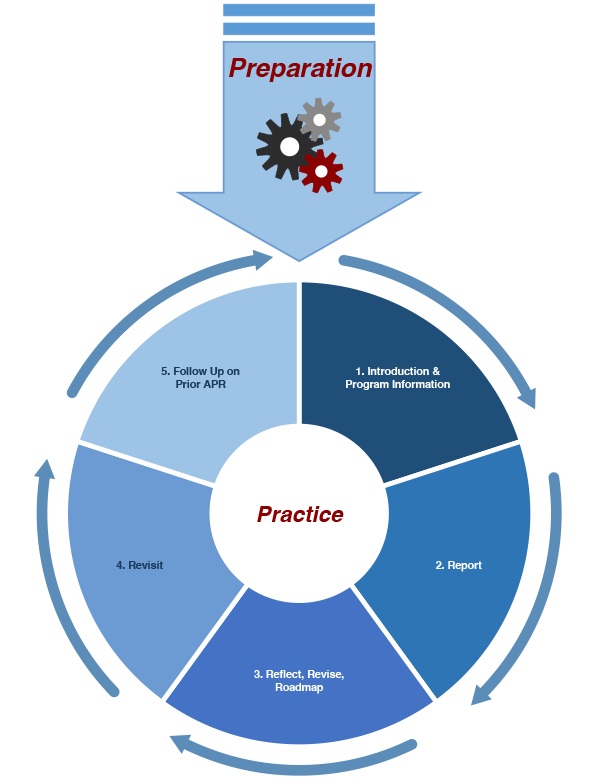
Preparation
The preparation phase, which occurs when a new program is developed or an existing program is heavily revised, sets up an academic program for assessment success. It involves clarifying what, which, when, how and who:
- What will students be expected to know, feel or do as a result of completing your program?
- Which student work will best demonstrate that they have achieved the learning outcomes? In other words, what specific criteria will demonstrate that students have learned what you have taught them?
- When and how will you gather evidence of student learning as a way of offering program-level feedback?
- Who will be responsible for leading regular program-level assessment in your department? For gathering the evidence of student learning? For evaluating it?
These preparatory questions are expected to be adequately addressed, and accompanying materials prepared, by those developing proposals for curriculum committees (UCC or GCC) or the Review of Academic Programs (RAP) committee.
Practice
The six steps outlined below mirror the six sections of the PLO Assessment Report. Taken together, they comprise the regular practice of learning outcomes assessment at Biola.
1. Introduction & Program Information
The Introduction and Program Information section establishes the administrative foundation for the assessment cycle, ensuring that all evaluative data is accurately attributed to the correct academic context. By documenting the program leadership, the specific reporting year, and the current status of curriculum maps, this section maintains the institutional record necessary for long-term consistency.
2. Report
Reporting is the most robust step in the process. Here, student evidence is gathered as planned (cf. Assessment Plan) and evaluated according to pre-established guidelines (e.g., PLO Rubric), and results on student achievement of learning outcomes are then reported. In order to facilitate efficient and consistent evaluation of student work, it is advised that your department conduct a rubric norming session as a part of a PLO assessment gathering. After student work is evaluated, results should be communicated to all department faculty in preparation for step 3.
3. Reflect, Revise, Roadmap
The Reflection, Revision, and Roadmap section represents the vital "closing of the loop" in the assessment cycle, where data is transformed into departmental action.
3a. Reflect. After results have been compiled and shared with all faculty in the department, it is time to reflect on what the results mean for practice. Key questions to ask include,
- What does the data tell us about students’ attainment of the learning outcome?
- What went well?
- What can be improved?
3b. Revise. The goal of assessment is evidence-based improvement. As a result of your department’s reflective discussion, it may be clear that one or more changes need to be made. Changes may be related to curriculum (revise the PLO or course content, offer certain courses more frequently, revise prerequisites or the course sequence, add or remove a course), resources (re-assign or train faculty or staff, increase classroom space), process (revise admission criteria or advising standards, improve use of technology), or assessment (modify our expectations, revise data collection methods or measurement approaches, collect and analyze additional data).
Certain changes will require that you notify the University (e.g., revising PLOs, Assessment Plans or Curriculum Maps). Curricular changes, such as revision of a PLO, requires curriculum committee approval. Changes to an Assessment Plan or Curriculum Map should be brought to the attention of the Office of Educational Effectiveness through the Assessment Documents Update Form.
3c. Roadmap. The next step in the PLO Assessment process is to look ahead. Consult your department’s Assessment Plan to address the following questions:
- Which PLO will your department be assessing next?
- What assignments need to be collected?
- From which courses and academic term(s)?
- Who will be tasked with gathering this evidence? With leading the assessment process?
4. Revisit: Follow Up on Previous PLO Assessment (from Spring a Year Ago)
The Revisit section emphasizes the iterative nature of the assessment cycle by connecting current practices to the departmental commitments made in the previous year. If an academic program has been in existence for more than one year, its faculty will begin by revisiting any changes that were made as a result of last year’s PLO assessment. This section asks, “What changes were made?” and “How were they implemented?” By documenting the status of proposed changes and any observable improvements in student learning, the program maintains a transparent record of its responsiveness to data. This ongoing dialogue ensures that the insights gained from one cycle directly inform the pedagogical and structural enhancements of the next, fostering a culture of continuous excellence and accountability.
5. Follow Up on Prior Academic Program Review
The Follow-up on Prior Academic Program Review section connects annual assessment activities to Biola’s comprehensive six-year review cycle. By reporting on progress made toward long-term Action Plan items, faculty ensure that the strategic goals established during the six-year APR remain a living priority. This section fosters sustained momentum for major program improvements, such as resource allocation or structural curriculum changes, ensuring that the program continues to evolve in a purposeful and accountable direction between formal review years.
If you have any questions, please contact educational.effectiveness@biola.edu.
Assessment Cycle