 Biola University
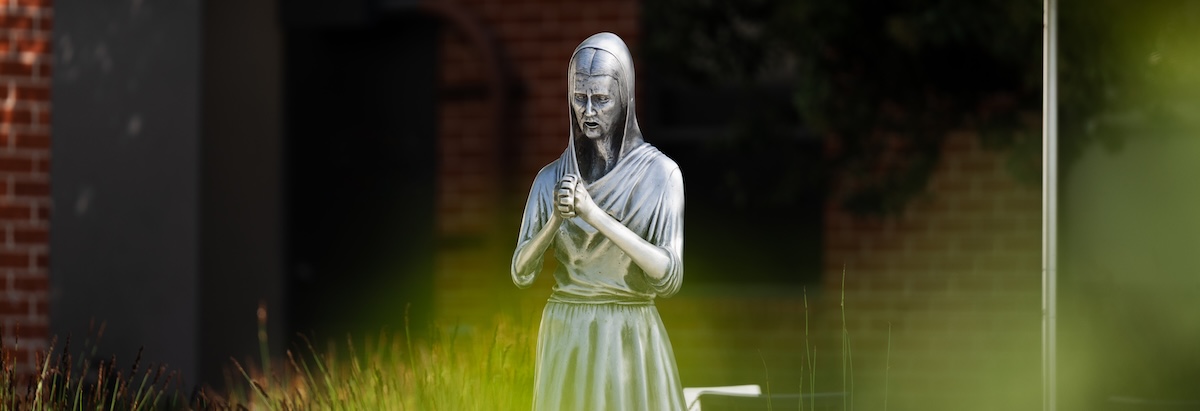
Faith of our Farmors
Dedication Address
As a young sculptor-in-training, I made my very first pilgrimage to the cultural Mecca that is New York City along with some fellow graduate students from Chicago. We had the good fortune of being guided by one of the world’s preeminent art critics, Jerry Saltz, who brought us to what he considered the most important shows happening in the city at that time. The show I, personally, was most excited for was a survey at the illustrious Whitney Museum of American Art of one of my favorite artists, a sculptor named Tim Hawkinson.
The show did not disappoint. I had never seen his work in person, and being face-to-face with the work for the first time, the incredible ingenuity & craftsmanship somehow exceeded my expectations. I realized at one point I was walking around with a big smile on my face; the work was a pure dose of joy straight to the soul. It was endlessly inventive in a mad scientist sort of way. It was unapologetically funny. And yet, it was also plumbing the depths of the human experience in ways that were meaningful to me as both an artist and as a Christian.
Several years before, as a first generation college student who somehow, against all seeming sense, chose art as my major, it was rare and difficult to find models of contemporary artists whose work addressed issues of Christian faith from anything resembling a faith-based perspective. So it was a transformative moment for me to sit in my very first Sculpture class and watch a clip from the PBS show ART21 on an artist who did exactly this, and was being celebrated on the biggest of international stages for work that illuminated many of the questions I was grappling with as a young Christian:
How to make sense of being a spiritual being in a frail, limited body.
How to come to terms with mortality while still delighting in the wonders of life.
How to make spiritually serious art that was also engaging contemporary artistic conversations.
How to do this amidst an art world that was generally skeptical of any work tackling such themes.
Tim’s work was doing all of this, and was doing it in such hugely impactful ways. I searched for all of the work I could find of his, then realized he was the same artist whose work I had been mesmerized by via the album art of a musician I had loved as a teen, in the album Mutations by Beck. Another important work was called Pentecost — a room-sized sculpture of 12 figures that functioned as a collective musical instrument—vessels capturing the movements of the spirit. This piece was prominently featured in one of the most important and authoritative surveys of contemporary art, the Whitney Biennial.
In the aforementioned PBS video, and then later in New York, was one of the most fantastically absurd objects I had ever seen: a football-field sized functioning pipe organ made of, amongst other things, large sheets of plastic, nylon rope, cardboard, glass jars, and a functioning light-sensitive player-piano machine that fed music to the machine, including old hymns that were recognizable despite sounding like they were being sung by a whale. I loved it so much. It expanded my imagination for what art could be. And I can say in all truth that Tim’s work influenced my decision to become a sculptor, leading me on the path that ultimately led me to taking a position heading the Sculpture concentration here in Biola’s Department of Art.
So imagine my delight after moving to Southern California when I visited a church near my new home in Pasadena and was told by the pastor that I should meet another artist in the congregation, a guy named Tim. Meeting Tim and Patty and Claire, and worshipping alongside them was such a gift, and such a joy, and I am deeply grateful to know them all.
And in a way, now, I feel like I will be worshipping alongside Tim every day, as this sculpture rests mere steps away from my office in Bardwell Hall. I mashed my face against the window of my office to confirm I can’t quite see it from there, but it’s close enough. It feels like such a gift to me personally and I wanted to personally thank Tim, and John and Marilyn Long for gifting this work so that the entirety of the Biola community can live with it for generations to come.
The piece is exemplary of so many of the elements that I love about Tim’s work. It includes some fantastic engineering: embedded in hands is a wheel bearing designed to be used in windmills. It also has a playful charm and interactivity that makes it feel so generously approachable. Those completely uninitiated to contemporary fine art will still be able to enjoy it. I’m guessing it’ll be very popular with students this coming week, as it would function as a great stress-reducing fidget spinner for exhausted students knee-deep in finals.
Of course, it is more than a fidget spinner. The metaphor of the wheel — specifically a specific tractor tire form that Tim saw as reminiscent of fingers interlocked in prayer, seems to invite passers-by to interlock their own hands in prayer. For viewers spinning the wheel and praying could become a sort of daily liturgy as they pass by it, back and forth across campus. An informal liturgy, but serving a similar function as the nearby bells, calling us to pause and look upward, or inward, in faith.
For a lot of people on a lot of days, the face of the figure will probably mirror their own feelings, ones common on a college campus—focus, concentration, perhaps pain—amidst the daily toils of life. On its surface, it’s not a particularly joyful face, but it is still the face of one steadily planting seeds that will one day bear fruit, even if they can’t envision that day amidst the challenges of the present moment.
It is also, very likely, the face of Tim’s grandmother, having been based on a painting by Tim’s grandfather. It was not the painting of a professional artist, but still survived him to be seen and considered and reimagined in ways his own mortality didn’t afford him to witness in the flesh. In that sense, we are here bearing witness to their faithfulness, a faith that was passed down for generations, and we are here today celebrating some of the fruits of that faith. Tim’s own faithful work carries that spirit forward, linking those past generations — Tim’s parents, grandparents, great-grandparents — to future generations.
In contrast to the image of the Word around the corner, the role of us believers isn’t to hold the fullness of the Truth in its entirety, but to labor toward it, imperfectly, faithfully, gratefully, in daily rituals of devotion, day after day, year after year, working out our faith while doggedly pursuing whatever tasks are set in front of us. I look forward to spinning this wheel, with gratitude, for years to come. Gratitude for the faith of those who came before, for the artist and his family, for the Long Foundation, for the leadership at Biola, and for all else who helped this sculpture, and the events of this day, to come together.
Luke Aleckson