Biola University
The greatest discovery in modern archaeology started with an unexpected trio: a shepherd, a lost sheep and a network of hidden alcoves. As the story goes, a shepherd of the Ta’amireh tribe first discovered a cave — crowded with dusty tomb-like jars — while searching for a stray from his flock. Scrolls of original Hebrew writings emerged, giving real-life proof to the authority of the Bible. What felt like happenstance would go on to reshape cultural understanding of the ancient world and the Christian faith.
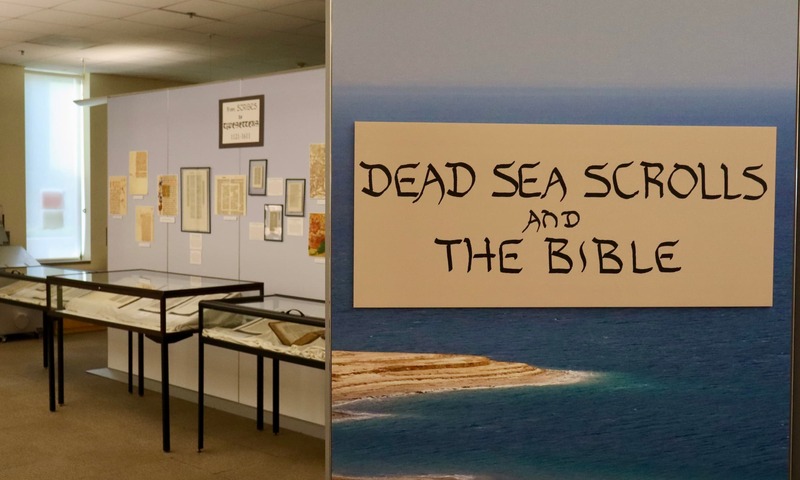
Nearly 80 years later, facsimiles,exact copies and reproductions, of the Dead Sea Scroll texts are on display in the Biola University Library.
The library exhibit features facsimiles of several Dead Sea Scrolls alongside ancient artifacts and rare Bibles. A standout includes three pre-Holocaust Jewish scrolls donated by Paul Rood, a former long-time Biola professor who is connected to one of Biola’s early presidents, Paul W. Rood. Other highlights are oil lamps from about 2500 B.C., a First Temple Period jug, pottery shards and a meteorite-type object from Jordan, just northwest of Sodom and Gomorrah.
Among those objects sits a single silver denarius, the same kind of coin Jesus held up in his famous reply to the question of paying taxes to Caesar: “Render to Caesar the things that are Caesar’s, and to God the things that are God’s” (Matthew 22:21).
“Knowing that Jesus specifically asked for that type of coin for his teaching is very meaningful,” shared Chuck Koontz, associate librarian for systems and special collections. “And to look at the coin actually makes the ‘whose likeness’ lesson somewhat funny to me, because that particular Caesar (Tiberius) had a large nose.”
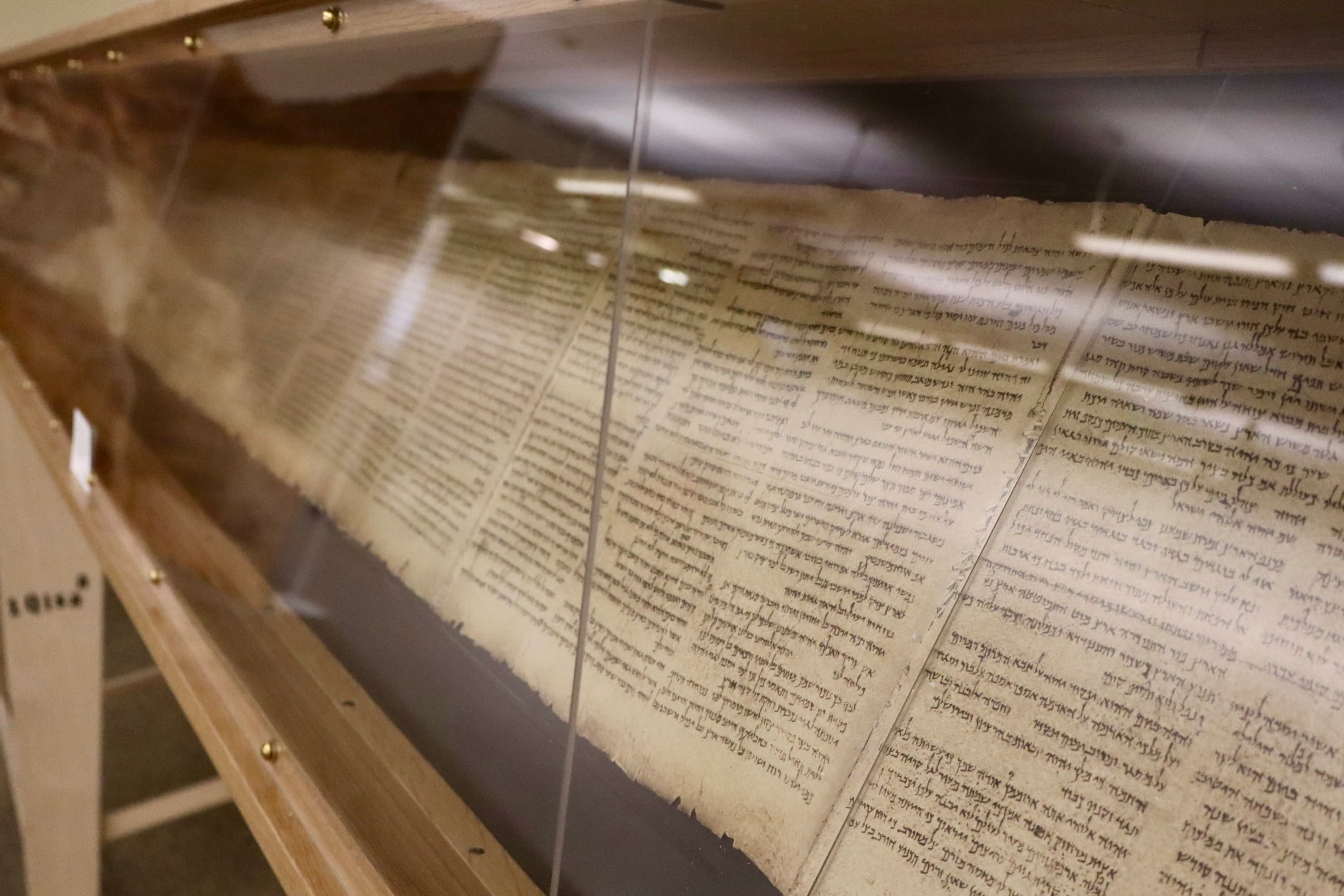
Another crowning jewel of the exhibit is a facsimile of the Great Isaiah Scroll — a 24-foot-long scroll of the 66 chapters of Isaiah. The prophetic message matches its epic length: it points to God’s sovereignty over creation, his blessing toward the “humble and contrite in spirit,” and his promise to gather the faithful of Israel.
Dr. Darin Lenz, professor and chair of the Department of History, highlighted the importance of this particular discovery: “The Dead Sea Scrolls, particularly Isaiah, disprove earlier historical-critical scholarship that discounted prophecies about the Messiah in Isaiah,” said Lenz. “Not only do those prophecies stand firm, but Jesus fulfilled them perfectly.”
At the time of their discovery, these oldest surviving copies of the Hebrew Scriptures sent a shockwave through culture for both skeptics and believers. Skeptics were faced with physical evidence challenging their beliefs, and a history more real than they could have imagined. Archaeologists had a new site to explore. Believers had tactile evidence for their hope.
It is one thing to believe in something abstractly. It is quite another to have objects which, in the spirit of Jesus’ words in Matthew 26:26, invite the world to “taste, eat, remember and believe.” Like the evidence of Christ’s nail-torn hands which took away the disbelief of Thomas, the Dead Sea Scrolls are another manifestation of an embodied Christ.
“Biola was founded on God’s Word, and faculty have been engaged in the study of biblical archaeology since at least the 1940s, so this exhibit continues in that tradition,” Koontz said. “Exhibits like these present truth in a way that is fundamentally different from hearing lectures, reading assigned texts or watching videos. Students preparing for ministry or teaching can have their studies deepened and broadened by engagement with these historical objects.”
Since 1908, that has been Biola’s vision: to know the Bible and make it known. This exhibit is a physical reminder to students and visitors alike of the reality of the gospel. It is an invitation for everyone to encounter the embodied realities of a historical Jesus.
“The Bible features real people and real events, and the Church has faithfully passed on to us a record we can believe,” Koontz said. “Through these authentic artifacts and documents, and through these faithful facsimiles, we want all visitors to be encouraged that God’s Word is true.”
Even with these historic pieces to reinforce the authenticity of Scripture, many young people are still asking profound questions about the relevance of the Bible in their lives such as, can a text so old be trusted? What does it mean for Scripture to be “inerrant”?
“For students, this is a testimony to the fact that history can faithfully record timeless truths of spiritual significance,” Lenz said. “Since all Christians are ministers as doers and believers of the Word, this affirmation of God's Word as trustworthy can help us as we wrestle with the tough questions and know the Bible is true.”
To address these questions, leading scholars at Biola are hosting a lecture series highlighting nuanced aspects of the Dead Sea Scrolls. They hope to shed light on Scripture’s implications and what the 1947 discovery of these texts at Qumran means for biblical scholarship.
Among those giving lectures, Lenz will be giving a talk on the historical implications of the scrolls’ first discovery, and how that discovery shaped cultural reactions to Christianity during the Cold War in 1946.
With this historical context in mind, Lenz shared that “The Dead Sea Scrolls show us that the Word of God is unchanging and trustworthy. They refute the musings and speculative theories of modern scholars who doubted that the Word of God was unchanging…the scrolls show us that scribes were not changing and inventing and rearranging texts to suit a political moment or to impose their hopes on the Old Testament.”
Visitors can visit the pieces for free in the Library Exhibit space, just left from the turnstile entrance on the first floor. The exhibit runs through Dec. 18.
The lecture series includes 10 distinct sessions led by faculty from Talbot School of Theology, Torrey Honors College, and the Department of History. A schedule of the remaining lecture series can be found here.
For more information, contact beacon@biola.edu.