Biola University
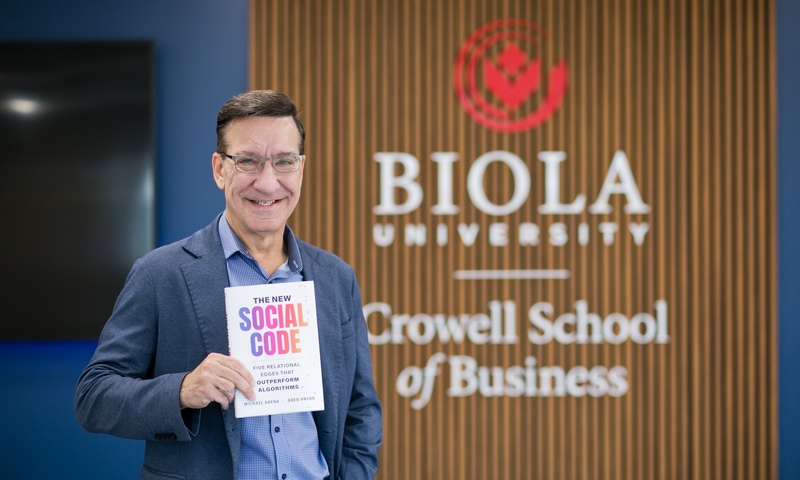
In the age of AI, the importance of human connection is becoming increasingly apparent. The new book, The New Social Code, which was recently recognized on the USA Today Best-Selling Book List, presents five relational edges that help professionals thrive as AI grows. Coauthored by Dr. Michael Arena, dean of the Crowell School of Business, and Greg Pryor, the book draws on a decade of research across nearly 100 organizations, including AWS, General Motors and Workday to reveal how opportunity, trust, attention, insight and influence create human-centered advantages algorithms cannot replicate.
Keep reading to hear from Arena as he dives deeper into how Biola students are being equipped to enter an AI-driven workforce.
As AI continues to reshape the workforce, what do you believe will distinguish successful graduates in today's job market?
We're witnessing a fundamental shift in what makes people valuable in the workforce. For decades, career success was largely determined by what you knew. But as AI makes knowledge abundant, human connection becomes the new scarcity.
That doesn't mean technical skills are less important. Students must become proficient in AI and business fundamentals, but technical proficiency alone won't distinguish them. These connections have always mattered; one three-year research study shows that maintaining professional connections is the strongest predictor of success and can explain as much as 49% of the variation in salary growth and career satisfaction. We believe this will become even more important in the immediate future.
At Crowell, we're responding with what I call a barbell approach to education. On one end, we're developing AI literacy and core business skills. On the other, we're intentionally cultivating six enduring human skills: emotional intelligence, social influence, adaptive leadership, critical thinking, teamwork and ethical reasoning.
The graduates who thrive won't simply know how to use AI. They'll know how to bring people together to accomplish what technology alone cannot.
In The New Social Code, you explore how relationships are becoming a critical competitive advantage. Why is building a strong professional network especially important for Biola students entering today's workforce?
The best career opportunities aren't posted. They're discovered through relationships.
In today's crowded job market, AI makes it easier than ever to submit hundreds of applications, making it increasingly difficult for qualified candidates to stand out. And research estimates that 70% to 80% of job opportunities are never publicly advertised. Many emerge upstream, through conversations, relationships and business challenges long before they become formal job postings.
In The New Social Code, we identify five relational advantages that distinguish successful professionals: Opportunity, Trust, Attention, Insight and Influence equip individuals to discover opportunities early, build meaningful relationships, focus on what matters, generate new ideas and mobilize others to enable impact.
At Biola, we want students to do more than learn how to apply for jobs. We want them to cultivate authentic relationships with alumni, executives and industry professionals. And importantly, networking isn't about collecting contacts. It's about curiosity, generosity, reciprocity and trust, values deeply aligned with our Christian mission.
You've emphasized the importance of students graduating with five brandable experiences and a strong professional network. How is Crowell School of Business intentionally creating opportunities for students to develop both?
At Crowell, we're challenging every student to graduate with five brandable experiences through meaningful client projects, internships, and real business engagements that demonstrate their ability to solve problems, lead initiatives and deliver measurable results.
Our goal is simple: We want our students' resumes to look like those of seasoned professionals, not recent college graduates. By the time they enter the workforce, they should have a portfolio of accomplishments that demonstrates what they've actually done in business, not just what they've learned.
Just as importantly, each experience creates opportunities to build relationships with executives, employers and industry professionals who can open doors long before jobs are ever posted.
The combination of demonstrated experience and a competitive network of relationships is what will differentiate Crowell graduates in an increasingly crowded job market.
What makes Biola uniquely positioned to prepare students for a workforce where human connection, character and adaptability are increasingly important?
I believe Biola has a distinct advantage because the qualities becoming most valuable in the age of AI are deeply rooted in our Christian understanding of what it means to be human.
At Biola, we believe every person is created in the image of God, endowed with inherent dignity, purpose, creativity and the capacity for meaningful relationships. Being an image bearer means our value is not defined simply by what we know or produce, but by who we are and how we reflect God's character in our relationships with others. That's why education isn't simply about transferring knowledge. It's about forming people with wisdom, character and a commitment to serving others.
At Crowell, we believe business is ministry. Our research shows that just 3% to 5% of employees sit at the center of organizational collaboration, carrying 20% to 35% of the collaborative demand within an organization. These individuals have an outsized impact because of their ability to connect people, build trust and influence others.
If we can equip Crowell graduates to become these central influencers, we can amplify their capacity to exercise redemptive impact. By positioning themselves at the heart of meaningful relationships, they can use their God-given gifts to serve others, shape organizational cultures and contribute to the flourishing of those around them.
How are Biola students not just prepared to enter today's workforce, but to adapt and thrive as the future of work continues to evolve?
The greatest mistake higher education could make would be preparing students exclusively for jobs that exist today. AI is changing work too quickly. That's why we're preparing Crowell students not simply for their first job, but for a lifetime of relevance, adaptability and meaningful contribution.
In the book, we call this social agility, the ability to intentionally move into and out of different relationships as opportunities, challenges and career aspirations change. At different stages of their careers, graduates will need to expand their networks to discover opportunities, build deeper relationships to establish trust, focus their attention on what matters, bridge across boundaries to generate new insights, and cultivate the influence needed to create meaningful change.
We're not simply preparing students to compete for today's jobs. We're equipping them to discover tomorrow's opportunities, adapt to whatever comes next and become the kind of people others want to work with, learn from and follow.
Learn more and apply to the Crowell School of Business, where students are equipped to future-proof their careers.
Interview conducted by Sarah Dougher, associate director of public relations and strategic communications. For more information, contact beacon@biola.edu.