Biola University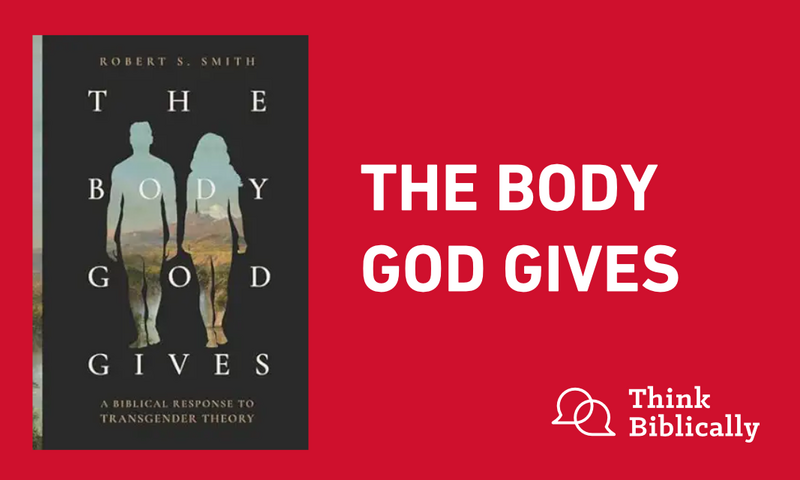
What is a biblical response to transgender theory? What is the relationship between sex and gender? How can Christians best navigate our cultural moment with biblical conviction and compassion? In our discussion, Dr. Smith argues that God's design is for a person's gender to be rooted in his or her biological sex, which is the body God gives. Smith offers a helpful and pastoral critique of transgender theory and talks about where this debate may be headed.
Dr. Robert S. Smith is an Australian ordained minister in the Anglican church and a writer in theology, ethics, and music ministry. He formerly taught at Sydney Missionary & Bible College. He is the award-winning author of The Body God Gives: A Biblical Response to Transgender Theory.
Episode Transcript
Sean McDowell: [upbeat music] What is a biblical response to transgender theory? What is the relationship between sex and gender? And how can Christians best navigate our cultural moment with biblical conviction and compassion? These are some of the questions we're going to explore today with our guest, Dr. Robert Smith, author of the new book, which is my go-to of its kind. It's called "The Body God Gives." I'm your host, Sean McDowell.
Scott Rae: I'm your co-host, Scott Rae.
Sean McDowell: This is Think Biblically from Talbot School of Theology, Biola University. Robert, it's great to have you on. Thanks so much for taking the time to join us.
Robert S. Smith: It's a great pleasure. I'm looking forward to talking with you both.
Sean McDowell: Well, you talk early in the book about what you call a transgender tipping point that hit around 2013, and someone could argue that we've had a tipping point maybe two years ago or so, but talk about what you mean by that and maybe how you think the conversation has again shifted, within the past couple years.
Robert S. Smith: Yeah, well, the language of the transgender tipping point, was the title given to a Time magazine cover story, I think early in 2014. And they pinpointed the tipping point sort of late 2013, where a number of things kind of coalesced. There were some changes in the DSM, the new DSM-V. That DSM stands for Diagnostic and Statistical Manual of Mental Disorders. That's where the language of gender dysphoria was introduced to replace- ... Gender identity disorder, so that was a fairly s- well, very significant shift. But, but the, I think the bigger thing was the cultural celebrations of transgender identities. And this, of course, was a time when tr- same-sex marriage was w- in the process of being, passed in the UK, the U.S., Australia, many other places, and I think people were looking for the next civil rights cause. And, of course, once you've ticked off LGB, you come to T. So-
Sean McDowell: That's right
Robert S. Smith: ... That's, I think, what got us to that tipping point. Yeah, I don't know what the reverse of a tipping poi- tipping point is, a receding point or something. But, I think in the last couple of years, w- there's certainly been some major pushback, certainly coming from medical bodies and medical reports. There's been cultural pushback about, you know, trans women in female sports. There's been, outrage really about, trans women being put into female prisons and so a number of things have, I think, caused the general public and certain, bodies like, yeah, well, medical people to s- stand up and say, "Hang on a second. No, no, we can't, we can't, run with this." And so that, I think, has put a major brake on things. But I don't think I don't think we're at the end of it. You know, we may be somewhere between, D-Day and VE Day, if you- ... Think in Second World War terms. But, we're certainly not, it's not all about to go away tomorrow.
Sean McDowell: I should have mentioned this at the beginning, but you're an ordained Anglican minister and lecturer in theology, ethics, and music ministry at Sydney Missionary and Bible College. So you've got an international perspective to bring to this and see things that we haven't quite heard from yet.
Robert S. Smith: Well, I should have mentioned this earlier. I've recently finished up my teaching time at SMBC.
Sean McDowell: Oh, okay.
Robert S. Smith: And, well, I'm in the midst of writing, [chuckles] one thing for you, of course.
Sean McDowell: That's right. [chuckles]
Robert S. Smith: But, I'm also just working out exactly where the Lord wants me- ... To direct my energies in the, well, whatever years He has left for me. So, but yes, I'm still doing some lecturing and, lots of writing at the moment.
Scott Rae: So Robert, tell us exactly what you mean by the term transgender and, you know, your subtitle is A Biblical Response to Transgender Theory. What, what's at the heart of transgender theory?
Robert S. Smith: Well, let me answer the first question first. Transgender,
Robert S. Smith: it's a term that is applied to people who either experience or express, their gender, and we'll come back to what that is, in a way that's, different from their sex. So the key to the word lies in the prefix trans, which is Latin meaning on the other side of. And so, strictly speaking, a transgender person, or as I prefer, a trans-identified person, again, experience or expresses their gender. Either they think about it, perceive it, or they, you know, live it out in the world in a way that is contrary or opposite to their sex. But of course, it's a bit messier than that because, as we're very familiar, there are terms like non-binary and, you know, demi-boy and demi-girl and then, so it's not exactly a sort of, 180 degree,
Robert S. Smith: opposition, as it were, between sex and gender. It could be 90 degrees or 45 degrees. And so again, I often just say it's for someone who expresses their, gender in a way that's different from their biological sex. It may be completely different, or it may be partially different, but different. So that's what that language is intended to convey. Now, transgender theory, I suppose is a w- an attempt to make sense of that, the experience that some people have. And the theory runs like this. Transgender theory says, first of all, sex and gender are in no way internally connected. They're, in fact, to use one proponent's language, they're radically independent, and that means that there's no reason why your sex and your gender, uh-Should align. They might happen to align, as they do for many people, but there's no reason why they should align or need to align. And so this is where the other term cisgender sometimes pops in as saying, well, that's when you- the two things end on the same side. Transgender is when they are on different sides. So the theory says that first up, but what that then implies is that, well, clearly it's not your body, your sex, that determines your gender. And so if you ask the question, "Well, what does determine your gender?" Transgender theory says it's your gender identity- ... That determines your gender and therefore, well, in the more radical versions, even rewrites your sex effectively. So yeah, gender identity is king in transgender theory. It's the real you. It's maybe subjective and internal and all of that, but i-i-it's the deepest truth about you, and if it's different to your body, then you can change your body to fit it or not, because as I said, the more radical end says that your gender identity kind of reclassifies your body. Um-
Sean McDowell: Give us your response to that, if you will, 'cause I have a way I respond when people say you can separate your gender identity from your biological sex, and I typically point towards other examples where people won't do that with age, they won't do it with race, they won't do it with, say, your height, but all of a sudden they will separate it when it comes to sexuality, which shows an inconsistent to me, an inconsistency and somewhat of an agenda behind it. But how do you respond to that i-idea at the heart of transgender theory that says your identity is rooted in your feelings and your attractions, so to speak, rather than in your body?
Robert S. Smith: Yeah, well, I think firstly, we just need to recognize that there certainly are some people who, well, clearly experience and clearly express, a gender that is different from their sex. Now why they're doing that, o-of course can... Well, there can be many and many different reasons for that. But I guess we just need, first of all, to recognize there's some pe-people in a lot of pain- ... About their experience of life and perhaps their sexed embodiment. They may be ashamed of that sex or confused about what gender is and where they fit in in the world. So I think it's important to perhaps just start there, recognize, okay, it's messy out there on the ground. But when someone with a male body says, "I am a woman," or even, "I feel like a woman," the simple fact of the matter is they're not a woman. You know, they're, they're a male person, and, you know, by definition cannot be a woman, which is an adult female human. But a-again, if you sort of press on that, as I certainly have in conversation with many people, and say, "Well, when you say you're a woman or you feel like a woman, what is it-- what are you saying by that?" and it does beg a logical question, you know. How can someone with a male body say that I feel like someone with a female body? [chuckles] How is that even possible? But it also begs the question, how would you even know what a woman felt like to know that you feel like one?
Sean McDowell: Great question.
Robert S. Smith: I... F- to be honest, I don't know what it feels like to be a man. I only know what it feels like to be me, who is a man, but I don't know what it feels like to be any man, e-either of you or anyone else. So yeah, there's some deep, I guess, logical philosophical issues there. But again, to come back to the personal pastoral, when a s- when a person says, "I feel like a woman," we probe that. Often they're say-saying something like, "Well, I seem to identify more with things that women identify with, and I'm perhaps not comfortable in the company of men or I don't find it easy to make friends with men," or, "I don't like my body and I wish I had a different body." you know, whatever, you know, there's a range of possible things, but often it comes down to some area of discomfort, perhaps even, with some trauma behind it or, some confusion in the person's experience that's then taking th-them to this place, and invoking this theory or philosophy that's saying, "Well, actually, I'm really a woman trapped in a man's body," which, of course, they're not.
Scott Rae: So Robert, let's be clear for our listeners here sort of right off the bat. What is the difference between sex and gender, and how should we-
Robert S. Smith: Yeah
Scott Rae: ... Think about the relationship between those two things?
Robert S. Smith: Yeah. Okay, this in some ways all that we've said so far kind of, requires a clarity on this question, doesn't it? Now, I think sex is fairly straightforward, and, certainly most people are not particularly confused. It's, it's got to do with our biology, our physiology, our reproductive anatomy, and so on. Are we male? Are we female? Gender is a much more complex notion, partly because it is used in a variety of different ways. Some people of course, just use it as a synonym for sex, and that certainly was a his- a historic meaning, for the term, and still a current meaning in that, you'll get it on forms, won't you? You know, the form says, you know-
Scott Rae: Mm-hmm
Robert S. Smith: ... Gender. They re- wanting to know if you're male or female. But, in the '50s and '60s and '70s, as we all may recall, gender became a way of talking about the kind of social expectations and social roles that men and women, were expected to occupy. And of course, second wave feminism was challenging that and saying, "Well, just my biology is not my destiny. My- just because I'm female doesn't mean I have to be, whatever, you know, the cook of the house or a housewife or only take these roles and not those roles or do these jobs and not those jobs." So again, socialAnd even the cultural expression of that in terms of clothing and hair and so on. So that was in the 60s. Now then moving on from that, we've now come to think of gender in terms of gender identity, which is not the social but the psychological. So that's why there's so much confusion. When someone says my gender is up to my sex, well, what do you mean? Are you, yeah. Is this how you think about yourself or is it how you are dressing yourself or what? Now, in my book, as you will no doubt recall having read it, I have run with a model which to me at least makes reasonable sense, which is to see gender a bit like a folder on your computer that when you double click on it, inside it has the social and the psychological files. So sex, your body, gender, your psychosocial extension of that, your expression of that, your perception of that. So that's how I've presented it in the book. And what I've argued is that biblically we have a
Robert S. Smith: task to express our sex through our gender in a way that is faithful to our sex, not contrary to our sex. So in the way I think about myself and the way I present myself, I should be thinking rightly about my sex and living out my sex in a way that's readable to others rather than confusing to others. We're stewards of our sex in that sense, but we present our sex to the world through our gender and we think about our sex in ourselves according to the reality of it.
Sean McDowell: And I think that's the trick, right? Is that God's given us bodies, we're male and female, but scripture doesn't really give us a lot of details or specificity what that looks like. So we have to draw out, like you said, some of these cultural stereotypes from what it really means to be male and female and live consistently with our biological sex. That's the challenge. And I'd love to circle back to that, but let's start with where you start in the book, which any conversation about sexuality and human nature begins, which is in Genesis 1 and 2. And you've got extensive, this is an academic book. It's very readable, but maybe if we go back to Genesis 1 or 2, what are just a couple of the most important takeaways that we learn there that contributes to our understanding of what it means to be embodied creatures?
Robert S. Smith: Yeah, yeah. Well, yes, I'd only intended to write one chapter on Genesis 1 and 2 and ended up writing three.
Sean McDowell: Good luck with that.
Robert S. Smith: And I could have written more.
Sean McDowell: Sure.
Scott Rae: Moses made it in two.
Robert S. Smith: Yes, well said, well said. Okay, well, let me make some brief points. Well, firstly, in Genesis 1, after being told that humanity's been made in the image of God, the very next thing we're told is that we come in one of two forms, sexed forms, male or female. And so we are sexually dimorphic, to use the technical language. Sex for humans, like for many animals, is binary, which is, again, not to say there aren't some confusions that have crept in after the fall, but there's still only two sexes. And interestingly, these are embodied terms, right? To be a male, to be a female is to have a certain type of body. So God has made us embodied and he's given us sexed bodies. And part of the purpose of that, not the only purpose, but part of the purpose is revealed in the very next verse 28 of Genesis 1, that we are to be fruitful and multiply. And so obviously our sexual difference allows for that. And again, as two bodies come together, they create more bodies. So embodiment's right in the center of the picture from the get-go. Now, coming into Genesis 2, we get a different account, although I think it's really just a zooming in, as it were. Camera comes in close to that whole process of the creation of male and female, or as the language of chapter 2, man and woman. And what we see firstly is that God forms the body of the man, even before he breathes into him the breath of life. And so he's already a man due to the form of his body, even before he's a living man. And then likewise, God forms the woman, or literally builds the woman out of part of the side of the man and gives her a different body, because what he needs is not a replica of himself. He needs a like opposite, that lovely expression there in the Hebrew, an ezer konego, a helper like opposite. And so he needs one who's like him in sex, but opposite him. Sorry, like him in humanity, opposite him in sex. And that's what he gets. And that's why he's so excited. She shall be called woman, for she was taken from man. So she is bone of his bone, flesh of his flesh, and yet a sexual complement. And again, this is all embodiment there. So we have a link there between the male and female of Genesis 1, the man and woman of Genesis 2. And well, if we need any confirmation as to how those line up, Jesus certainly gives it to us, doesn't he, in Matthew 19, where he mashes up those two texts of Genesis 1.27 and Genesis 2.24 and says, from the beginning, God made them male and female. For this reason, a man shall leave his father and mother, be joined to his woman, his wife, and the two will become one.flesh. And so that tells you, to use the modern language, that sex and gender i-in God's design go together. They, they line up. If you're male, you grow to be a man. If you're female, you grow to be a woman. And, and so that plays out, you know. Husband, wife, father, mother, son, daughter, and on and on. Th-these are all fundamentally embodied terms that have to do with what sex God has made us. So there you go. There's, there's a few insights from the opening.
Sean McDowell: That's great. Really key ones.
Scott Rae: Yeah, that's really helpful. Let me follow up, Robert, on the, on the, when you... The conversation about a woman trapped in a man's body. I take it from there, you, in your view, it is not, it is not possible ontologically to be that kind of mismatch between the soul and the body. But would you say is the soul sexed, or is that something that is just only reserved for the body?
Robert S. Smith: Yeah, look, that's a, that's, a hard question to answer, [laughs] uh-
Sean McDowell: [laughs] I agree
Robert S. Smith: ... I think. Yeah, I think fundamentally sex is a characteristic of bodies. But because we are our bodies, then we are sexed persons. I'm not just... I'm not a person with a sexed body. I'm a sexed person. And so, yeah, in as... If our souls are sexed, they are sexed, I think, fundamentally because of our bodies.
Robert S. Smith: R- They're certainly not sexed independently of our bodies because I don't think there is any independence in the way scripture presents sort of human constitution. Now, what is interesting to ponder is w- you know, what happens at death when there is a separation of soul and body, and clearly the person continues to, as it were, be the male or female person they were in this life. So, you know, if you think about Jesus, between death and resurrection, Jesus remains the man Christ Jesus.
Robert S. Smith: And then of course he's resurrected in... His male body is resurrected. So we don't lose our sex even i-i-in the so-called intermediate state, where we are temporarily, without body. But clearly God's purpose is that we are an integral body-soul unity. A psychosomatic unity is the technical language. And that will be the case, of course, in resurrection. So death is a kind of anomaly. It's an interruption to the norm. And so again, se- body and soul go together. And so yeah, I'm again happy to think about the soul as sexed, but perhaps sexed via the body or in unity with the body.
Sean McDowell: That's interesting. Uh-
Scott Rae: That's helpful.
Sean McDowell: Yeah, I think that's, that's right on. I agree it's a difficult question to land, but I could not land it better than that's for sure. Tell us what it means to be made in the image of God, and how our embodied natures and sexed bodies are an extension of being made in God's image. What does that mean?
Robert S. Smith: You guys like to ask the easy questions, don't you? [laughs]
Sean McDowell: [laughs]
Robert S. Smith: As you'll know, there's an ocean of literature on the image of God and many different, thoughts about it. I do think fundamentally, to be God's image i-i-in scripture is to be God's children. I mean, I suppose you might even say first and foremost, it's simply to be human. To be the image of God is to be human. To be human is to be the image of God. But what is it to be human? I do think Genesis 5 gives us a bit of a clue when it, links, Seth as the s- as the image of Adam and so on. So I do think to be God's image is to be God's children, and therefore we are to, represent Him. We are to rule under Him. And again, all of those things require bodies. We are certainly physical representations of God, and we rule a physical world, with our physical bodies. But we do so as God's children. Now, that I think, leads you straight into, biblically, to understanding the ultimate image of God, who is the Lord Jesus, who is the eternal Son of God, and so, you know, the child of God par excellence, you might say. And of course, our ultimate destiny, which is to be conformed to His image, so that we become perfect sons and daughters of God in Christ's likeness. And, and so I do think scripture links all of these things up very profoundly. And of course, it's why Jesus comes and takes on our humanity, that as the, you might say, the eternal image of God, He becomes the incarnate image of God, that we might again be conformed to Him as the God man, in that way. Now, there was another part to your question. I think I've lost it somewhere there, Sean. Um-
Sean McDowell: Yeah. I was just curious about what you meant by being made in God's image and how that contributes to our discussion about gender in response to kind of transgender theory. Just making-
Robert S. Smith: Yes
Sean McDowell: ... Those connections is really good.
Robert S. Smith: Yes. Okay. Yeah, yeah. Well, again, I think it does, it does highlight the physicality factor- ... The embodiment factor. But if I can come back to the Christological end of that, again, Jesus is a man. He's a man because he has a male body. Now of course the coming Messiah was always prophesied to be male, you know, a son, a king. But of course he is in eternity the eternal Son who therefore becomes, the man Christ Jesus. And so again, there's no disconnect there between, soul and body. Um-in the Lord Jesus. And, it's quite-- the scripture's quite, you know, explicit. You know, He was circumcised, for example. So he doesn't just identify as a man. He has a male body. And that body which lived, which died, which, was buried, which rose again, which is ascended into heaven, which will come again in glory, that's the same body all the way through. I think Todd Wilson puts it brilliantly when he says, "Jesus will always be a circumcised Jewish male." he hasn't got a different body to the one that, was conceived in the womb of Mary. It's, it's the same male body all the way through, you know, well, forever. And that's instructive, I think, to us. That tells us, not only that we will be raised, embodied as He was raised embodied, but the sex of our bodies will be what it is in his world, i-in the world to come, just as his sex body remains male forever.
Sean McDowell: So I've got a last question for you, and i- your book is so exhaustive. I used it, and I mean that in a good sense. I used it with my students in a class I taught this fall on apologetics, and it's got over 350 pages in here. But there's one question I did wanna ask you about, what you call this transgender temptation. And there's so much behind this-
Robert S. Smith: Okay
Sean McDowell: ... But maybe just highlight the key points of what these stages are and what scripture calls us to resist in terms of this temptation.
Robert S. Smith: Yeah. Well, yes, this occurred to me while I was in the course of writing that, particularly as I was reflecting on Genesis 3 and the pattern of temptation, which I do think is kind of paradigmatic in, you might say, for all of our temptations at some level, that we,
Robert S. Smith: you know, God's word is questioned, the goodness of God's intentions questioned. And, well, I suppose he... Let me run through a scenario here. So here's a person who, you know, is not comfortable with their body. Now again, there could be 100 reasons for that.
Sean McDowell: Sure.
Robert S. Smith: Or a whole combination of reasons that, But they read in scripture that, okay, God made us male and female. They pick up some of the things we've been talking about, that our task is to live consistently with our sex.
Robert S. Smith: But, you know, someone comes along and says, "Oh, no. Did God really say?" [chuckles] is that really what scripture is requiring? And, there are, as you know, there are plenty of voices out there who are, who are asking that question and casting doubt, upon the sex and gender connection, as I call it. Or there may be the, other side to that temptation, where does God really know, you know, does He really understand you? Has He made a mistake? Are His intentions good? Can I trust Him? Maybe I need to take matters into my own hands and change my body or, you know, live otherwise than scripture would be suggesting. So, so all the same scenario is being played out right there. So what do we do with that temptation? W-whose voice do we listen to, and so on. And so this is the place where, a-again, having spent many hours with many people talking about these things-
Sean McDowell: Yeah
Robert S. Smith: ... Many get to, a-a-and they feel profoundly tempted to take some action, now a-again, it may be minimal, may just be in, maybe in the realm of social transitioning, or it may be maximal in the, i-in the form of surgical transitioning, to take some action, that effectively is succumbing to that temptation, that God can't be trusted or He's, or perhaps I've misunderstood His word or, you know. So I guess the ministry that I and others are trying to do with people is to help them see through that, [chuckles] to realize the goodness of their bodies, not to, not to deny or minimize whatever struggles they're having with their bodies or... But to realize that whatever those problems are, it's not because they're in the wrong body. That, and changing the body is not gonna solve the problems. A-and so we need to work out what the real issues are and, well, find the right solution, which i-it will in the end be going with the grain of creation and going, embracing the reality of the gift God has given, and as Oliver O'Donovan says it beautifully, he says, you know, learning to, learning to love it, even though it may not come to us without difficulties. And that can be a lifelong lesson, right, for some, learning to love their body. I mean, all of us, we won't go into confessional territory n-right now, but all of us have [chuckles] got issues with our bodies, right?
Sean McDowell: Sure.
Robert S. Smith: And the longer we live, the more they accumulate, but of course some of us have much larger issues, you might say, with our sex and, you know, again, that can be very painful. But the solution is not to try to, well, reject the gift that God gave and reach for another, as again, they did in the garden, but rather to embrace the gift we've been given, r-to resist the snake oil, as it were, that's on offer, and, take the medicine God provides, even though it may be a slow journey.
Sean McDowell: Robert, I wanna make sure our audience picks up on not only the academic and intellectual and biblical response you're bringing here, but just such a pastoral response to a number of these questions you've gone out of your way to highlight. These are real individuals. People are suffering. Many did not choose to have these feelings. And so that pastoral side, to come alongside such a thoughtful academic book that, again, is readableI think just really bodes well. So really appreciate you coming on. You know, on this temptation question, I feel like we could do a whole episode on this. And you're right, we all have issues with our bodies [chuckles] in different ways. We all have temptations. I've heard Rosaria Butterfield talk about the unique temptation of transgender is envy.
Robert S. Smith: Yes.
Sean McDowell: To want something that's not mine and reject what God has given me is at the root of it, and I think that's right. And of course, that's not to say individuals who experience this have sin in their life in the way other people don't. That'd be ridiculous. We are all fallen, and it manifests itself in different ways. But I do think that is one of the root temptations that individuals with gender dysphoria will really wrestle with. Uh-
Robert S. Smith: Yeah. Yeah, I think that's right. I wrote about this in my little book called, How Should We Think About Gender and Identity? That, that covetousness is, which again, another word for envy, really-
Sean McDowell: Sure
Robert S. Smith: ... In this context. Yeah, covetousness is i-i-is the sin, that many wrestle with. But again, yeah, behind that i-i-it does beg the question of why. Why, why is a person coveting another body? Anyway, I interrupted you. I'm sorry.
Sean McDowell: No, that's good. I appreciate you clarifying. Good stuff. I wanna commend to our listeners your book is called The Body God Gives, which I love, by the way. It's memorable, it's short, it indicates that the body is a gift, and it... God is the source of it, and that's at the root, amongst other things, of our identity. It's called The Body God Gives: A Biblical Response to Transger- Gender Theory. Again, my go-to book of its kind, but this is not n-nighttime easy reading. It's an academic book, very readable to non-academics. But if you wanna get into what transgender theory is and a deep biblical response to it, you will not find a better text. Really enjoyed this. Thanks for coming on, and thanks for your time.
Robert S. Smith: My pleasure.
Sean McDowell: This has been an episode of the podcast Think Biblically: Conversations on Faith and Culture. We've got... We have programs. We'd love to have you come study with us at Talbot School of Theology in person in Southern California or online in our Masters in Christian Apologetics, Spiritual Formation, Bible Theology, and so much more. Please, submit your comments and your questions to us. Our email is thinkbiblically@biola.edu. If you enjoyed today's conversation, we'd be honored if you'd take a minute to give us a rating on your podcast app or consider sharing this with a friend. Seriously, every rating and every sharing helps. Remember to join us Friday with our weekly cultural update. Thanks for listening, and remember, think biblically about everything. [outro music]