Biola University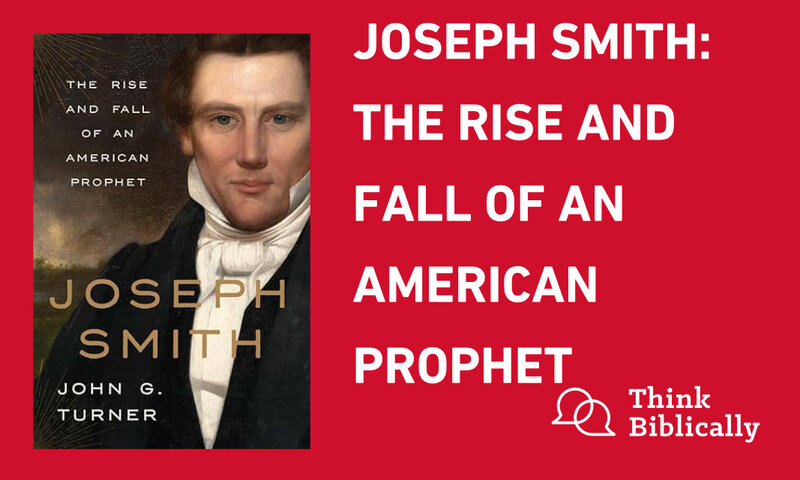
Who was Joseph Smith and what childhood experiences shaped his life, worldview, and the start of the Church of Jesus Christ of Latter-day Saints? What are some of his positive characteristics that drew so many people to him and what were his flaws? How did his theology develop throughout his life? In this interview, Sean and Scott talk with John Turner about his fascinating biography: Joseph Smith: The Rise & Fall of an American Prophet.
John Turner is a cradle-to-halfway-to-the-grave Presbyterian (straddling mainline and evangelical Protestantism) and belongs to Burke Presbyterian Church. He came of age in evangelical parachurch organizations, namely Young Life and InterVarsity Christian Fellowship. One of the things that drew him to the study of U.S. History was a desire to understand the institutions and personalities that had shaped my own religious culture. His dissertation-turned-first book, Bill Bright and Campus Crusade for Christ: The Renewal of Evangelicalism in Postwar America, won Christianity Today’s 2009 prize for best History / Biography.
Episode Transcript
Sean McDowell: [upbeat music] Who is Joseph Smith? What are some of the key experiences that shaped his life and the founding of the Church of Jesus Christ of Latter-day Saints? These are just a couple of questions we're going to explore today with our guest, Jon Turner, author of the new fascinating biography called Joseph Smith: The Rise and Fall of an American Prophet. I'm your host, Sean McDowell.
Scott Rae: I'm your co-host, Scott Rae.
Sean McDowell: This is the Think Biblically podcast, brought to you by Talbot School of Theology, Biola University. Jon, my brother-in-law told me about your book, and I, like, ordered it right away and devoured it. I thought it was so interesting, so well-written on a ton of levels. We haven't even got into it yet, and I hope our audience will pick it up. But I wanna know your backstory because you've written other biographies on people like Brigham Young and beyond. Why focus on the person of Joseph Smith?
John Turner: Well, your brother-in-law has great taste in books.
Sean McDowell: [laughs]
John Turner: I just wanna, I wanna say that at the outset. So for me, Joseph Smith is... I mean, he's, if you set theology and maybe religious concerns aside, I mean, he's such an all-American story. He grew up as, like, an uneducated, super impoverished farmhand. And then in his late, You know, in his, in his early 20s, he decides to write a book, which he publishes as the Book of Mormon, a totally improbable way of either making a living or starting a religious movement. And what he ends up doing is forming a series of communities, challenging some of the most broadly cherished, American ideals. He's murdered at the age of 38, and nevertheless really made a mark. He organized a church that currently has 18 million members around the world. So in terms of dramatic life story and long-term impact, for me, it's a really compelling, biographical figure.
Scott Rae: So Jon, to the best of our knowledge, you are not a member of the Church of Jesus Christ of Latter-day Saints. I'm curious, how does that shape your research and writing of your biography of Joseph Smith? And so tell us a little bit about what makes this particular biography you've done more unique.
John Turner: So I'll get to myself in a second, but in terms of what would separate this biography from prior biographies of Joseph Smith, it's really access to the historical record. So over the last 20, 25 years, the Church of Jesus Christ of Latter-day Saints has spent tens, at least, of millions of dollars, annotating and publishing, the papers of Joseph Smith. So the sources that are important for reconstructing his life are accessible in a way that they weren't, say, 30 or 40 years ago. I'm not a member of the church. I never have been. I don't have family who are members. So I'm, I am really coming at this, as an outsider. I don't think that necessarily makes me totally unbiased, but it does mean that I don't have a personal stake in his story. I really am a historian who finds his life fascinating, and perhaps also fascinating in part because Joseph Smith does still matter, for a lot of people. You know, there are, you know, there are 18 million members of the LDS Church today around the world. There are also a lot of other people who bump up against this religious movement in either positive or negative ways or who are curious about it. I like writing about subjects that matter to people. And so for me, that was part of the attraction.
Sean McDowell: Well, the book works chronologically, so you start with his life. And I've read a couple of the other biographies, but there are so many insights in here that either I completely forgot or more likely just had not heard before. But maybe walk through some of what you consider some of the childhood experiences that just most shaped Joseph's worldview.
John Turner: Sure. So in terms of his childhood, in many ways it was unremarkable. I mean, his- ... His family really lived on the economic margins. He was born in Vermont. His parents, had, some land. They had a farm. They lost it because of a bad investment, that Joseph Smith's father made. And then they, you know, they basically moved around from place to place, for the rest of his childhood. They then sort of restarted their lives in Western New York, acquired another piece of land, also lost it. Couple of things stand out to me about his childhood. Number one was that sort of cycle of hope, and then hopes dashed. Like, this family could just never really get back on its feet. Secondly, they were also adrift in terms of religion. You know, from what Joseph said about his parents understood themselves to be Christians, but they- Rejected for the most part the churches that surrounded them. Joseph's father was pretty resolute in that position. His mother, was a little bit more interested in both the Methodists, and the Presbyterians. So the family was a bit adrift, and divided. They also were very open to visions and other supernatural experiences. Both of his parents were visionaries. They believed that God communicated to people through dreams and visions. Joseph had a grandfather who also had a powerful conversion experience that involved miraculous healing. So it was a family that was moving around, wasn't settled either economically or spiritually, and was very much open to new directions.
Sean McDowell: And by the way, before you jump in here, Scott, that's one of the things that surprised me, 'cause when I think of Latter-day Saints, I don't think of, like, charismatic [laughs] and Pentecostal.
Scott Rae: That's right.
Sean McDowell: It's just not that mindset. But to see that in his experience and in the early church really took me back how present that kind of supernatural phenomenon was.
Scott Rae: Yeah, so t-tell us a little bit more just about what was the religious context in the places where he grew up in the, you know, those early to mid-1800s?
John Turner: Yeah, it was sort of newly up for grabs, I think, in the early American republic. And I think as Americans, we tend to look back on the newfound religious freedoms associated with the founding of the United States as something that was just very positive. It allowed for individuals to form and join new churches, worship according to their dictates. Those are all great things.
John Turner: When Joseph Smith looked back on that atmosphere, he didn't see freedom, or liberty first and foremost. He saw chaos and confusion.
Scott Rae: Interesting.
John Turner: And I can, I can understand that you know, you have a variety of churches all telling you that they can point you to Jesus Christ, and I think Joseph, he had some attraction to Methodism, but for the most part, he followed his own father in sort of throwing up his hands and saying, "I don't know which, if any, of these churches are true. I don't really know what to do."
Sean McDowell: Man, that's so interesting to describe the milieu of that time. Now, we're gonna get into some of the critiques that are often leveled against Joseph Smith, but one of the things you do well in the book is you point out just so many of the positive attributes that he had. So what are some of the positive characteristics of Joseph Smith that obviously drew so many people to him, and he was able to sell ... He wrote the best-selling book in American literature history. I never thought about that until I read your book. I was like, "Oh, my goodness, The Book of Mormon is number one." Clearly, there's something about his character, that drew so many people to follow him. What was it?
John Turner: So a couple of things. I think in terms of his personality, he was audacious and bold. He was also mirthful. He was also, as a leader, he had a lot of setbacks in his life, and he was remarkably resilient. So if a big plan of his failed, he was back up on his feet really quickly and back with sort of a bigger, bolder plan. In terms of the religious vision that was compelling to people, I would point to a couple of things. You know, first, Joseph Smith was focused on building communities rather than, simply a string of congregations. And this, you know, vision of community certainly didn't appeal to most Americans, but for those who were attracted to his movement, it was all-encompassing, and it was purposeful. You know, if people converted to the early, Mormon movement, they were encouraged to leave where they live and to gather with other believers, and those who did, they would be, helped to acquire a parcel of land. They would have work to do. They would have sort of tasks within the church to do. I think that was remarkably compelling. Also, as Joseph's life unfolded, his ideas about human beings, about God, about Jesus Christ evolved. So if you showed up to a Sunday meeting and Joseph Smith preached, you really didn't know what he was gonna say.
Sean McDowell: [laughs]
John Turner: And I think that- ... That actually is a little bit unusual.
Scott Rae: Oh.
John Turner: You know, if you think about popular preachers today, I'm not gonna say they're, like, always predictable. You know, you want, you might wanna hear what they say on a particular circumstance. But- Also, most preachers, they have customary themes, and you have some sense of what you're gonna get within certain boundaries. Joseph Smith just, like, blew those boundaries open all the time. And so I think, you know, for some people that was concerning, but for others, there was a good reason to listen to him.
Scott Rae: Well, I'll go to the downside-
John Turner: Okay [laughs]
Scott Rae: ... Then if if we, if we can. And I think, you know, part of the book that sort of, that caught my attention, where you said, "Smith likewise had flaws. I wouldn't trust him with my money, my wife, or my daughter." What what are you trying to say about his character?
John Turner: Okay, well, that is sort of a harsh summary.
Scott Rae: [laughs]
John Turner: So that makes for a fun question. So let me take the wife and the daughter part first. So, you know, listeners might know that toward the end of his life, Joseph Smith, began practicing polygamy, and taught that righteous men, so righteous church members, had a, actually had an obligation to pursue-
Scott Rae: Oh
John Turner: ... Polygamous marriages. And-
Scott Rae: So he, actually put it in terms of a, of a positive
John Turner: Duty
Scott Rae: ... That they had?
John Turner: Positive duty.
Scott Rae: Wow.
John Turner: Absolutely. And so Joseph proposed to, the daughter of one of his closest long-term associates. She turned him down, and that contributed to a rupture, between the, those two men. Joseph Smith also proposed marriage, to the wives of several, church members in good standing. And so that's why I wouldn't trust him with my wife or my daughter.
Scott Rae: [laughs]
John Turner: He might ask to marry them. Just to put it really bluntly, like that, I wouldn't want that to happen. And in terms of money, I don't think that Joseph was, corrupt or a scoundrel with money, but he wasn't good with it, and he, repeatedly got himself, and therefore the church, into debt in ways that compromised his leadership and the church's stability. So, you know, Joseph certainly asked followers to consecrate their wealth, to the church. And I don't think he was a great steward of those resources.
Scott Rae: Let me go back to the wife-
John Turner: Sure
Scott Rae: ... Part just a second. I'm really curious how his own wife at the time responded to him proposing marriage to the wives of other, of other men.
John Turner: So that's a great question. So Joseph... Well, you could kind of guess-
Scott Rae: Yeah. [laughs]
John Turner: ... I suppose. But, so Joseph had married a woman named Emma Hale, back in 1826. She was a Methodist. She does very much seem to have accepted, her husband as a prophet, as someone called by God, to translate the Book of Mormon, to start, to start the church. And for the most part, they seem to have had a pretty affectionate and warm, marriage. In the early 1840s, when Joseph began, practicing polygamy, he at first kept Emma in the dark, didn't tell her about it. There were a lot of rumors about it in,
Scott Rae: Say, that that would be a tough one to keep under wraps, I would think.
John Turner: I think it definitely was tough. There were a lot of rumors and accusations, but, you know, Joseph denied them. By the spring of 1843, he had been sealed, that's kind of common, Mormon parlance, sealed in marriage to around two dozen women, and he decided to broach the subject to both, Emma and also to his brother Hiram, whom he'd also kept in the dark. When Joseph told, his first wife, Emma, about this doctrine, he didn't tell her everything. He didn't tell her he'd already been sealed to two dozen women. He didn't tell her that some of those women included good friends of hers, who were already married to other men. She seems to have, when he first taught this to her, accepted it on some level, perhaps out of the belief that it was purely spiritual or ceremonial. Once she realized that was not the case, which she discovered very soon, she was just flat out livid. And they fought bitterly about it, for around four or five months. She seems to have been able to persuade him to abandon, some of his plural wives, or at least not have anything more to do with them. It's a super contentious and complex, you know, time in their relationship. It's a huge subject, but that's a, that's at least an introductory-
Scott Rae: Yeah
John Turner: ... Answer to your question.
Scott Rae: That's helpful. Thanks.
Sean McDowell: Yeah, that's so, that's totally fair. One of the other topics that always comes up is the translation of the golden plates, and we talk about it, I think you used the word earlier, translating the golden plates, and yet when you describe in the In the book, it didn't seem to really be a translation at all because the plates are covered up. Sometimes he's putting his head in this hat that I want you to describe with the seer stone, and then later he's, like, recording revelations, and the plates aren't even present. So what, how did that process actually take place?
John Turner: That's a great question. That's also a huge subject. So for listeners who are not familiar with the Book of Mormon, it purports to be the history of peoples who live from about 600 BC to about 400 AD, and it narrates the migration of a family of Israelites, to the New World. It eventually also narrates the appearance of Jesus Christ to the descendants of those people in the New World. So it purports to be an ancient record. And Joseph Smith's, Joseph Smith reported receiving this record inscribed on gold plates, from an angel, in 1827, and then translating those plates. So let's unpack this a little bit. In the fall of 1827, when, Joseph reports having received these plates, he doesn't show them to anybody in an ordinary way. He does seem to have had something. He had some kind of heavy object in a box that he let people hold. A few people reported either seeing the corner of the plates or to having felt them under a cloth. When I say plates, I mean thin sheets of metal with writing on them. So he had some kind of object. He didn't show it to anybody in any kind of ordinary way. My interpretation is he didn't have those gold plates. He had something else, and we don't have information about what exactly that something else was. Could've been printing plates, could've been sheets of tin, could've been something else.
John Turner: What we do have is the Book of Mormon that Joseph Smith published a few years later. What he did was dictate a text to, a series of scribes, and the length of the Book of Mormon, it's almost as long as the New Testament, so he dictated a lot of, a lot of material. And a scribe wrote it down. I think they went over it. He was satisfied with it, and then they found a printer who would publish it and put it out into the world.
Scott Rae: That's, yeah. Now this is, this is... Some of this is news. And it would be news to a lot of our listeners who- ... Who might not see that. Now, to go a little bit further on this, John, I'm gonna quote, I'm gonna quote from a section of the book and just, and have you mean by this. You said, "Then there is the published Book of Mormon, which Joseph claimed was a translation of the engravings on the plates, but archeology, DNA of Indigenous Americans, the relationship between the Book of Mormon and the Bible all point to the Book of Mormon as a 19th century creation."
John Turner: Sure. So I see the, I see the Book of Mormon as the handiwork of Joseph Smith, not as an ancient record, and there are a few reasons why. First of all, there's no archeological, evidence- ... At least acceptable to non-Mormons, of the civilizations that the Book of Mormon describes. DNA analysis doesn't provide evidence that, the Indigenous peoples of the Americas, or a portion of them, are descendants of Israelites. And also, the Book of Mormon, if you read the portions that,
John Turner: predate, the New Testament in its own chronology, they draw extensively on, New Testament language-
Scott Rae: Mm-hmm
John Turner: ... In a way that's, you know, really anachronistic. So I see the, I see the Book of Mormon as Joseph Smith's book, and so I don't think it I don't think it is what he said it was. So, you know, that might sound like a big accusation against Joseph Smith, and I suppose it is. I also, at the same time, I find it remarkable that this uneducated farmhand was able to compose this massive book that was compelling to a lot of people. So, you know, rather than, you know, shouting about the Book of Mormon being a fraud, I also see this as something really bold, audacious, and as having a lot of chutzpah. I mean, it's kind of remarkable to me that Joseph Smith was able to pull this off.
Sean McDowell: I think that's undebatable. I mean, I'm looking at this. I'm not a historian like you are. I'm not a biographer. I'm an apologist, and I'm an evangelist, so I've got a little bit of a different angle as I approach this. But I can fully say this is a remarkable American story. It has all the elements of drama in it. It, it's just, it's a fascinating account by any way that you look at it, that he could pull this off [chuckles] divine or not. Certainly a fascinating story, and I could see why you would wanna study, and probe into it. One of the things that does interest me is you described earlier that there are certain... He would show up [laughs] to preach, and you wouldn't know what he was gonna preach on. So of course, we don't have to necessarily go into detail on this, but like the King Follett discourse, which he delivered this sermon two months before he died, that was like a game-changing theological discourse for him. As I understand it, when you read through, like, the Book of Mormon, that's not where you see some of the theological development really emerge. I mean, in some ways it seemed to me that he's writing the story of Jesus coming to America largely orthodox, but just adding a new place where Jesus visited and a new community and a new vision. It's not till later that some of these developments start to emerge, Doctrine and Covenants, Book of Abraham, et cetera. So I'd love to hear from you, what kind of theological development do we see through the life of Joseph Smith? Like, from the beginning to the end, and, like, what trajectory [laughs] was he maybe on as best we can tell?
John Turner: That's a great question. So yeah, first of all, you're correct. You know, there's a lot, there's a lot in the Book of Mormon that would understandably appeal to Protestant Christians of the early 1830s. One of those things is a really robust affirmation of the eternity and divinity of Jesus Christ, which, you know, with, other American movements like the Unitarians, saying otherwise, sort of a loud response to that. So you referenced, yeah, there is this famous sermon that Joseph Smith gives a couple of months before his death, and one of the things he says in that sermon is that if you could see God, you would see a man who looked much like yourselves, so God as an exalted man. And then as Joseph sort of worked this out logically, Jesus Christ had followed in his father's footsteps, had laid down his life, and had achieved, exaltation to the fullness of divine glory. And human beings could also imitate, Jesus Christ in that trajectory. Joseph had been working with some of these ideas for quite some time. Already in the early 1830s, you see in some of, in some documents this sense that God, Jesus Christ, and men are all in a way of the same species and have the same potentiality. What Joseph really spends the last 10 years of his life,
John Turner: unfolding is what men have to do on Earth to achieve that divine exaltation unto godhood. Some of those conclusions are, they have to be sealed in marriage for eternity, and they have to, make and keep, covenants in another ritual that becomes known as the endowment. And so I would say to... There's maybe two parts of an answer to your question, is Joseph's understanding of the relationship among God, Jesus, and men, that evolves. And then also his, you know, the focus shifts from salvation to exaltation and to what men have to do to attain exaltation.
Scott Rae: And the marriage part is a, is a non-negotiable part of that, correct?
John Turner: The marriage part is an, is an... Well, it at least becomes within the church a non-negotiable. And it seems to have been for Joseph as well, although, you know, he's kind of unfolding these things right at the end of his life. It's hard to know exactly where he would've gone had he not been murdered.
Scott Rae: Yeah. Yeah, I, you know, I have one final question for you. Sean may have something else he wants to ask you, but, what... Is there, is there one thing about Joseph that you think a lot of people just don't get? Or do you find yourself, correcting certain myths about him on a regular basis?
John Turner: Well, that's a, that's a fun question. You know, I think... I guess I would take it as from the angle of what did people outside the LDS church not get about Joseph Smith? And one thing I would suggest is that,
John Turner: you know, if you, if you hear some of these ideas that diverge from what we Protestants would consider orthodox theology, you might think that Joseph had a pretty fast and loose relationship with the Bible. One thing that actually stood out to me
John Turner: And this, you know, I'm saying this partly because the title of your, the title of your podcast, Think Biblically. I mean, Joseph spent a lot of time with the Bible in just really idiosyncratic and different ways. So a lot of his ideas flowed out of engaging with a passage of scripture, and then, you know, seeking in his terms, seeking revelation from God on the subject, and then unfolding some new ideas and practices.
John Turner: I think it's... This is actually an important correction because one of the things that Protestants quickly realize if they spend time in conversation with faithful Latter-day Saints today is, Mormons are really well-versed in the Bible, typically. And, you know, that began with Joseph Smith.
Scott Rae: Interesting.
Sean McDowell: That is interesting. That's not what I,
Scott Rae: Would not have expected that
Sean McDowell: ... You were going to say. Certainly the-
Scott Rae: Yeah
Sean McDowell: ... The King James translation is a part of the quad of the scriptures, and they use, and cite, and references, reference it. I think what we mean by Think Biblically is not using the Bible in some fashion- [laughs]
John Turner: Right
Sean McDowell: ... Which would involve eisegesis, but exegesis.
John Turner: Right.
Sean McDowell: Is this what it says? Is this what it means? But if anybody implies that LDS don't care about the Bible, even though we interpret it radically differently, that would certainly be a misconception. So, Scott said, "If I had one more question for you." I have, like, 3,637-
Scott Rae: [laughs]
Sean McDowell: ... Questions for you, John. I really enjoyed your book, and I don't... And Scott'll know that I... We only bring on people that we wanna recommend their books to them, but I was just, I was enthralled by this. I think you're a good writer. You struck me as just being very balanced on the issue, and just trying to tell the story as it is, rather than land the plane as maybe an apologist or evangelist would, and so I think it's fantastic. It, once again, is called Joseph Smith: The Rise and Fall of an American Prophet, and it's by our guest today, John Turner. Thanks for a great book, and thanks for joining us.
John Turner: Thanks, guys. I appreciate it.
Sean McDowell: This has been an episode of the podcast Think Biblically: Conversations on Faith and Culture. We have programs in person and online in Old Testament, in ethics, in philosophy, apologetics, New Testament, marriage and family, spiritual formation. So many more. We'd love to have you join us. Talbot is really growing right now, which is quite remarkable. Please keep your comments and questions coming. You can send them to us at thinkbiblically@biola.edu. If you enjoyed today's conversation, please give us a rating on your podcast app, and consider sharing it with a friend. Remember to join us Friday for our weekly cultural update, and in the meantime, remember to think biblically about everything. [outro music]