Biola University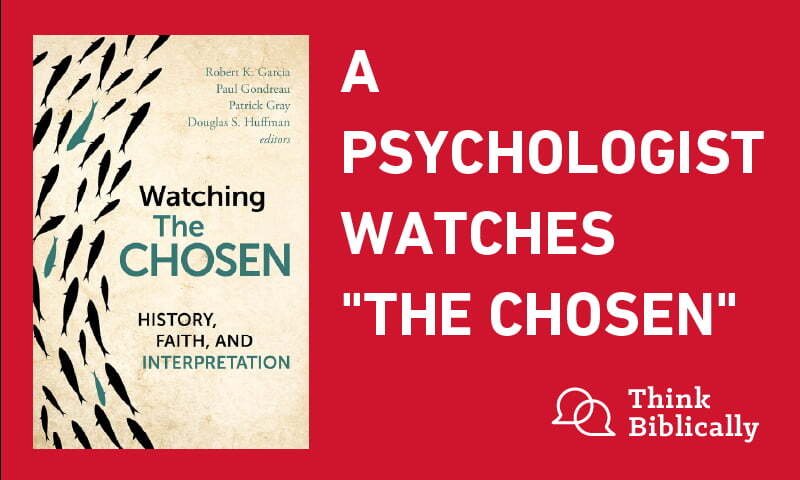
How would a psychologist view the TV series, The Chosen? What does the portrayal of the characters, namely Jesus, say about how we connect with God? We’ll talk about these questions and more with our guest, Rosemead colleague and psychologist, Dr. Liz Hall, who contributed to a new book, Watching The Chosen.
Dr. Liz Hall is Professor of Psychology at Rosemead School of Psychology, Biola University. Her research interests include women and work, mothering, sexism, embodiment and meaning-making in suffering. She has published numerous articles and book chapters on these topics. In all of these areas, she strives to bring together psychological research and theological insights.
Episode Transcript
Scott Rae: [upbeat music] How would a psychologist look at the TV series, The Chosen? What does the portrayal of the characters, namely Jesus, say about how we connect with God? We'll talk about these questions and a whole lot more with our Biola colleague and psychologist, Dr. Liz Hall, who contributed to a new book entitled Watching The Chosen. I'm your host, Scott Rae.
Sean McDowell: And I'm your co-host, Sean McDowell.
Scott Rae: This is Think Biblically from Talbot School of Theology at Biola University. Liz, thanks so much for being part of this. My, I first wanna know, how did you get interested in The Chosen in the first place? You've contributed a chapter to this book that is different than any of the other ones that were in here, but what got your attention about The Chosen in the first place?
Liz Hall: So I've been volunteering with a young adults group at my church for a number of years now, and, during the summer, if you've been involved in young adult ministry, you know how it is. It's... You never know what's gonna- who's gonna show up from week to week. Your usual crowd isn't there, but, kids that are returning home are there, and so, we wanted to come up with kind of a low-key way to keep the ministry going, but without, maybe a whole lot of preparation involved on folks' parts. And the idea came up to just show an episode of The Chosen every week, and we'd have a, kind of a discussion around it.
Scott Rae: Great.
Liz Hall: And, we've actually done that now for a number of summers- ... Because it's been, I don't know if successful is the way to s- It's ver- been very thought-provoking-
Scott Rae: Sure
Liz Hall: ... And very well-received.
Scott Rae: I'm sure.
Liz Hall: Provokes-
Scott Rae: Yeah
Liz Hall: ... A lot of good, discussion with folks. And the thing that we've really noticed is how often, people would use language like, "It, it just brings it alive." "They- ... They seem more real to me." So something was really happening as these young adults were watching the episode, and there was kind of a parallel process where I found myself really reflecting on what I was viewing, too. You know, the Jesus especially, the Jesus character- ... Was, it made me reflect that there was a, really a disconnect between kind of the... You never really think about the image you have of Jesus, but I started realizing that the image that I had of Jesus, that I interacted with, for example, in my prayer life, was very different from the Jesus that I saw portrayed. And specifically, the Jesus that I kind of had an image of in the back of my mind was, a pretty serious guy. [chuckles] He would wander around. He was a little mysterious. He would wander around, and every once in a while, he would say, "Verily, verily, I say unto you," and some profound-
Scott Rae: [chuckles]
Liz Hall: ... Wisdom would come out of his mouth.
Sean McDowell: In the King James.
Liz Hall: That's right.
Scott Rae: Kind of like a psychologist, huh?
Liz Hall: [laughing]
Scott Rae: [chuckles]
Liz Hall: But the idea was that even though he was somebody, that I admired a lot, he wasn't a particularly approachable guy. And this was very different than what I was seeing depicted-
Scott Rae: Yeah
Liz Hall: ... And it made me just stop and think, "Where did I get this idea of who Jesus was like?" So that was a bit kind of where my psychological hat came on in terms of con- looking at, yeah, at the series as a whole.
Sean McDowell: Makes sense. We all read a book, we watch any TV se- show from a certain lens, and so when I've watched The Chosen with my wife or my kids, my lens a little bit is as an apologist at times. I'm also watching, like, what's the biblical fidelity that's here?
Liz Hall: [chuckles]
Sean McDowell: I can't get that out of my mind. And sometimes look at it through the lens of, like, film. How close are they? How are they telling the story? What do they focus on, what they don't? Like, there's all these different angles.
Liz Hall: That's right.
Sean McDowell: What does it mean to watch that show as a psychologist?
Liz Hall: Well, when my husband and I were thinking of contributing, this chapter, the things that came to mind just right off the bat were a couple of theories that I think are helpful lenses through looking at the series. One is attachment theory-
Sean McDowell: Yeah
Liz Hall: ... Which is, a pretty prominent theory in psychology these days, but that, basically focuses on how our early childhood experiences influence the way that we relate with others and perhaps most importantly, the way that we relate to God. And then the other theory that we thought about was, a, basically a theory of knowledge. It's dual processing theory is what we might call it, where it's not just kind of the conscious, things that we're aware of, but there's a whole different level to how we know things in the world, that is more implicit. And so that theory, s- is really relevant when we think about things like, the portrayals in The Chosen.
Scott Rae: And now we'll look, we'll look at each of those two lenses a little bit more carefully. But, spell out a little bit more about what's involved in attachment theory. How d- how do our early attachments help us k- either connect or not with other people, and namely with God?
Liz Hall: Yeah. John Bowlby is the originator of the theory. He was, a British psychiatrist writing, just after the World Wars and observing, working with kids and observing their interactions, and so he laid the foundations for attachment theory. And, since his early work, it has really taken off. It's, as I said, it's really, I think, one of the most significant theories, in the field of psychology these days, in all kinds of different corners-
Scott Rae: Wow
Liz Hall: ... Primarily because it has so much explanatory power that, in just about, any study where you put in attachment-type variables, it relates to outcomes. Not just outcomes that are relational, which are the ones you might think of if you think of the influence of early child relationships-
Scott Rae: Sure
Liz Hall: ... But even, for example, in a study I was doing recently, even in terms of the ways that we, think and make decisions, it turns out that these attachment lenses- ... Influence that. So it's a very, it's a... I guess I want to make the point, it's a pretty important theory, in psychology these days. And the basic idea is that as we're interacting with our early caregivers, usually our parents, but sometimes other important figures, we internalize models- ... Of kind of the right way to do relationships to get the care that we need.... And then as we-
Scott Rae: Regardless of how dysfunctional they might be.
Liz Hall: Exactly. Exactly, yeah.
Scott Rae: Yeah.
Liz Hall: And then we wander through the world, and these serve as basically our models for- ... How we're supposed to do relationships. Influencing all of our relationships and other areas of functioning, of course, but primarily our closest, our most intimate relationships.
Sean McDowell: And a lot of this is implicit, that we don't think about and learn. It's just kind of wired into us and affects the way we approach God as well, doesn't it?
Liz Hall: That's right. So there's a kind of an interesting offshoot of research, that has been going on for several decades now, that shows very clearly that often we bring our attachment filters to the ways that we, uh- ... Understand and experience God. And what's interesting as a Christian is to often note just the discrepancy between what we know in our heads, how- what God is like, and the ways that we actually experience God, which are, of course, filtered through these attachment lenses.
Sean McDowell: So what would an example be? Like, sometimes- ... People talk about, like, a relationship with an earthly father-
Liz Hall: Mm-hmm
Sean McDowell: ... Or lack thereof, and how we import that onto our Heavenly Father. Is this kind of a tangible example, and a common one, of what you're referring to?
Liz Hall: That it's- that's exactly right. I mean, even if I could use myself as an illustration, there are different... We haven't gotten into this yet, but there are different kind of ways of things going wrong, and when things go right- ... You call it a secure attachment. So I would say generally, I have a secure attachment. I thank God I was raised by two parents that were very loving and caring. But even, when we have secure attachments, living in a fallen world, uh-
Sean McDowell: Mm-hmm
Liz Hall: ... Our attachment styles will have, you know, edges on them. You know, they'll have tendencies, that are toward one of the two other primary ways of dysfunction, avoidant or anxious. And, I told you about my kind of implicit idea of Jesus, and as I s- kind of sat with that and reflected on it, I think it has a lot to do with, You know, my dad was a really great guy and very talented, and he spent his time serving God's church. And a lot of our family life growing up was oriented around protecting Dad's time so he could do the important things.
Sean McDowell: Interesting.
Liz Hall: So what that meant is I've always felt- ... Loved, very loved by my parents. That's not something I've ever doubted. But sometimes I think when I approach God, it's kind of like, he's, he's a busy guy. Let me just-
Scott Rae: [chuckles]
Liz Hall: ... Like, bring home-
Scott Rae: Just cut to the chase here.
Liz Hall: That's right. Let me just cut to the chase.
Scott Rae: [chuckles]
Liz Hall: Talk to him about the important things I need to talk to him about, and then leave him, you know, free to do the things he really needs to do. So even in these very subtle ways, I think that with some kind of reflection, we can, just-
Sean McDowell: Yeah
Liz Hall: ... Know kind of what we've inherited in terms of our tendencies. Yeah.
Scott Rae: So let's talk a little bit more about Sean's early attachments. [laughing]
Sean McDowell: [laughing]
Liz Hall: [laughing]
Scott Rae: Just kidding. Now, you also talk about the way, the way Jesus interacts with some of the characters-
Liz Hall: Yeah, yeah
Scott Rae: ... I think being particularly insightful about some of these attachments.
Liz Hall: Yeah.
Scott Rae: Spell out- spell that out a little bit further.
Liz Hall: Well, you know, one of the primary figures, ha- is Mary Magdalene in those, in that series.
Scott Rae: Yeah.
Liz Hall: And the way that she's depicted is very much what, in psychological terms, we would call an anxious attachment. So she has a history of abandonment, through death. She has a history of trauma, that we get a glimpse of, very early in the series, and, it actually works itself out in many ways throughout the series. We see her struggling, throughout several seasons with just kind of this feeling that, she has to work really hard to stay in relationship with Jesus. She has to perform, and she gets to a point where she kind of loses it a bit and relapses, and, it's, again, she thinks that it's all on her to kind of maintain the relationship with her actions, and that follows very much the pattern of somebody with anxious attachment. They are fearful that, they are going to be abandoned, and so there is always kind of a sense of insecurity or, doubt or, you know, just wondering when the other shoe is going to fall- ... Because they've experienced their caregivers as not being consistent. And, and so what we see in Jesus's, interactions with her is, I think very moving. I can't remember if it's the, even the f- the very first or maybe the second episode, where there's that encounter where he calls her by name, the name that she hasn't heard used in many times, and he says, "You are mine." And, um- ... And that kind of, what we would call in attachment terms, that attunement to her, and that helping her to know that she is seen and she is loved, is something that you get very clearly over, the series. When she relapses, that initial conversation with Jesus when she comes back is interesting because several times he says, "Look at me. Look at me." She's so ashamed- ... She doesn't even want to look up. But it's that sense of being viewed by Jesus, that Jesus looks at her and knows her, and I think that's what we all want. We want a God who sees us and who knows us, and that we feel loved by, and that's the epitome of the kind of caregiving that leads to a secure attachment.
Sean McDowell: And would you argue that seeing this depicted in film can a- give a certain kind of healing that reading words alone maybe can't?
Liz Hall: I think so. I mean, you know, I often think, 'cause I work really hard in my classes to help my students see the connection between their psychology that I teach and their Bible, but sometimes it feels like our Bibles are in this whole other realm. We read it in a certain sense that feels disconnected with anything else. And, I mean, there's, there's a lot of reasons for that. I mean, if you put-... You know, the, our Bibles, maybe the gospel, side by side with, like, contemporary fiction. You know, I mean, it reads very differently.
Sean McDowell: Yeah.
Liz Hall: There are just a lot of, there are a lot of stylistic differences. There are- ... Cultural differences.
Sean McDowell: Mm-hmm.
Liz Hall: There are ways that things were done back then that are not the way things are done now, and so those are just all additional barriers to being able to read the Gospels and say, "This is something that I resonate with." Now, obviously, it's God's Word. God's Spirit works through it, and we can still get there, but, just on the face of it, there are a number of barriers there. And so, seeing it depicted, and I would add, seeing it depicted through the imaginations of the people who are writing it, who are writing the, you know, the screenplays and that kind of thing, it is helpful. It really brings- ... It alive in a way that the written word just doesn't.
Sean McDowell: Scott, can I follow up on one of these?
Scott Rae: Go for it.
Sean McDowell: So I thoroughly enjoy The Chosen. My wife is, like, a mega fan, counts down in some ways when the next episode is coming out. I have no problem with, like, creative filling in the gaps to tell a story because they state, "Here's what we're doing. We're making it come alive." This isn't gospel, so to speak. I interviewed Dallas, and he's like, "Go back to the text, and you read it." So I love what they're doing. There's a few episodes that people will debate about, like, I don't know if that's right or not. Like, I think someone could correct me. There's an earlier episode of Jesus, like, practicing the Sermon on the Mount and getting feedback on it.
Liz Hall: Mm-hmm.
Sean McDowell: And that created some theological discussion- ... And debate. Are there any things where you watch it that, as a psychologist, from your understanding of Scripture-
Scott Rae: That's a good question
Sean McDowell: ... Or just good psychology, just give you pause, like, "I'm not sure it went down like that, or I would have portrayed it this way?"
Liz Hall: Yeah, actually, no. I mean, I tend to, uh- ... I'm kind of on the opposite side of it. So, you know, just kind of to lay it out there, I think our imaginations are something that God uses just like He uses every other part of our faculties to draw us closer to Him. Ignatius of Loyola made this point, you know, many years ago. In his, form of imaginative prayer, he encouraged, his people who, you know, that he was mentoring to invoke their imaginative faculties to bring them closer to, God, and so I think this is part of what is happening there. So I have no problem with, uh- ... People doing that. I actually wonder sometimes... So again, I'm working, I haven't interacted with you about, you know, what you think.
Sean McDowell: Sure. Yeah, yeah.
Liz Hall: College kids or young adults, the things, because they often, the discussions are like- ... "Well, I'm not sure about that. I'm not sure about that." Well, one, you know, one interesting example, just, this past summer, of course, The Chosen now is, we were watching the lead-up to the Cross. And there were some pretty emotional scenes-
Sean McDowell: Yeah
Liz Hall: ... Some scenes where Jesus was- ... Depicted as being pretty shaken up, pretty- You know, just in-
Sean McDowell: Mm-hmm
Liz Hall: ... A lot of emotion. And, one of the young men in the group said, "Yeah, I'm not sure I'm comfortable with that." He said, "Wouldn't Jesus just have been happy that He was going to go and accomplish all this for us?" [chuckles] and I thought, "Wow," you know?
Scott Rae: Or maybe at least a little stoic about it.
Liz Hall: That... Yeah, that's right.
Sean McDowell: Yeah.
Liz Hall: That's right.
Sean McDowell: I think that's fair.
Liz Hall: And so I almost think that, like, our attachment filters sometimes are the problem, right? So, I think he liked to depict God, and I s- I happen to know his dad. His dad's kind of a very manly, you know, man-
Scott Rae: Interesting
Liz Hall: ... Probably pretty stoic and-
Scott Rae: Interesting
Liz Hall: ... It was uncomfortable for him to think about Jesus as-
Scott Rae: Yeah
Liz Hall: ... Possibly showing a wider range of emotions than he was used to seeing in the men maybe that he looked up to-
Scott Rae: Yeah
Liz Hall: ... Or that had formed his attachment filters, so.
Scott Rae: That's really, that's really insightful. Because I, you know, I've, I really appreciate the way Jesus was, has been depicted in The Chosen because I never envisioned Him having the sense of humor that He, that He's portrayed with. I mean, He's just... I mean, the fact that He would make the disciples laugh, I sort of never, I just never thought much about that because the text doesn't, do- ... Doesn't lend itself to that when you read it-
Liz Hall: Yeah
Scott Rae: ... Literally. Are there other thing- are there other specific things about the way Jesus is portrayed that hel- have helped you and helped some of the young adults you serve connect with Him better?
Liz Hall: Yeah, I mean, there is that aspect, so definitely the humor is something that caught their attention, too. Part of it is just, depicting Him as being so embodied, that He does experience a range of emotions. They depict Him sometimes as just being exhausted, you know, and just ready to collapse, needing to take some time off. I mean, these are all just very human depictions of Jesus that altogether serve to make Him more approachable. And, you know, the... If you think about somebody that you have an intimate relationship with, it's somebody who is approachable, and I think that that's one of the big benefits of the way that He is, that He's portrayed.
Sean McDowell: I think in many ways, the way Jesus was portrayed is the way you talked about the Bible, like He floats on air.
Liz Hall: [chuckles]
Sean McDowell: He's got a halo, like early art, which leans into His otherness and divinity.
Liz Hall: That's right.
Sean McDowell: There's a truth to that. You could maybe say this leans more into His humanity in some fashion, and just keeping these in balance is a part of the key. But when it comes to attachment theory, you've got to have a human [chuckles] Jesus modeled to be able to wrestle with and ultimately, like you said, get healing through this. What do you mean by implicit and explicit knowledge?
Liz Hall: So here we're getting into that second psychological theory that I talked about, dual processing models. And so cognitive psychologists for a long time have been telling us that, when we think about knowing, when we think about how we get information from the world, how we then, judge things or form attitudes or that kind of thing, that-... We're missing most of the story, actually, when we just think about the ways that we are conscious of, when we think about, like, propositional truth, statements of truth- -and things that we can reason and logic, you know, apply logic to, and that we can, you know, put into words, even. And that's an important part of how we know the world. That's the explicit system.
Sean McDowell: Mm-hmm.
Liz Hall: But there's all kinds of stuff going on under the system, the implicit system, the more embodied system, the kind of emotion-driven system. That's a really foundational way, that we have of navigating the world. And what's interesting about it is it functions much more quickly and automatically than the explicit system, and, it, in a sense, in some areas, there's been a lot of evidence that it kind of drives the explicit system. Like, this part of how we know the world that is underground and usually not something we're consciously aware of, does so much work in shaping how we respond to things. So that sometimes the analogy is made that our explicit system comes on to kind of justify- ... The decisions-
Sean McDowell: Interesting
Liz Hall: ... The actions that have already been, that have already happened at kind of that more gut level. That, by the way, is where our attachment filters usually function, is at that implicit, at that implicit level as well. Yeah.
Sean McDowell: Now, before we apply this to The Chosen, I think your husband's done some work with Mark Matlock, a friend of mine, he's written some chapters for me, and he would talk about implicit and explicit knowledge. And the example I believe he gave was about art- ... And these forgeries from the past, and these experts could kind of implicitly know there's something wrong with that, but they didn't know why. It was just wired into them from training and experience. The explicit knowledge came later. It's almost like an intuitive sense about things that we have about relationships or about people or about the world. So given that distinction, how does The Chosen utilize both of these types of knowledge? Maybe give an example, if you can.
Liz Hall: So the important thing to just kind of put out there is that we function at our best when our explicit and our implicit systems are working together, and they're influencing- ... Each other. And so the work that goes into kind of pulling these together is really important, including things f- like, you know, growing in our, in our intimacy with God, you know, when we bring these two things together. So, the key, like, the bridge between the two, is often imagery or stories. That's, that's often where we can access, like, the implicit-
Sean McDowell: Mm-hmm
Liz Hall: ... And bring it into the explicit, where we can then work with it and think about it and reflect on it. And so I think that the connection there becomes obvious, right? When you have depictions, when you have images, and then when you have these really good stories, that are being told, it brings up... It, it allows us to access things that are in that implicit system, and it allows us to bring that, it up into kind of our conscious awareness, where we are able to meditate on it and share it with others and think about it more in these, in these explicit ways.
Scott Rae: So this, in es- it sounds like, in essence, the, this, the imagery and the stories... You know, we had Jeannie Hanger on not long ago-
Liz Hall: Mm-hmm
Scott Rae: ... And she talked about, you know, getting better access to the smells and the body language and the facial expressions-
Liz Hall: Mm-hmm.
Sean McDowell: The text, yeah
Scott Rae: ... Even as you read the text. I mean, it sounds like those are the way to help us access what is, what is otherwise pretty challenging to do.
Liz Hall: That's right.
Scott Rae: And that, I mean, I've, I've heard your husband and you, in the books that you've done together, talk about how we- how these help- these actually help us process things at this deeper level that we don't often get just when we, you know, maybe when we hear a lecture or a student hears something in the classroom, or we hear a sermon in our church, where we just sort of hear- we hear it explicitly, but then we walk out and never have any way to process it.
Liz Hall: That's exactly right.
Scott Rae: So the, and that's why I think this, The Chosen, I think, has been so effective-
Liz Hall: That's right
Scott Rae: ... In helping us access this deeper level of this sense of emotion and the sense of, you know, bringing some things that, about our connection to God that we might not even have been conscious about.
Liz Hall: That's right.
Scott Rae: So the... It struck me, the example that you give in your chapter is the character of Nicodemus.
Liz Hall: That's right.
Scott Rae: So how does Nicodemus illustrate- ... These two types of n- knowledge-
Liz Hall: Yeah
Scott Rae: ... Coming together?
Liz Hall: So Nicodemus, of course, is, he's a biblical figure who is a teacher of the law. In terms of explicit knowledge, he has it down. I mean, he has... He's, you know, he's an older, man. He's been, dedicated to, the rabbinic teachings for decades. He has explicit knowledge down pat, and then this Jesus figure comes in and makes him kind of reevaluate. Like, he's, he's wondering how that- ... Fits with his explicit knowledge. And he- you see him, they depict him as really struggling with this. I, you know, I can't quote it from memory, but he says something like, "What do I do with this, you know- ... When my experiences and what I'm seeing, you know, how do I reconcile this with what I know about God?" and he has this conversation with Jesus, that's in our- it's recorded in our Bibles, but where Jesus uses the analogy of the wind, to depict-
Scott Rae: Mm-hmm, mm-hmm
Liz Hall: ... The Spirit. And what is wind? I mean, it's, it's something that we experience bodily. It's something that we know is there- ... Because of its effect on us, but not because we-... Have put it, captured it in words or anything like that. And so Jesus challenges him, I think, in that conversation, to, in a sense, step, beyond and incorporate this really important part of his life with God that has to do with his embodied experience and the things that he has seen portrayed in Jesus's life. So I think Nicodemus is a really interesting example of that attempt to try to bring together these implicit and explicit ways of knowing God.
Sean McDowell: And of course, that's in John chapter 3 as well, when he talks about being born again. No memory of being born, but a clear, visceral understanding of what that is like, and reframes his categories of, "What do you mean to be born again?" Like, he doesn't even understand it. He's pressing in explicit knowledge through an experience that he has. And it sounds like you think that Chosen is a good medium to challenge our implicit knowledge. Like, how would you... What, what would that look like to challenge the implicit knowledge of people who are watching this in a way that you think is healthy and good?
Liz Hall: Well, there's-- first of all, I would say that there's some things that we have to overcome. I mean, I think the three of us, may- we might differ from maybe some of our listeners who are perhaps, a decade, a couple decades younger than us, because I think there's been kind of a cultural shift. But I think the three of us were formed in a tradition, culturally, in the broader culture, and also within, evangelicalism, that was very focused on explicit knowledge. And the models we had for spiritual growth were very much about knowledge of the Bible and having right theology, and there was very little emphasis-
Scott Rae: Right. How much you could pack into your frontal lobe.
Liz Hall: That's right. That's right, yeah. And, so there are some tendencies, I think, that we bring to the table that are not necessarily that helpful. It's funny, you talked about kind of that critical lens. I think I have that as well, you know? Where you're looking for the places where maybe they didn't quite it quite right or that kind of thing. But that's not particularly the lens that's going to be helpful, that's going to facilitate this kind of-
Sean McDowell: Right
Liz Hall: ... Transformation.
Sean McDowell: That's right, yeah.
Liz Hall: Because it is more focused on kind of the explicit, the explicit system. I think it can really hit us, when we allow ourselves to really get immersed in the story, to allow it to bring up things inside of ourselves, and then to pay attention to that. So what are the moments of surprise? Who are the characters that we really find ourselves identifying with? And so then we can take those things that have been elicited by watching it- ... And spend some time in the presence of the Holy Spirit thinking about why that is the case. The key is, again, that integration of the in- implicit and the explicit. So what we're wanting to do is allow ourselves to, have the implicit, like, brought up by the story and the imagery, and then spend some time with that explicit system, thinking it through, praying it through, considering what it means for our lives, and that kind of thing.
Scott Rae: Yeah, I could see, I could see viewers of The Chosen having these Nicodemus moments, where you just say, you know, "What do I do with this?" You know, "I've, I've got... You know, this stuff is being unearthed, but now where do I go with all this?" And that's why I think it's been so helpful for you to do that in a small group.
Liz Hall: Yeah.
Scott Rae: That is, I think that's a super insightful way to help to give people a safe place to process some of this-
Liz Hall: Yeah
Scott Rae: ... That they might not otherwise do on their own.
Liz Hall: Well, let me point out something else. You know, in the chapter, we talk about the fact that one of the challenges that we face as Christians in this, day and age is that, intimacy is so, bodily for most of us.
Sean McDowell: Mm-hmm.
Liz Hall: We, you know, we use our bodies to become intimate with, you know, our friends and our spouses and our children and that kind of thing, and God is spirit. And sure- ... Jesus was incarnated, but He's in His body-
Sean McDowell: Right
Liz Hall: ... He's not here [chuckles] anymore, right? So, but indirectly, we come back around to th- where the, where God is embodied now, and that's in the body of Christ. And so I think that the spiritual formation, process, just the growth in Christ, is never just a me alone and God. So I appreciate that you brought up the groups because I think that that's where the work happens. We come to the end of ourselves when, we don't know where to go then, but our brothers and sisters in Christ might have some ideas. They might have some-
Scott Rae: Yeah
Liz Hall: ... Ways to challenge us and help us to change, and yeah.
Sean McDowell: So my last question for you is, how do you, how do you think we should watch The Chosen? What's your... Obviously, you think we should, [chuckles] that's clear, but through what lens? Should we just watch it for entertainment? Does some of this transformation take place by itself? Should we have a lens of, not a critical lens-
Liz Hall: Yeah
Sean McDowell: ... But just paying attention to these things?
Liz Hall: Yeah.
Sean McDowell: What's your advice?
Liz Hall: Yeah. Again, with the insight that the way that we grow is by bringing together those implicit and explicit systems.
Sean McDowell: Mm-hmm.
Liz Hall: What that means is that if we go to it with a lens to not just, not just, "How might this entertain me?" or, "What details about Jesus's life might I learn, you know, in my head, that will, make me know more," but what, how might God's Spirit be using this to help me to draw closer to Him, you know? That, that's, I think, an interesting just kind of framework for looking at it. And again, the paying attention, like, either in the moment or immediately afterwards, of what are the things that really struck me? What are the things that surprised me? What are the characters, that just pulled something from me, that I can see myself in them, a little bit? Uh-... And to spend some time, again, in discussion with others and in the presence of the Holy Spirit- -and just kind of noticing those, and what does that mean about, some areas where I need a little more help, or I need to spend a little bit more time? I mean, I think, you know, one of the changes that I implemented after realizing kind of this disconnect between- ... My view of, Jesus and how he was portrayed is, you know, my prayer-- I've been a Christian a long time, so my prayer life has looked different, uh-
Sean McDowell: Wow
Liz Hall: ... At different moments. But, [lips smack] for a time there, I was using the, you know, the Sinner's Prayer: "Jesus Christ, have mercy on me, a sinner."
Sean McDowell: Mm-hmm.
Liz Hall: And I realized that that particular prayer was not doing much to help me, draw closer to God, to incorporate a sense that I was loved by God. And so I haven't quite come up with, like, an alternative to that, but when I sit in God's presence now, instead of praying that prayer, I think about how God loves me and desires-
Sean McDowell: Yes
Liz Hall: ... To be with me. And so that's, I guess, maybe one small, um-
Sean McDowell: Great
Liz Hall: ... Example.
Sean McDowell: Yeah.
Scott Rae: I'd say that, I'd say that's a really healthy change.
Sean McDowell: For sure.
Scott Rae: You know, we have our former colleague, Doug Huffman- ... Was one of the three theological contributors or-
Liz Hall: Yeah
Scott Rae: ... Evaluators of the, of The Chosen in the sc- in the scripts. I wonder what it would've looked like if we'd had a psychologist be part of that- [laughing]
Sean McDowell: [chuckles] That's interesting.
Scott Rae: Part, part of that group.
Liz Hall: [chuckles]
Scott Rae: That, that could've been really insightful-
Sean McDowell: Yeah.
Liz Hall: [chuckles]
Scott Rae: ... I think, for the-
Sean McDowell: Huh
Scott Rae: ... For the creators of the show. So Liz, this has been so helpful. I so appreciate the perspective that, you and your husband, Todd, bring to this, and for your contribution to this. It, it was unlike any other chapter in the book. We, we highly recommend, watching The Chosen: History, Faith, and Interpretation. It's a series of essays that are all really well done, but the, you know, yours is one not, that's not to miss.
Liz Hall: Thank you.
Scott Rae: So we are super grateful for this, and thanks for helping us sort of ma-make sense out of this-
Liz Hall: Yeah
Scott Rae: ... And for your own vulnerability-
Liz Hall: Yeah
Scott Rae: ... Along the way. It's nice to know that The Chosen's had an impact on you spiritually-
Liz Hall: Mm-hmm
Scott Rae: ... You know, just as well as, you know, as well as providing your insight as a, as a psychologist.
Liz Hall: Absolutely.
Scott Rae: So super fun. Great stuff, and very thankful for you being with us.
Liz Hall: It was great to be here. Thank you for the invite.
Scott Rae: Yeah. This has been Think Biblically: Conversations on Faith and Culture. We get lots of, lots of people wanting to ask questions of maybe this episode in particular. I suspect we'll get some questions about this one. But if you have questions or comments, please email us at thinkbiblically@biola.edu. That's thinkbiblically@biola.edu. Be sure to join us on Fridays for our, for our, weekly cultural update. In the meantime, think biblically about everything. [upbeat music]