Biola University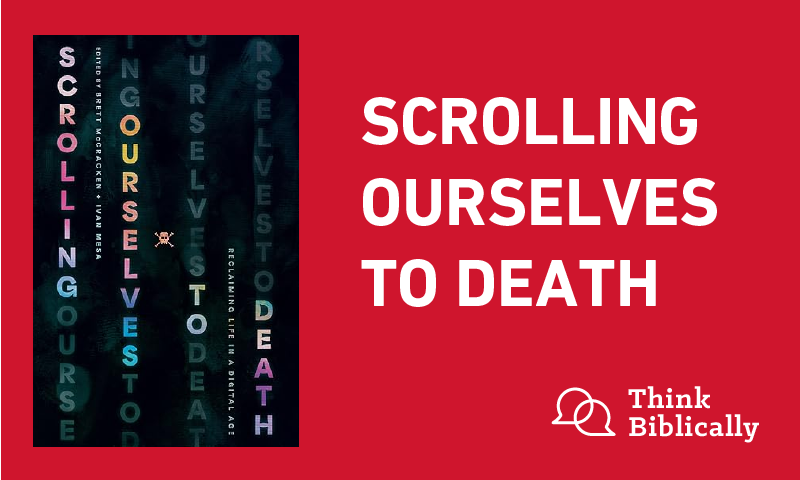
Screens and social media have reshaped the world and our minds, bringing an appetite for distraction, loneliness, and increased rates of mental health challenges. It is time for Christians to rethink their relationship with screens and to consider what it means to live faithfully in our screen-dominated world. Our guest today, Brett McCracken, is the co-editor of a helpful and insightful new book Scrolling Ourselves to Death.
Brett McCracken is a senior editor and director of communications for The Gospel Coalition. He is the author of multiple books including The Wisdom Pyramid: Feeding Your Soul in a Post-Truth World (Crossway, 2021), as well as the co-editor of Scrolling Ourselves to Death: Reclaiming Life in a Digital Age (Crossway, 2025). He has written for The Wall Street Journal, The Washington Post, Huffington Post, CNN.com, Christianity Today, and many other publications.
Episode Transcript
Sean McDowell: [upbeat music] Screens and social media have reshaped the world and our minds, bringing an appetite for distraction, loneliness, and increased rates of mental health challenges. Is it time for Christians to rethink their relationship with screens and to consider what it means to live faithfully in our screen-dominated world? Our guest today, author Brett McCracken, says yes, and he is the co-editor of a helpful, insightful, and timely new book called Scrolling Ourselves to Death. I'm your host, Sean McDowell.
Scott Rae: I'm your co-host, Scott Rae.
Sean McDowell: This is Think Biblically, a podcast brought to you by Talbot School of Theology, Biola University. Brett, it's always good to have you back on. Thanks for joining us today.
Brett McCracken: Yeah, thank you. Thanks, Sean. Thanks, Scott. It's great to be back.
Sean McDowell: So you state the motivation for this book pretty early in your opening chapter when you say, quote, "In many ways, the smartphone is literally killing us." What do you mean by that, and how does that play into the vision for this book?
Brett McCracken: Yeah, I mean, it's, it's killing us on a number of levels. So, you know, w- one is, like, literally killing us, so you could, [chuckles] you could look at, like, distracted driving as an example of that, where the numbers of people killed every year from literally scrolling or looking at their phone while they're driving or- ... You know, the person taking a selfie at the Grand Canyon and, like,-
Scott Rae: [laughing] Oh, gosh
Brett McCracken: ... Dies, you know, death by selfie.
Sean McDowell: Yeah. [chuckles]
Brett McCracken: So there's kind of that, there's that hyper-literal level, where we... You know, some people actually do scroll themselves to death. But, probably the bigger category is the emotional death, you know, that is happening in our culture with mental health is deteriorating, and that's widely documented. Suicide, you know, youth suicide rates are on the rise, depression, anxiety, things like that. So in a very real way, screens, social media, you know, are killing us on that emotional level. But I would say there's a third level, which, for Christians, is of note and of concern, and that's the spiritual death that I think happens when we are addicted to screens, and we're kind of going through life hunched over, looking down at our screens instead of looking up, right? Instead of communing with the Creator and having time to just be still with Him, and spiritual disciplines kind of get crowded out in the age of the algorithm and hyper distraction. And so there's a real spiritual deprivation that's going on th- that I think is very directly related to our habits of digital technology and smartphones. And that third level of kind of the spiritual death, I think is probably what we're getting at the most in Scrolling Ourselves to Death, although we do, you know, mention those other forms of death as well.
Scott Rae: Now, Brett, one of the things that attracted me to the book almost immediately is it's, it's a, it's, it's a tribute to wh- I think one of the most insightful people I've ever read, which is Neil Postman from his-
Brett McCracken: Yes
Scott Rae: ... From his book 40 years ago, Amusing Ourselves to Death. So tell us a little bit about who Postman was and why that book was so important and so prophetic for the moment- ... That we're in now, 'cause I completely-
Brett McCracken: Yeah
Scott Rae: ... Agree.
Brett McCracken: Yeah. Yeah, Postman, also for me, just in my intellectual formation, has been f- hugely, influential. I remember reading him as an undergrad. I went to Wheaton College, and I was a communications major, and my professor had actually studied under Neil Postman at NYU in his media ecology, graduate program. And so I kind of had this secondhand, like, education in all things Neil Postman and Marshall McLuhan by extension, as an undergrad. So, so yeah, Postman and that book, Amusing Ourselves to Death, also Technopoly, another book, that he wrote in the early '90s, were really formational for me and for so many people. I talk to people all the time who point to Amusing Ourselves to Death as, like, one of those seminal books that has stood the test of time, even though it was a very timely book in one sense when it came out in 1985. Postman, you know, who was a public intellectual, writing about culture and kind of trends he was seeing, he was responding to a very specific technological moment, namely television, and how television had transformed, discourse and kind of the life of the mind. But even though he was talking about a specific technological form that we look back upon as kind of, well, that's a relic, you know, t, you know, analog television-
Scott Rae: Yeah
Brett McCracken: ... Three networks.
Scott Rae: Three stations. [chuckles]
Brett McCracken: Three stations.
Sean McDowell: Right.
Brett McCracken: That was a long time ago. We're in a different era now, but so many of the principles of what he... Kind of how he was thinking through this still apply today, and that's what, I think makes that book such a classic, is, it dr- it really models well how to think critically about technology and how a form of technology, how the medium affects the message, how a- ... Technology changes how we think and how we act and how we live in the world. And so even if the particular technology he was looking at is outdated, the form and the method which, with which he goes about analyzing that technology is timeless in some way. And so what we're doing in Scrolling Ourselves to Death is trying to just apply some of Postman's evergreen wisdom and method to a new era of digital technology, things that he couldn't even have imagined, you know, would be technologies 40 years from now, and yet have some continuity with television, right? There's, there's a lot of overlap between what he was observing about television as a form and obviously what-... Or s- our iPhone screens, you know, it, [chuckles] they're like mini televisions, right? But-
Sean McDowell: Yeah.
Brett McCracken: They're very different, but they're also the same in a lot of ways. So- So yeah, that was kind of our inspiration.
Scott Rae: Yeah. Do you think Postman would say anything different about- ... The internet, TikTok, social media-
Brett McCracken: Yeah
Scott Rae: ... Than he said about television?
Brett McCracken: I mean, I think he would say a lot of the same things, but maybe just elevated to, like, kind of next level of urgent concern. Because, like, for example, one of the things he talks about in Amusing Ourselves to Death is the way that television juxtaposes the serious and the trivial, right? Like, think of a newscast where there is a, [tsks] kind of a weather report next to, like, a sports report, next to a serious news report about politics or some sort of, like, genocide in another part of the world. Like, Postman observed, like, there's something problematic here, where we are digesting information that's all over the map. It's the trivial next to the serious, next to, you know, cute videos of dogs. You know- ... Like, what does that do to our brains? What does that do to our thinking, when we're consuming information that way? Well, if you would look at TikTok or, like, your Facebook feed or X feed, you know, it is that same thing, but just to a heightened degree, where we're scrolling through very disconnected, very fragmentary information, and it's the serious next to the trivial, and now it's the real next to the fake. It's, like, AI videos and real videos.
Scott Rae: So we're, we are amusing ourselves to death on steroids then.
Brett McCracken: [laughing]
Sean McDowell: That's awesome. So one of the questions I have is what metrics we should use as Christians, whether we use a particular technology or not. And, you know, when we look in the Scriptures, Paul wrote letters, the means of his day to spread the word. Jesus told stories that you could remember. I mean, they're using wise means of communication. Always-
Brett McCracken: Mm-hmm
Sean McDowell: ... Jesus would go stand in a boat, in part, it would echo his voice. So what metrics should we use to questions like, would Jesus have used TikTok? Would the Apostle Paul have a YouTube channel, and should we? How would you even approach those questions?
Brett McCracken: I think those are fascinating questions and thought experiments, and I think it's actually a useful thought experiment for Christians to think through that kind of what would Jesus do, question. I think diagnostic questions that I think through personally when it comes to, like, whether or not to use a technology, include things like, is this going to change the essence of what I'm trying to do here? Is it going to compromise it? Is it going to undermine it, or is it going to enhance it, or, at the very least, kind of, not damage it in some way? But I think as Postman and McLuhan point out, most technologies, if not all technologies, are not neutral in the sense that they all change the game in some way. They, they have pluses and minuses, pros and cons. And so I think the question, the hypothetical question about what would-- what technologies today would, like, the apostles use, would Jesus use, it's impossible to answer in some way, but I would hope that they would at least kind of think carefully about that medium changing the message, question. Like, I was thinking about, like, [tsks] Jesus and the children, that scene in the Gospels where Jesus says, "Let the children come to me." That was, like, an incarnational, like, embodied moment. But, like, what if he started, like, a YouTube channel for children, like so many YouTube influencers are doing today? Like, my kids watch, like, their favourite YouTube channels of, like, children-oriented entertainment. Like, would Jesus do that? Like, instead of just going to a group of kids and let them come kind of sit at his feet, would he choose instead to have a greater reach, perhaps reach more children with a YouTube channel, but at the expense of not seeing these children face to face and not having this incarnational, encounter with them? You know, think about his encounter with the woman at the well. Like, could that happen on Instagram today, where, like-
Sean McDowell: [chuckles]
Brett McCracken: ... Through, like, through, like, direct messages with some, like, unfortunate woman who's having, like, a difficult time? Like, maybe Jesus would just DM her and have that whole interchange that way.
Sean McDowell: [laughing]
Brett McCracken: Like, I don't think so, right? I think for him, the incarnational aspect of, like, sitting with people face to face mattered a lot. So I actually... To, to answer that question, would Jesus use these technologies, I personally have a hard time thinking that he would- ... For the simple fact that he valued embodiment, right? That's what the incarnation is all about. He chose to take on flesh. He chose to be in relationship with people, to sit at tables with people and have meals. That mattered to him, and I think we should take something from that. It should matter to us, and we're living in a world where it matters less and less, and we're choosing to have more of our lives, more of our interactions with people disembodied, you know, in the direct message, in the text message, in the YouTube influencer kind of platform. And I just think for us, you know, trying to be like Jesus, that's what being a Christian is. We're trying to be more like Jesus. We should really ask that question, like, "What are we missing here, like, in terms of embodied communion with fellow embodied beings?"
Sean McDowell: ... So I appreciate that you're asking certain questions rather than giving a dogmatic response, 'cause it is hypothetical. [chuckles]
Brett McCracken: Mm-hmm.
Sean McDowell: But I, if the, if the concern is being embodied, well, letters are not embodied. They were written-
Brett McCracken: Yes
Sean McDowell: ... And carried, so why couldn't a YouTube channel, in principle, not replace, but be used within a community, in the same way?
Brett McCracken: Yeah, and I think those, obviously, there's examples throughout the New Testament of, you know, letters and even the form of the Bible. You know, God chose to reveal himself in another form. So the incarnation was one example of, like, a medium as the message, the medium of a body, the, of Christ, the message. But after the ascension, right, and the Holy Spirit comes, and now the Word in the accumulated canon of Scripture became the primary kind of communication form. So there's obviously other forms of communication that are valid for Christians, but I think in every case, we just need to ask those simple questions of like- ... What is gained here, and what is lost? Are there any better alternatives? And sometimes there aren't, right? For Paul, with, like, s- letters to churches, there simply wasn't a better alternative for what he wanted to accomplish. And I- and so that's... If it's the best solution to a problem you have, then I think that's a valid, a valid thing in terms of adopting a technology. But oftentimes, I find in today's world, there are better alternatives that are available to us. For example, with, like, a friendship. Like, if it's a friend that lives in my city and not too far away, and I have the option of going out to coffee with them in person and having this embodied moment with them, or just, like, texting them all the time, and that's the extent of it, like, in that case, texting is not the best option. Like, it's [chuckles] it's an easier option, and maybe it's more convenient, but it's not the best option. And when we have two options available to us, I think we have to think through what is going to be the best for this particular type of communication, type of communion that we want to have. But obviously, if you're trying to reach friends on the other side of the world or if you're, you know... If there's limitations that prohibit, a certain form of communication, choose the next best option. And that, Paul was certainly doing that as he tried to communicate to the churches in the Mediterranean world.
Scott Rae: Yeah, Sean, I've actually had people say to me today, "You know, don't, don't call me unless it's emergency. Text me."
Sean McDowell: [chuckles]
Scott Rae: They don't, they don't wanna hear a voice. They just say, "Uh, don't waste my time with a phone call. Just send me a text, unless it's an emer- if it's an emergency," and then, you know, and so there are times when I've texted... When I've called, and they say, "Well, you know, why are you calling me?"
Sean McDowell: [chuckles]
Scott Rae: You know-
Brett McCracken: Yeah
Scott Rae: ... Just put it, put it in a text. Brett, I don't think it's... I mean, it used to be, I think, like a contested notion that, technology is neutral or not. I think, I think most people agree today that tech, you know, especially media technology, is not neutral.
Brett McCracken: Mm-hmm.
Scott Rae: You know, either morally, worldview, or however you wanna describe that. But you make a... One of your authors in the book makes a really provocative point, that, media technology has shaped and reshaped specifically our theology and our- ... And the way we, the way we kind of do our theological understanding. Can you spell out a little bit more why you think that's the case? 'Cause that's a, that's an application, honestly, I just, I haven't considered before.
Brett McCracken: Yeah, I mean, I think there's a lot of different, ways that that is happening. I think one thing that comes to mind for me is the orientation of social media and smartphones is so individualistic, right? Like, we're- they condition us to look at the world through the lens of, "I get what I want when I want it, tailored to me. I can opt out and unfollow things that I don't like very easily. I can delete apps if I don't want them anymore. Like, everything I want, I can get on Amazon Prime, next-day shipping." Like, it puts us in this very, artificially inflated sense of power and kind of, "I'm the center of the universe." Some people have called it the main character syndrome, where-
Scott Rae: [chuckles]
Brett McCracken: ... Just the inter, just the interface of the smartphone, it's called the iPhone for a reason, right? Lowercase i.
Scott Rae: [chuckles]
Brett McCracken: Like, the world is about you. It's, it's the iPhone. It, it's- it conditions you over time to expect everything to cater to your whims, and I think that for theological thinking, that can't help but shape us to start to think about Scripture, and doctrine, and theology in this kind of like, "Well, I'm gonna, like, contort it to fit my preferences because that's just the way that I interact with everything in the world. And if there's a part of Scripture I don't like or a theological tribe that I find off-putting, I'm just gonna mute that and ignore that, and I'm gonna gravitate to my own kind of personally curated echo chamber of truth as I see it. You know, my truth- ... Your truth." So even that epistemological question of, like, truth is very much affected by this dynamic. [chuckles] Like, it's no, it's no coincidence that the post-truth era, the word of the year in 2016, was post-truth. That coincided with this technological revolution of, the internet and social media, and what happens to truth-... In this technological era is that inevitably, we all just see what we wanna see. We define truth as we wanna define it, and whenever there's a truth that we don't like, just like if there's, someone on Twitter that we don't like or someone on Instagram that we don't like, we just unfollow it, and we mute it, and we pretend it doesn't exist. We don't have to reckon with truth that we don't like, because there's more than enough things online that I can find that support my truth and that are evidence, quote-unquote, for my truth. So there's a lot more we could say about that, but-
Sean McDowell: Sure.
Scott Rae: Yeah, that's true
Brett McCracken: ... And there's a couple chapters in the book that get at that, but I do think the epistemological transformation is just massive in our culture due to the technological change.
Sean McDowell: When I speak at conferences, I'll often do a breakout session on smartphones and social media, and I don't preach to the students. They don't generally wanna hear a dad telling them what to do [chuckles]
Brett McCracken: Mm-hmm, mm-hmm
Sean McDowell: ... And not do, but I just ask them questions. How does your smartphone positively, negatively influence your relationships? How does it positively, negatively affect your sense of identity? How does it positively, negatively affect you spiritually? And this isn't true just for smartphones. There's some amazing technology. Like, think about how much the clock has changed the way we see the world-
Brett McCracken: Yeah
Sean McDowell: ... Or cars and airplanes and air conditioning and refrigerators. [chuckles] Like, all technology-
Brett McCracken: Yeah
Sean McDowell: ... Changes the way we see the world and each other. And a smartphone, even though we've lived through this, is arguably one of the s- most significant- ... Worldview-changing technologies ever produced, and sometimes we're so in the middle of it, that we don't see it.
Brett McCracken: Yeah.
Sean McDowell: Now, with that said, I'm, I'm curious if you could answer this question. We- you talk about in one of the chapters in the book, this is a compilation book, and by the way, our very own Thaddeus Williams-
Brett McCracken: Mm-hmm
Sean McDowell: ... Here at Talbot, has an excellent chapter in this one on telling the truth about Jesus in an age of incoherence.
Brett McCracken: Yeah.
Sean McDowell: But I'd be curious if you could talk about how smartphones change not just our minds, our thinking, but they also change our brains.
Brett McCracken: Yeah, there's a ton of really interesting science out there that gets at this. You know, even books like Nicholas Carr's The Shallows, which is now kind of dated. I think that came out-
Sean McDowell: Yeah
Brett McCracken: ... You know, 15 years ago, but he was already starting to tell that story, and ever since, there's been more and more research. A book that I l- that I like that's came out five years ago is called Reader, Come Home by Maryanne Wolf, and she talks about how, like, the reading brain and the capacity, the, just the cognitive capacity to read and digest information in kind of the way that we used to do, is atrophying. It's a muscle that, people are losing the ability to [chuckles] kind of, to kind of exercise, and it's because of the way that we encounter information on the internet, on social media, is just this mile wide, inch deep, constant, like, inundation of information. That's, to go back to Postman, like, that's disconnected. It's kind of this and this and this and this. There's no kind of, thread that ties it together. There's no big, overarching framework that we categorize things in, so on our brain- on our brains, this is just incredibly tac- taxing, as you can imagine. And our brains are... More than, more than any other era of human history, our brains are being forced to process information at a speed and at a, glut, at an amount that has- they've never had to before. And so the energy that is being spent on our brains just kind of doing triage with this- ... Flood of information that's disconnected, that's coming at us from every direction so fast, it means that our brains are exhausted and losing the ability to expend energy in other ways, like deep, kind of reflective thinking, that kind of, The, the place where wisdom is born, where you're actually able to connect dots and synthesize. Now our brains are just so s- they're so spent [chuckles] just simply, like, categorizing all this stimulation that's coming in, that they don't, they don't have anything left, and you're seeing that. You're seeing how the ability to think critically, I'm sure, you know, you guys in the classroom over the years have maybe noticed this with students. Just it seems like the capacity for like-
Sean McDowell: Not, not at Biola, Brett, just for the record.
Brett McCracken: Oh, okay.
Sean McDowell: But generally speaking, yes. [laughing]
Brett McCracken: Biola is the exception. Yes, Gen Z at Biola are- they are stellar.
Sean McDowell: [laughing]
Brett McCracken: But I've... I mean, I've noticed it in myself. I, so-
Sean McDowell: Yeah, that's fair
Brett McCracken: ... I don't wanna blame- I don't wanna only point the finger at Gen Z. Like, I've even noticed my ability- ... To, like, sit with a really intense, meaty book for, like, long periods of time is getting harder and- ... Yeah, and I'm someone who's very cautious about this and careful, and if it's happening to me, I can't imagine, you know, what digital natives and Gen Z and Gen Alpha, what they're dealing with in terms of the brain and how they're processing information.
Scott Rae: You know, Brett, one of the chapters I found the most helpful was the one on apologetics and evangelism-
Brett McCracken: Mm-hmm
Scott Rae: ... And how they, how they relate to what the author calls the scroll-shaped mind.
Sean McDowell: [chuckles]
Scott Rae: I love that phrase.
Brett McCracken: Yeah.
Scott Rae: So helpful. But is there is there something we need to learn about how to proclaim Christian faith or how not to- ... In light of the scroll-shaped mind?
Brett McCracken: Yeah, I mean, I d- I think I have, like, a simple answer, or maybe it's too simple, but I think we have to get people offline. Like, I, [chuckles] I don't think the answer is, like-... Let's battle with people on Twitter, and let's like, duke it out in the YouTube comment sections. Like, yes, to some extent, that can be helpful, but like ultimately, to have substantive conversations, apologetics, evangelism, I think it needs to happen in that more human space where you can read non-verbal signals with faces, and it's not just, an unseen person beneath an avatar that you're trying to reach with the gospel or convince of the truth of Christianity. So yeah, I k- I mean, I know, Sean, I know you do a lot of work on YouTube, and like, you're someone who is an exemplar of, like, using, a new media form in a way that is bringing good kind of gospel, evangelistic content to that space, and there's a lot of great examples of that happening. But I do think there are limits to that, and, I think God uses that stuff, but, at the end of the day, we also wanna get people incarnationally plugged into churches. So the move, at some point, has to go offline, right? We have to get people, plugged into real embodied churches because the life of a disciple of Jesus can't exist just only in virtual space on social media. So we can meet people there, we can try to bring apologetics and evangelism and good, you know, theologically rich content into those spaces. It's what I do, it's what The Gospel Coalition does, so I believe there's a value in it, obviously. But I think at some point, the pipeline has to be move people into real embodied relationship, because I think that's where the sweet sauce of Christian life happens, and I think, God uses technology to kind of bring people into the funnel, if you will. But, ultimately, we wanna get people, face-to-face and shoulder-to-shoulder and in a, in an environment where they can be fully known and seen and discipled, without kind of the illusions and the, yeah, just the ways that we can kind of manipulate ourselves and things online.
Sean McDowell: So you have a chapter towards the end of the book on staying sane in an overstimulated age. This could be a series of podcasts in itself, but maybe give us a few points to stay sane and how this might apply to parents.
Brett McCracken: Yeah, so, that chapter, I was really getting at something that Neil Postman talked about in Amusing Ourselves to Death, which is how we have this really out-of-balance ratio of information and action, and that will make you crazy, and, it is making us crazy in today's world, where we-- we're overstimulated with information that's coming across our feeds. It-- we're watching it on the news, YouTube, and yet very little of the information is something that we can channel into action, w- and we're, we're created to actually, like, have a pretty even ratio, Postman argued, and I think he's right. We're-- we need to have a fairly even ratio of information that comes into our heads and action we can then take in our lives in a real way. And so it makes us insane when we have a huge amount of information coming into our brains, but very little of it is actionable. So one simple solution, I think, for all of us to become more sane in this world is just to try to do what we can to reduce the amount of unactionable information that we consume on any given day. So kind of endless scrolling on social media, you know, hours of consuming news, whatever, like, rein that in. Like, do as little as you can get away with and focus on, like, spending your informational, energy in areas where it has more relevance to your life. So consume information that you can like, then take action on, whether it's like if you're in ministry and you know, well, there's plenty of information on the Gospel Coalition website or other places that can, that can, that can be actionable information for you. If you're a parent and you're, you're needing help figuring out some dynamic of parenting, you know, that-- the information online in that genre can be useful for you because it's, it's actually actionable information. So that's one thing you could do, is just kind of audit your information intake and try to make it, lower in the, like, trivial information that's like, has nothing to do with my life, and I could never take any meaningful action on this, and heavier on pertinent information that is immediately, or eventually actionable in my life. I think another thing that is helpful, and I'll just end with this, just to go back to a theme I've been kinda harping on this whole interview, is spend more of your life, offline. You know, [chuckles] imagine that! Imagine that as a solution to our mental health woes in the digital age. Carve out time in your week, in your day, where you intentionally aren't around screens, and you're going on a walk in your neighborhood with your family or your spouse, unmediated, without any technology. Spend time just sitting in your backyard, observing God's creation, and that will do wonders. Speaking from personal experience, that will do wonders for your stress and anxiety and just even giving your brain a break, to go back to the brain science piece of this- ... Of all this. Like, s- what's lost in the digital age is kind of open time for your brain to actually do that synthesizing work and to start to make connections. There's a--... An author who I really like, Christine Rosen, who has a new book out on, kind of the death of embodiment. And one of the things she talks about is how daydreaming is becoming a endangered species. We don't, we don't have time to daydream because we just fill all of our- ... Moments of open time with content and screens. But there's a real, there's real value in daydreaming and just seeing l- where your mind goes when it has space to just sit and be still and wander. And I think it, not only does it, is it good for your brain to kind of catch up with all the inputs that it's st- trying to kind of sort through, but also for your soul to just kind of have some breathing room and to not be constantly stressing about what you just saw on TikTok or Twitter or a headline on some news website or whatever. So, and I think just embodied experience is more grounding. You know, sometimes when I'm stressed, and, like, what's happening in the world, what I'm seeing on social media is, like, causing me some anxiety, like, I find that just, like, going outside in the backyard and playing with my kids and having, like, just a simple, like, experience of, like, this is what life is about. M- so much more important [chuckles] in a sense than what's happening in Washington, DC, with politics right now, or what's happening with whatever, is what's happening here with me communing with my sons, playing baseball or whatever the case may be, in the backyard. And it's a simple truth, right? Like, God created us as embodied beings to live and to be faithful in small spheres of influence: the home, the family, the neighborhood, the church. And I think we need to, we need to kind of re-embrace that value of kind of local faithfulness- ... In a world that maybe calls us, beckons us to be spending our passion and our interests and our energies on things that are far away from us and that are pseudo events happening on Twitter or, you know, far-flung controversies that are erupting on social media and that will die off, you know, within 24 hours, and no one will remember. That is a waste of your time, and it's gonna make you anxious, and it's gonna [inhales] cause mental stress. But committing to the things right in front of you that God has placed in your path to, like, to be faithful in, that's where you're gonna be most used by God, and it's where you're gonna find the most flourishing in every sense, I believe. So I'll end there, and just call people to live a little bit more of a local, embodied experience in a world of digital disembodiment.
Sean McDowell: Well, that's a great call, and I think one of the strengths of your book is you do a few things, is you just invite us to reflect on things differently. Scott and I did a show a while ago on just how would Jesus comment on social media?
Brett McCracken: Mm-hmm.
Sean McDowell: Would he comment on [chuckles] social media? What does it look like-
Brett McCracken: [chuckles]
Sean McDowell: ... For a Christian to do this? What's a theology of screens and smartphones? And we don't think about that. We just take our script from the world. So you and the contributors are just asking the right questions, pushing back, bringing clarity, and then giving some biblical wisdom to live that out today. So I thoroughly enjoy it. Again, it's called Scrolling Ourselves to Death, and, it's edited by Brett McCracken, our guest today. Brett, thanks so much for coming on.
Brett McCracken: Thanks so much, guys.
Sean McDowell: This has been an episode of the podcast Think Biblically: Conversations on Faith and Culture. We have programs online and in person, Christian apologetics, spiritual formation, Bible, theology, marriage and family, so much more. We'd love to have you join us in Southern California or, of course, online. Please keep your comments and questions coming. You can email us at thinkbiblically@biola.edu. And please consider giving us a rating on your podcast app. Seriously, every one helps. Of course, we'd prefer five stars, but just an honest review helps get the word out. Thanks for listening, and remember, think biblically about everything. [upbeat music]