Biola University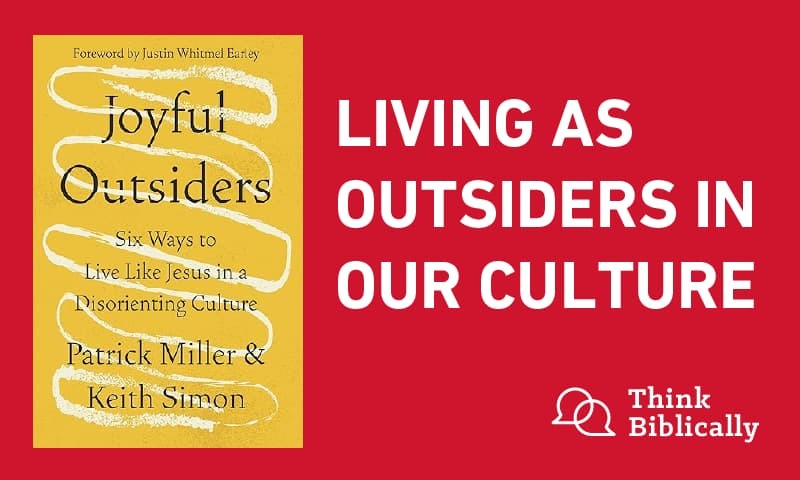
What does it mean that the Christian is an outsider in one’s community? How do we engage our divisive culture well and faithfully at the same time? What might your particular style for cultural engagement be? We’ll answer these questions and more with our guest, pastor Patrick Miller, around his new book, Joyful Outsiders: Six Ways to Live Like Jesus in a Disorienting Culture.
Patrick Miller is a teaching Pastor and Director of Digital Relationships at the Crossing Church in Columbia, MO. He has a master’s degree from Covenant Theological Seminary and he cohosts two podcasts: Ten Minute Bible Talks and Truth over Tribe, with Keith Simon. He and Keith are the authors of Truth Over Tribe, and their most recent book, Joyful Outsiders: Six Ways to Live Like Jesus in a Disorienting Culture.
Episode Transcript
Scott Rae: [upbeat music] What does it mean that the Christian is an outsider in one's community? How do we engage our divisive culture well and faithfully at the same time? And what might your particular style for cultural engagement might that be? We'll answer these questions and a whole lot more with our guest, Pastor Patrick Miller, around his new book that he's co-authored with his, with his co-pastor, Keith Simon, called Joyful Outsiders: Six Ways to Live Like Jesus in a Disorienting Culture. I'm your host, Scott Rae.
Sean McDowell: I'm your co-host, Sean McDowell.
Scott Rae: This is Think Biblically from Talbot School of Theology at Biola University. Patrick, thanks so much for joining us on this. Really appreciate your book. Super insightful stuff, and I think will be really helpful to our listeners to establish their particular style with which they engage the culture that we're in.
Patrick Miller: Oh, it's an honor to be here with you both.
Scott Rae: So tell us, how has what you've ex- you've both experienced as pastors in this divisive culture motivated you to write about this particular subject?
Patrick Miller: Well, I don't know about you two, but I do not like one-size-fits-all clothing. I think it should be called one-size-fits-none clothing, because it never fits right. And I think when you go to a lot of churches, you'll find that they have one or maybe two ways that they orient themselves towards their community, towards their culture. You know, so you have art churches, where everybody's talking about the arts and culture. And you have prophetic churches, where everybody's protesting, and maybe they're a little bit more political. You have what I call trainer churches where they emphasize discipleship, but maybe they don't talk about the political stuff at all, or evangelistic churches. We're all about reaching people for Jesus and converting people, but maybe we aren't so much about building institutions. And what we've seen in our church is that if we can get all Christians to use the unique gifts that God has given them to engage the world around them, we sing a full song. I think that the song Christ wants us to sing in our world, it's not a single-part song. It's a song full of harmony, full of beauty. It's not a muddle. It's many voices singing at once, and I think it's only collectively, as we all take on our different roles and parts in our culture and world, that we can do that. Now, of course, part of why we wrote this is because these different churches, they tend to get into fights with one another, and we tend not to like each other. And I want to encourage us to encourage one another in our gifts, even if they're different than our own.
Sean McDowell: How does this overlap with and intersect with your previous book, which was more about navigating politics, Truth Over Tribe?
Patrick Miller: Yeah. So our first book was called Truth Over Tribe: Pledging Allegiance to the Lamb, Not the Donkey or the Elephant. [laughing]
Scott Rae: [laughing]
Patrick Miller: And the subtitle really summarizes it all. I kind of saw it as ground clearing because so many of us, we've come to faith in Jesus, maybe we've walked with Him for a lifetime, and we haven't developed a robust political theology. We, we haven't really realized that Jesus established a kingdom, and there is a politic to that kingdom, but while Jesus has a politic, a way of doing life together, He isn't a partisan. And so what ends up happening is we end up superimposing partisan politics, like liberal politics or conservative politics, on top of Jesus, and all of a sudden, instead of getting Jesus, we end up getting a donkified Jesus or an elephantized Jesus. And we end up in arguments with one another, and it ends up dividing churches. And so before we can even talk about how to engage culture, it felt like we needed to start a conversation about how we set aside partisanship in the church, not because, both sides are equally right or wrong, but because neither side is the Kingdom of God. Neither side is the ultimate politic of Jesus, and until we know what that is, we can hardly have a conversation about how to engage the world around us.
Scott Rae: Yeah, we've suggested several times on this p- on this show that, no political platform is go- is going to be perfect or reflect biblical values entirely because that's not the, that's not the purpose for which they were written.
Patrick Miller: Yeah.
Scott Rae: And so every political platform's gonna have, gonna have good things. It's go- it's gonna be a bit of a mixed bag. Now, you know, I think some of us who live maybe on the West Coast will resonate with your notion of feeling like exiles. I think Sean and I would suggest that, you know, living in California, you know, at least since, at least since the Obergefell decision was handed down about 10 years ago, I have, I have felt more like an exile in my own community. But I think some might not sense that, depending on the part of the country that they live in. I could see people in the South or the Midwest feeling a little differently about that. But you know, you insist in the book that we, you know, we all are exiles in our own communities, and I think have a little bit of surprise that I saw coming out in between the lines in the book when people don't feel like they are exiles in their own community. So why is that?
Patrick Miller: Well, I think we need to divide this discussion into two parts. First, we need to talk about our identity in a normative sense, so what the Bible says is true about us in all times and all places, and then we need to have a contextual conversation about what's true in my place, in my time. And I think that the Bible is pretty clear that no matter who you are, you are in exile. In 1 Peter's writing to, citizens of Rome who are living in, you know, what's modern-day Turkey, that region, and he opens up the letter by calling these people exiles, which would've been very strange because they would've said, "No, I'm living in the city I grew up in. I'm not in exile here." And when he does that, he's superimposing on top of them an ancient Jewish identity, people who were quite literally taken from Jerusalem, brought to Babylon, and had to live as exiles in a foreign land. And he's saying, in effect, "As a follower of Jesus, you are a foreigner. You are a sojourner. You are a citizen of God's kingdom first and foremost, and that means that wherever you live, you live as an exile." Now, in the Old Testament, to be an exile didn't mean that you were against the place that you lived. It meant that you both cultivated it and resisted it at the same time, and so that's the normative part of our identity. No matter who you are, you are in exile. But I also think that there's a contextual aspect to our identity. In other words, the way in which I'm in exile is different depending on where I live. Our exile-ness is the... It's a liquid fact.... So if you're living in China, your experience of exile is going to be radically different than someone who lives in Iran, than someone who lives in California, or than someone who lives in Missouri, like myself. I think sometimes we get so fixated on, in the United States, federal politics, that we try to treat the whole of our country like it's one big thing, and it's not. I live in a college town. It's a very progressive city, so while it's not California, I probably resonate with the two of you in a way that I might not if I lived just two hours south of where I live currently, in the Bible Belt. And so part of figuring out what it means to be in exile is coming to terms with the context in which you live.
Sean McDowell: What are some of the tensions that living as an outsider would create for Christians today?
Patrick Miller: Well, I can speak about my own context most easily. In fact, I'll, I'll share a little story. This was probably two or three years ago. Every year, our city holds a diversity breakfast in honor of Dr. Martin Luther King. And normally, it's just a celebration of his civil rights legacy. They'll bring in local dignitaries from the city, business owners, city councilmen, but they also bring in students from the schools, especially the middle schools. And a few years ago, it's one of these breakfasts. They bring in all of these middle school students from the schools, and at the end of it, there is a drag performance. Now, here's the thing: there was nothing about there being a drag performance on the permission slip for the field trip. And so students get back, and as you can imagine, some parents think this is a nothing burger. Who cares? But other parents are understandably upset. They didn't give their child permission to go see a drag performance. They had no idea that a drag performance was happening there. And so the question becomes, what do you do in that scenario? For example, we had a woman in our church who had a child who's autistic, and he has always wanted to go on field trips but was often not allowed to because his autism is very severe. But because it was a diversity breakfast, they invited him to come and be a part of it. So she finds out just, you know, a few hours later that he saw this performance, but because he's non-communicative, she can't even have a conversation with him about what he saw, what he experienced. So if you're that mom, are you feeling tension right now? What do you do? If you're a parent who didn't have a kid there, do you feel tension? What do you do? Do you write an angry email to the president... Or sorry, to the superintendent, to the principal? Do you write a kind email trying to persuade? Do you just ignore it and say, "Look, this is the world we live in. We can't change the world"? There's a lot of questions about how you respond. How do you respond if you're working for the state? Do you go after the school district for their field, for their field trip policy? Or if you work inside the school, you're a principal, what do you do? You can't change the field trip policy, but you also know that maybe this was wrong. So all of these Christians working in all of these places, because of this single event, felt a tremendous amount of tension, and I'm convinced that when you're in those tensions, oftentimes the answer is not black and white. It's not always clear what the right decision is, and it's often only in retrospect that you can say, "I think I made a wise choice, or I didn't."
Scott Rae: Now, that strikes me as one of the kinds of things that, could potentially divide your church.
Patrick Miller: Oh, yeah.
Scott Rae: If you had, if you had parents on both sides of that in your church looking to you and your co-pastor and your staff to support one position or the other on this. So how do you, how do you keep that from being divisive when that controversy comes? And that's, that's not a school district so much, but it's- it comes much closer to home.
Patrick Miller: Well, I do think part of this is faithfully preaching God's Word. The fact that we preach through the Bible, book by book, meant that we'd already had conversations in our church about the transgender issue in general. And so I think people in our church were already formed and prepared to think properly about this particular challenge. Also, because we go through the Bible book by book, we talk about what it looks like to be exiles in Babylon. Jeremiah 29 is a letter that Jeremiah wrote to the exiles, challenging them to work for the welfare of the city in which they find themselves. And so we also have people in our church who understand that we aren't culture warriors. We aren't antagonistic towards our culture, although we might resist it and challenge it. Ultimately, we're also trying to cultivate it. Now, that said, it was still hard. You know, Keith and I, my co-author, we eventually decided that we were going to write a public piece. This is because the school district was refusing to back down. They'd publicly said that anyone who resisted their current policy, which was that they would never tell parents if there was a drag show, that they were being bigots, and-
Scott Rae: Wow
Patrick Miller: ... You know, essentially, you need to get out of dodge. And so we wrote a piece in, Newsweek, responding to what was happening, hoping that we could actually turn down the heat. Because the piece didn't say, "You're wrong about drag shows." The piece simply said this: "We live in a pluralistic society, in a pluralistic city, and even though we might not agree about drag queen performances, can't we all agree that it's a parent's right to decide what their child is exposed to or not? Whether that's a prayer rally or a drag show, parents should have the ultimate choice." Now, we thought, "Hey, this would give us all common ground. We don't have to agree on the trans issue, but we can maybe agree about parental consent." The superintendent invited us to come into his office the next day, and Keith and I, before we got in there, we had a piece of paper. We wrote down our goals, and the first goal on that list was to make a friend. We know how hard and lonely it can be to be in leadership. But when we got in there, that's not the way things ended up going. He brought in a school board member who does not like us very much, and very quickly, they compared us to Jim Crow segregationists. They said that we were causing trans kids to commit suicide in our community. You know, and of course, none of those things are true. But again, it just highlights, even if you're trying to act with wisdom, even if you're trying to act with grace, even if you come into a room saying, "I want to be your friend," there is no guarantee that the tension goes away, that things go the way that you want. That's not a promise God makes us. There, there's no cultural prosperity gospel out there. People think you're gonna write the book that helps them, you know, have a happy life and culture. I hate to be the one to break it to you. You live in Babylon. There's not always happy endings.
Scott Rae: I think this is why Paul says in Romans, "As far as it depends on you-... Be at peace with those in your community. Now, the heart of the book, that which was I found so helpful, is that there are different types of outsiders that have both positive and negative aspects to them, and that we all don't have to engage the culture in the same way. I just found that incredibly liberating, that I, that I don't have to fit into a mold that doesn't, that doesn't fit who I am. So what determines what kind of an outsider you actually are? Is it a function of personality, giftedness, passion, all the above? So what goes into that?
Patrick Miller: That's a fantastic question, and, you know, if people are trying to figure out which... We have six different ways that you can be an outsider, and it would be rather boring if I went through each one on this [chuckles] podcast.
Sean McDowell: Sure.
Patrick Miller: But you can go to joyfuloutsiders.com, and we do have a little test that people can take to try to evaluate it. But you're asking a really, an even deeper question, and I'm not sure I have the totally correct answer to it. Because what I wanna say is, the kind of outsider God's calling you to be is a result of a number of things. I do think part of it's your personality. You know, some of us have, how shall I put it, more fiery dispositions, and we're not too bothered by having conflict. And so it might be natural for us to step into the role of being a protester, someone who changes the world by challenging injustice, just because of our disposition. My wife loves harmony. She loves peace. As, as much as she might want to be a protester, she will never be a protester. That's not her heart. Now, I have maybe a more fiery disposition, so that [chuckles] comes a bit more naturally to me. But I would add to that it's, it's not just having a personality, it's also having the opportunity. You might be, someone who feels like you've been called to be an advisor, someone who changes the world by influencing influential people. But the reality is, if you're not invited into the big rooms where the big decisions are being made, you don't have the opportunity to be an advisor. And so whatever your personality is, it doesn't really matter unless you have the opportunity. And then, of course, the last thing I would just say is your actual experience. There are gonna be things that happen in your life that will shape you into being a particular kind of person. For example, if you were blessed to have a mentor who was what we call a trainer, a discipler, someone who really developed you in the way of Jesus, you might become that as well, simply because you've seen someone else do it. You had the opportunity to watch, and now you can implement. My single last thought here would be is this: While I think people are gonna lean in one of six ways that we offer in the book, there are circumstances when all of us are called to step into a role that we don't feel comfortable in. My wife might love harmony, but if she's in a room where there's a terrible injustice happening, God tells her she has the responsibility to speak up despite her love of harmony, and that could be said about any of the various ways that we talk about.
Sean McDowell: So people understand, you have, like, trainer, advisor, artist, ambassador, protester, and builder, and you explain what each of those are. And we fall into different categories to varying degrees, and like you said, there's times where if you're a trainer, you might have to step up and be a protester.
Patrick Miller: Mm-hmm.
Sean McDowell: I tend to have what someone- people would describe, and this is probably a loaded way to put it, but a little bit more of a pastoral, relational voice. I am not a protester [chuckles] by nature, although there's a time to do that. But I also will say to people, like, for example, we speak in truth, and we speak in love. We've gotta do both. Well, on the flip side, there's some people that are naturally more truth tellers and some people that are not, but then we tend to judge other people according to one of the six categories that we fall into. So how do you and Keith, who tend to fall into one of these categories, cultivate a church and an environment where the other categories are heard, and understood, and appreciated, and biblically included?
Patrick Miller: That's a fantastic question. In our church context, we believe, what the Bible says about plurality of leadership. And this can come in many different shapes and forms. I'm not advocating for, you know, Presbyterianism or fill-in-the-blank-ism. What I am saying is that unless your leadership team is able to reflect some of these various ways of engaging the world, it's going to be very challenging to see it reflected in your congregation. And so one of the things we've done, we don't have a head pastor at our church. We're very abnormal. We have co-lead pastors, and we have an elder board, and we have a very diverse group of leaders, some of whom, like you said, have a more relational or pastoral voice, some of whom are ambassadors, people who love evangelism. They love reaching people for Jesus. Others of whom have a more artistic way of leaning into the world. And because we've allowed for that kind of diversity and shared leadership, I think it's become something that gets reflected in our congregation. Because as you can imagine, there's people in our congregation who are drawn to those leaders because those leaders can help them cultivate their gifts. So what I would say to anyone, no matter your church size is, "Okay, inside the church, try to identify wise, mature individuals who don't look exactly like you." The best gift you can give to the church is ordaining elders who are actually able to be different than you are.
Scott Rae: Yeah, and actually who might be better than you at some of those things. [laughs]
Sean McDowell: [laughs]
Patrick Miller: Yeah. Wouldn't that be wonderful-
Scott Rae: Yeah [laughs]
Patrick Miller: ... If you went to a church where the pastor doesn't have to be everything at all times for everyone but has a wonderful group of people around him who supersede him in so many different ways? I mean- ... I think that's such a better picture of Christ himself.
Scott Rae: Now, I think Sean and I would probably not make any claim to the artist type-
Sean McDowell: For sure. [laughs]
Scott Rae: Because I think we are- we're both, I'd say, somewhat genetically handicapped in that area. [laughs]
Sean McDowell: [laughs] Oh, no.
Scott Rae: But, but tell... Just tell us a little bit more about, a cou- a couple of these different types of outsiders. You know, maybe the, you know, the trainer, the ambassador, uh-... What, give us an example of some of these that have, that they have things that are, that are positive, but they also have, a dar- a dark side to them as well. That, that I think you're really right to point out that, you know, all of, all of these styles are a mi- are a bit of a mixed bag.
Patrick Miller: Yes.
Scott Rae: Um-
Patrick Miller: Yeah, as is the case with anything, strengths sometimes come with weaknesses, and sometimes the gifts God gives us, end up leading us down paths that, can be sinful and destructive if we're not careful, if we're not fully submitting ourselves to His Spirit. You know, I'll, I'll, I'll pick... There's so many, I could talk about each of them. But I'll talk for a second about the builder, because I haven't said much about that. The builder is someone who changes the world by building institutions. This is someone who fundamentally understands that, as important as politics and, you know, Washington, DC, and whatever else, and the arts and culture may be for our world, they understand that for most people, the culture in which they live, their day-to-day experience, happen inside of institutions. That might be the business that they work for, it might be the nonprofit they work for, it might be the church they're a part of, the schools that they attend. It might be the family even that you're a part of. There is no living human who is not a part of some sort of institution. We all surround ourselves with other people, and institutions have this profound ability to shape our sense of time, our sense of values. You know, like, you look at in the past events like Enron. You know, you have this massive corporation that, somehow convinces everybody on board to lie, to lie about what's happening on the inside in order to make more money. And people ask, "How did that happen? I mean, how do you convince so many smart people to all go along with a big lie?" That's the power of institutions. They normalize ethical or unethical behavior. And so one of the ways institutions change the world is by whether or not the people inside of it are Christians, it's by shaping their virtues, shaping their values, making them into a certain kind of person. This is the power of institutions. They, they not only do that, they can also promote, social, and spiritual, and economic capital, the things that people need for human flourishing. And so you can see lots of great examples of builders out there. I like looking at entrepreneurs. I've got a friend, named Pete Oaks, who runs a company called Seat King, and Pete's story is fantastic. You know, he used to call himself a 90/10 guy. Basically, he thought, "Look, God just wants 10% of my tithe, and that's all." And he realized after losing a lot, that actually God wanted 100% of him, and this led him to change how he ran his businesses. He was no longer about the single bottom line of profits. He said he also had a bottom line of what he called social capital, healed relationships; spiritual capital, helping people to grow in their, moral and ethical, virtue; and of course, capital capital, money. You know, he did need to make a profit. And so he buys this company called Seat King. They make basically industrial seats for, truckers, and he's trying to find a place to move it because he can't find enough workers, and he discovers his solution: a maximum security prison.
Scott Rae: Huh.
Patrick Miller: So he moves the company in there, but unlike what most people do, he decides, "I'm not gonna pay you pennies on the dollar for your time," which you're allowed to do with prisoners. He says, "I'm gonna pay you a good wage. I'm gonna train you how to do these skills, so that when you leave, you can go get a job doing this. I'm going to have classes on how to be a father, on how to be a man, so that I can help you to grow in virtue." And everybody in this place is looking at him like he's insane. But you fast-forward 10 years, and he has changed the lives of hundreds of inmates, who all say, "Not only is this the best paying job that you can get in the prison, this is the job that might actually help you get out of prison and stay out of prison."
Scott Rae: Wow, that's fantastic.
Patrick Miller: It's not perfect, not everybody does, but that's what a builder does. He was making a profit. This is not a nonprofit. He was making money, he was making good money doing this, but he built a kingdom-based institution for the flourishing of his fellow humans.
Sean McDowell: So each of these on the back, you have all six listed, and it- they all talk about changing the world through discipleship, creating beauty, sharing the Gospel, challenging injustice, building institutions. Which one was Jesus?
Patrick Miller: [chuckles] Oh, what a question. I don't know if I can answer that. I mean, I'm tempted to say Jesus was all of them.
Sean McDowell: [chuckles]
Patrick Miller: In some ways, we try to show how Jesus does embody each of these. I mean, Jesus was a disciple maker, so He was a trainer. It's undeniable. He was an ambassador. He evangelized. He shared the Gospel, the Good News of the Kingdom, with people. He was a prophet. You know, He called Herod a fox, and He protested the, idolatry, of the self-righteous Pharisees. You know, maybe a builder might be the one thing He doesn't quite fall into, but it's ha- it's hard to say He didn't, because, you know, He kind of started the biggest movement in world history. And, of course, I think He was an artist. I mean, the parables are masterful art. They- it's, it's... In this case, He's one of the best storytellers who's ever lived. I mean, people across the world know this man's stories. So in some ways, I wanna say you can see Him in every single one. And that's not to say that Jesus is personality-less, and these really aren't personalities anyways. I think it is to say that He is the fulfillment of the law of the prophets, and it's no shocker that He's taken up all the Old Testament figures, exiles, who kind of embodied each of these six ways and has, in a sense, perfected them in His life.
Scott Rae: That's a, that's a good insight. And you do, in the book, I think, give different biblical examples of people who, I think, have, you know, have mo- more do- more... One, one of these more dominant than the other. But I think, to sort of follow up on Sean's question, we're all... You, I think, rightly point out, we're all called to do a bit of all these six types.
Patrick Miller: Mm-hmm.
Scott Rae: You know, we're all called to spiritual disciplines. We're called to influence leaders when we can, definitely to appreciate beauty. I mean, even, you know, one of the things I realized about my, you know, my wife and my home is that, you know, our landscaping, creating beauty, is really important to her. It just, it contributes to her well-being. I think, you know, the ambassador, we all have the obligation to proclaim the Gospel. We all have the obligation to stand up for, against injustice, you know, help, and help build things that will outlive us. So what's the, what's the value in knowing what your main engagement style might be?
Patrick Miller: ... Well, I'm gonna take a note from John the Baptist. He very famously was asked if he was the Messiah, and he told everybody, "I am not the Christ." And what I mean when I say that is, while Jesus might be able to be all of these things, I cannot. I am a limited, finite human with finite talents, finite time, finite resources, and that is a glorious truth. God designed me this way. I can't be everything, and that is good, because that's how He made me. And so the beauty of finding which of the six ways you most identify with, is that you can start cultivating it in your life. For example, you know, I'm probably, by disposition, kind of an artist-trainer, and so I have to ask myself the question: How do I cultivate these two callings in my life in a very intentional way? In the books that I read, in my daily practices, how I spend my time, because I can't do all of them. And then I trust that if I'm doing my part, and I- there's gonna be other people in my church, in my body, that are doing the exact same thing. And it's only collectively that we together can faithfully do the ministry of Jesus in our culture that He's calling us to do. So I think that's the beauty. It's... You're, you're gonna figure out what you are. And, I- let me add one other thing. Sometimes we feel guilty because we aren't something. You know? Like, you guys were already saying, "Ah, we don't see ourselves as artists." You know, you can start feeling bad, you know?
Sean McDowell: I don't, actually. [laughing]
Patrick Miller: [laughing] Okay, let me reframe that. All of us are called to do evangelism. I want to be really clear. Some people have the gift of evangelism. I've met them. These are people who just have an amazing ability to draw a conversation to Christ in, the most kind, generous, gracious ways. Now, that doesn't mean that the rest of us aren't called to evangelize, but there are some who have that specific gift. And if you don't have that gift, it's easy to become jealous of the person who just has a knack for turning every conversation to Christ, for drawing people to know Jesus. And I don't think God wants us to feel guilty about not being, gifted in every possible way. Again, you have a calling to evangelize. I want to be clear here. But on the other side, that's the beauty of knowing what you are, is saying, "Okay, I might be an artist. I might not be as good at the ambassador-type job, but thankfully, there's other ambassadors. I still need to be an ambassador sometimes, but I'm not gonna beat myself up because I'm spending my time creating beauty that draws people to the kingdom. Like, that's what God made me to do, so I'm gonna go do that thing."
Scott Rae: This is, this is precisely what's so liberating about- ... The kind of concepts that you have and what I think is so helpful. One other question, and then we'll, we need to wrap up here. How would you like for people to use your book and the ideas that are in it?
Patrick Miller: I would obviously love it if people find one of the six ways, and they find it really helpful for their life. That, that would be fantastic, and that is the bulk of the book. But I think at the core, what I really want, for this book is for people to learn to embrace tension and learn to see Christ in tension. One, one last little story. There was a tightrope walker in the 1800s. His name was Charles Blondin, and he was the first person to attempt tightrope walking the Niagara Falls. And so he announces this, and there's, you know, the newspapers and the people, and they all gather there to see him die. According to the newspaper reports, everybody thinks he's gonna be smashed to atoms. That's, I guess, what you do in the 1800s. And so he starts going across the rope, and he gets about halfway, and he stops, and he lowers a rope down to a boat below him, and he pulls something up, and people are wondering what's going on. Is he finished? It's a bottle of wine, and he drinks the entire bottle of wine, stands back up, and finishes his first tightrope walk.
Scott Rae: [laughing]
Patrick Miller: Y- that doesn't sound very wise to me, but that's what he did, and he continues to do this. He does it backwards. He does it blindfolded. He does it without a balance beam. He does it with a camera, and he takes a picture of the crowd. And after two weeks of this, the crowd begins to think that he can do anything. And so he finally asks them, "Do you believe I can do anything?" And they all cheer, "Yes, you can do anything!" He says, "Great. Then one of you volunteer to climb on my back." Well, you can imagine, the whole crowd goes silent except for one man, a guy named Harry Colcord, and he volunteers to get on top of Charles Blondin's back and let Charles Blondin carry him across the Niagara Falls on a tightrope. About halfway across, the guy-wires holding the rope steady begin to snap because it wasn't designed for that much weight, and now this rope is swinging wildly in the air, and Charles Blondin says to Harry Colcord, "You are no longer Harry Colcord. You are now Charles Blondin. When I sway, you sway. When I balance, you balance. Do not try to balance on your own, or we will perish." They end up getting to the other side, thankfully. But I always think that as a picture of our walk with Jesus. When we're in these moments of tremendous tension, He's up there saying, "Will you trust me?" He's saying: Look, you've already seen me do it. You've seen me go across a tightrope once. I went through death, and I came out the other side alive. You know I can do it. And now He's inviting us. He's saying, "Who will get on my back and walk through this tension?" And when you're living in that tension in your life of being an outsider, you are walking on a knife's edge. But here's the deal, it's only the people who walk into the tension and embrace it who get to be on Jesus' shoulders and hear Him say, "We are one. When I sway, you sway. When I balance, you balance." I have no greater aspiration in my life than to be one with Him, to enjoy life with Him, to sway with Him, to move with Him, to trust Him wholly and fully. And so that's my deepest aspiration [chuckles] for the book, is that people would walk into tension with, some level of confidence, not because they know how to do it, but because they know the great Savior who's already done it on their behalf.
Scott Rae: That is a great word to end this on. I don't, I don't think we could have ended this any better ourselves, Sean. That's ter- that's terrific.
Sean McDowell: Mic drop moment, baby.
Scott Rae: That's it.
Sean McDowell: Way to preach it, brother. [laughing]
Patrick Miller: That's... Well, we are pastors, at the end of the day. [laughing]
Sean McDowell: I know. I was about to say-
Scott Rae: I hear you
Sean McDowell: ... Your true colors are coming out in a beautiful way. [laughing]
Scott Rae: That's right. We're closing in prayer and going home.
Sean McDowell: [laughing]
Scott Rae: So, Patrick, thanks so much for joining us on this. We so appreciate the work you've done, you and your co-author, your co-pastor, Keith Simon. I want to recommend to our listeners your book, Joyful Outsiders: Six Ways to Live Like Jesus in a Disorienting Culture. Great stuff. Look forward to, further work you're gonna do, and we'd love to have you on again.
Patrick Miller: Thank you so much for having me. It's been an honor.
Scott Rae: This has been an episode of the podcast Think Biblically: Conversations on Faith and Culture. It's brought to you by Talbot School of Theology at Biola University, offering programs in Southern California and residentially and online, including master's degrees in apologetics, spiritual formation, Bible and theology, Old and New Testament, marriage and family therapy. I've, I've- I'm sure I'm forgetting one or more of those, Sean, but, we've got a lot of programs, for people to look into. Visit biola.edu/talbot in order to learn more. If you want to submit comments, ask questions, make suggestions on issues you'd like us to cover or guests you'd like us to consider, email us at thinkbiblically@biola.edu. That's thinkbiblically@biola.edu. Thanks so much for listening, and remember, think biblically about everything. [upbeat music]