Biola University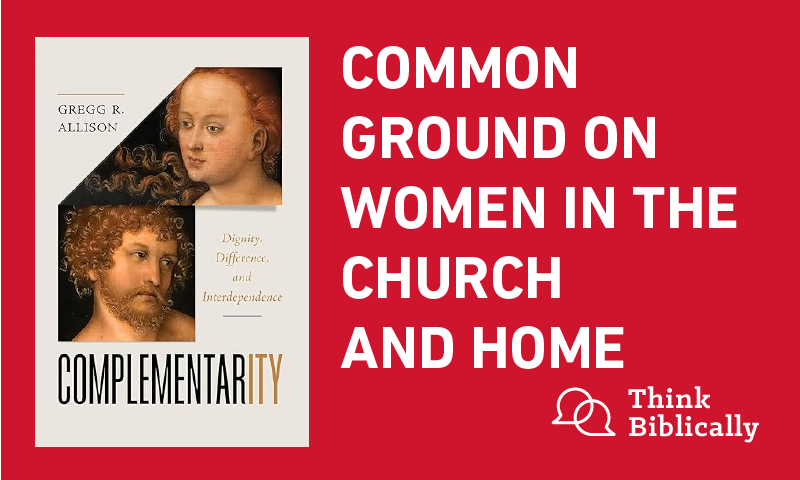
Is there a way to reconcile differences in the body of Christ over the role of women in the church and the home? In some ways, this issue is tearing the church apart, and our guest on this episode has a unique proposal of how the church can move forward with unity on this topic amidst significant differences. Professor Gregg Allison is the author of a new book, Complementarity and he is here to talk about complementarianism, egalitarianism, and how to find common ground in the church.
Episode Transcript
Sean McDowell: [upbeat music] Is there a way to reconcile differences in the body of Christ over the role of women in the church and the role of women in the home? In some ways, this issue is tearing apart the global church, and our guest today, Dr. Greg Allison, has a unique proposal of how the church can move forward with unity on this topic amidst significant differences. Southern Baptist Theological Seminary professor Greg Allison is the author of the book Complementarity, and he is here to talk about it. I'm your host, Sean McDowell.
Scott Rae: I'm your co-host, Scott Rae.
Sean McDowell: This is an episode of the podcast Think Biblically, brought to you by Talbot School of Theology, Biola University. Greg, thanks for coming on.
Gregg Allison: Thank you so much for hosting me, Scott and Sean. Pleasure to be with you.
Sean McDowell: Absolutely. Well, I just wanna start with the question we typically start with, 'cause it's always interesting, it's just the backstory. Like, what motivated you to write a book? And this is a lengthy book that strives for unity amongst Christians, despite vast differences,
Scott Rae: About 510 pages.
Sean McDowell: It's 510 pages! About the role of men-
Gregg Allison: Compliment-
Sean McDowell: ... Women in the church-
Gregg Allison: Compliment [laughing]
Sean McDowell: ... And the home. [laughing]
Gregg Allison: What motivated me, the scriptural emphasis on matters like love and unity, mutual respect. Just from Romans 12, a couple of verses, "Let love be genuine, love one another with brotherly affection, outdo one another in showing honor- ... Live in harmony with one another." These passages gripped me and caused me to r- really think about the disaster that we're in. You even mentioned it in the intro, and these warring parties in the church over men and women's issues. I hear complementarians charging egalitarians with giving up on inerrancy- ... And being on a slippery slope toward the LGBTQ agenda. I hear egalitarians charging complementarians with fostering, sexual abuse and misogyny, and this cancel culture deeps- deeply, concerns me, and it clashes with Scripture's emphasis on love and unity and respect. This brought forth, then, this book.
Sean McDowell: All right,
Gregg Allison: So... Okay, go ahead. I, yeah.
Sean McDowell: Let me follow up with this one, Scott.
Gregg Allison: No, I got it. I got it.
Sean McDowell: Before, before we jump into the particulars of your book, why is this an issue we should have unity over? You mentioned that there's the topic of, like, same-sex marriage. You know, some people are saying that egalitarians are giving up inerrancy and caving on that issue. You would consider that an issue we should divide over, presumably.
Gregg Allison: Yes.
Sean McDowell: Why is this issue, even though it's tied to creation, one we should still strive for unity over?
Gregg Allison: Well, I'm not encouraging waffling on our positions or compromising where we should not compromise. But even as we hold difference in these views on men and women in the church and in the home, we still have to show, mutual respect for one another and be able to dialogue as brothers and sisters in Christ who are united with Him, and we will live one- with one another for all eternity. We have to learn how to, negotiate our differences and instill an atmosphere of loving you.
Scott Rae: All right, so Greg, let's, let's, as Sean mentioned in the introduction to this, let's define our terms. You know, there's three terms here that need definition: a complementarian, an egalitarian, and then your term of complementarity. So let's, let's do them in that order, if you would.
Gregg Allison: So complementarianism is a framework for roles between men and women, primarily in the home and in the church. Some complementarians would add also in society. That framework is men are to lead, they're the heads of the home, they're to be the elders, pastors in churches, and women are not, allowed to take that leadership role in the home or in the church. Egalitarianism is a framework for roles of men and women in the church and the home, but emphasizes that men and women are equal, not only in nature, but also in roles and functions, so that in the home, husbands submit to wives submit to husbands. In the church, all offices, like pastor, elder, are off- are open to both men and women. So those two are frameworks for roles and functions. I define complementarity as God's design for His male image-bearers and female image-bearers to fill out and mutually support one another, relationally, familially, so in the home, vocationally, at our work, and ecclesially, ecclesiastically, in our churches, for, edification, for flourishing, both individually, as individuals, as well as for, corporate entities, like the church. And so I see complementarity as the foundation for these other frameworks, 'cause the foundation has to do with the essence of men, the essence of women, and their relationships, before we even engage in talking about functions and roles.
Scott Rae: Okay, so your term complementarity is not actually a third alternative that's different from these other two, but more-
Gregg Allison: It is not
Scott Rae: ... A foundat- a foundational way-... That you approach the debate, but you still have to make a choice, biblically and theologically, about complementarianism or egalitarianism. Is that what I-
Gregg Allison: E-
Scott Rae: I'm representing that correctly?
Gregg Allison: Exactly. Yes, I'm not offering a third way approach, another framework somehow in the middle between complementarianism and egalitarianism. I'm not attempting to do that. Perhaps the word complementarity in the title doesn't help people understand I'm not doing complementarianism. So I'm not offering a third way, but I'm trying to say there's a foundational matter that perhaps in the emphasis on functions and roles, we've missed the reality of God's call upon men and women, again, to love one another, respect one another, outdo one another in showing honor, and be united, right? That, that's the foundational matter. What I'm trying to do, to use the, 30,000-foot view illustration that Sean talked about, I'm, I'm trying to have a- fly in a plane 30,000 feet above the conflict and say, "There's this beautiful, biblical, theologically grounded vision of complementarity between men and women, and we need to stay in the plane at this 30,000-foot level, absorb that, be thrilled with God's vision for us, before we land the plane and then get into the very practical and important matters of roles and functions."
Sean McDowell: Okay, so one thing you do in your book we won't get into here is that there's even, like, different layers within complementarianism and egalitarianism, like minimal and maximal. Like, people are saying, "Okay, a woman could be a pastor, but maybe not a senior pastor. She could teach, but not doctrine." Like, that's where the, you know, the devil's in the details, so to speak. You're not landing those questions. You have kind of a higher question you're asking. So if I understand correctly, if we figure out first complementarity, then as you see it, could somebody be an egalitarian and have a church and a home that still flourishes within an egalitarian model, but embracing what you're claiming is biblical in complementarity?
Gregg Allison: Yes. I think both complementarianism and egalitarianism can thoroughly agree on my offering of a foundation that I call complementarity.
Sean McDowell: Okay. All right.
Gregg Allison: I hope they can. Yep.
Scott Rae: Okay.
Sean McDowell: Okay.
Scott Rae: So Greg, let's, let's go back historically a bit. Has there been a dominant view of the role of women in the church and in the home throughout church history? And maybe give a couple of examples of who might have held this... If there is a dominant view, who might have held this dominant view, or who was influential in making it the dominant view?
Gregg Allison: So I interact with a very important conversation partner, Sister Prudence Allen, who does a three-volume work on the concept of woman, and she identifies the dominant, the most influential view of women, as she calls it, traditional sex polarity. That is, men are superior and women are inferior. Traces it all the way back to Aristotle, who held that women are essentially defective men, because men are hot and women are cold, men are aggressive, women are passive, men contribute everything to sexual reproduction, women don't have any role. So it's, it's this notion of the superiority of men over women, who are nothing more than defective men. This traditional sex polarity has also been highly influential, tragically so, in the church, such that a person like Augustine, turning to 1 Corinthians 11:7, talking about men and women in the image of God, Augustine would maintain that only man is in the image of God.
Sean McDowell: Wow!
Gregg Allison: And looking at Genesis 2:18, the helper, which is the title given for Eve, the woman, the helper means that the woman is not the image of God. And then you've got Thomas Aquinas talking about men being more perfect reflections of the image of God.
Sean McDowell: Right.
Gregg Allison: And in sexual reproduction, men provide the soul, right, the most important part of the child, women just provide the body. And, and men are characterized by reason and the cardinal virtues of wisdom and rationality and things like that, and men rule and act in public. Women's role is basically to obey and act in, private matters. And so this has been the traditional view of the church, of male superiority and female inferiority, and I think it's only becoming more evident, in the last 40 or 50 years. And my thesis would be that that disparity between men and women still impacts the church, very influentially today.
Sean McDowell: That's, that's such a tragedy to hear that. And, you know, someone like Augustine and Aquinas to hold these clearly unbiblical views show that they were influenced far more by the culture of their day than the scriptures. I think Genesis, the creation account of women, men and women clearly in the image of God, it's just... It's inexcusable that a worldview like Christianity, the Judeo-Christian tradition, has the resources to fully value women as image-bearers, has failed to do that throughout history. I think we gotta call attention to that, and yet you say our concern now is that this still remains.... Now, we're gonna come back to some of what it looks like to flourish, in the way God designed us to. But one of the sections I enjoyed most [chuckles] in your book is, you talk about some of the hermeneutical and cultural assumptions that shape how people read the biblical text, and thus come to different conclusions about egalitarianism and complementarianism. People can go to your chapter and get all the details, but what's maybe one or two, kind of a couple, different cultural hum- hermeneutical assumptions that often play out in how somebody lands this issue?
Gregg Allison: Yeah, the issue here is how, we approach scripture. What is our pre-understanding of these key issues, even before we read scripture? So what's our pre-understanding of gender, how men and women relate- church leadership, roles of men and women? As someone has said, "If we approach scripture with a complementarian framework, we're going to find complementarianism. If we approach scripture with more an egalitarian framework, we're going to find egalitarianism there." So a lot has to do with the pre-understanding, what we come to the text, our views on gender, leadership roles, and all like that, before we ever read the text. That would be one major hermeneutical, issue here.
Scott Rae: All right, I think we can go... Let's- shall we go to the biblical text?
Sean McDowell: Yeah, let's do it.
Scott Rae: And have, and have a few, just have a... Just, I think, Greg, just a brief e- excursus on some of the central passages in the scripture that speak to this. Now, the f- the first one of these would be, I think, appropriate to start from the very beginning, because egalitarians and complementarians view Genesis 1 to 3 quite differently in their understanding of creation and the, and how the Fall affected the roles between men and women. So just, b- can you briefly summarize the way egalitarians and complementarians read Genesis 1 to 3? Although I will say that-
Gregg Allison: Let's-
Scott Rae: ... That chapter was probably 100 pages of your book. [laughing]
Sean McDowell: [laughing]
Gregg Allison: It, it is, yes. [chuckles]
Scott Rae: [chuckles]
Gregg Allison: So let's just start with, one of the key texts, Genesis 1:26 to, 26 to 28. Do we, read the passage as saying, "God created man in His image," and that word "man" then would have some kind of emphasis on male headship and leadership within humankind? Or do we read it, "God created humanity," or, "God created humankind in His image," with then equality between men and women emphasized? There's two different types of image-bearers, but they are equal in terms of dignity and essence and significance. So even the way we start with Genesis 1:26 to 28 impacts us. Genesis 2, another issue, is Adam the first man? Which means there should be male headship and leadership of men over all women, and then Eve then is the first woman, and she represents all women who should submit to all men. Or in Genesis 2, is Adam the first husband, with male headship or leadership reserved for his wife, who is Eve, who is the first wife there? So how we read Genesis 2, is Adam first man or first husband, Eve is first woman, first wife, that impacts this. So those are just two examples. And then in terms of the Fall, Genesis 3, was Adam's main sin failure to protect his wife, Eve, from the machinations of the evil one, and therefore, he caused her, in a sense, or, prompted an environment in which she was not protected, and therefore created an environment in which she would fall? Or is that not even an issue here in Genesis 3, which seems to emphasize sin as the eating of the fruit? Complementarians and egalitarians will read that differently. The, the whole idea of Adam f- being created first and Eve being inc- created second, after Adam, is this an order that has importance for headship and submission, or is this simply just a sequence that the Bible lays out? These are just a couple of examples from the first chapters of Genesis.
Sean McDowell: God, that's so interesting, and you go back and forth and really lay out what's at stake here. And you're right with, like, the sequence. I've often made the point when people say, you know, "The Bible is anti-women and doesn't hold up the value of women," it's like, God doesn't stop the creation account until he makes the woman and says, "Okay, I'm done." It's as if there's kind of a climax in the creation account, the human beings and then the woman, you could say gives more value to the woman, at least arguably. But that's where these discussions go back and forth. How do we interpret the Fall? How do we interpret the creation order? So there's a lot more at stake here than people thinking it's just simply settled by pointing to one verse.
Gregg Allison: Absolutely.
Sean McDowell: Now, now maybe tell us, what does, what does Jesus add? And one of the differences, obviously, between Paul's writings, which we'll get to, is Paul's writing to Christian churches who are dealing with doctrine and practical [chuckles] issues in the church. Jesus is like an itinerant preacher and prophet, and so approaches things differently. But what can we draw, you think, if anything, from his engagement with men and women in the Gospels?
Gregg Allison: ... I look at tons of passages, Jesus' interaction with male characters, Jesus' interaction with female characters. I find it a fascinating study. I conclude that Jesus was sent on a mission of compassion and salvation from God the Father. And that mission includes both sexes, reaching out equally to men and women. To reach women, though, Jesus had to challenge insidious taboos, like men should never talk to women- ... Men should never touch women. Jesus, challenged, attacked all those taboos and refused to let those taboos interfere with his mission that the Father sent him. And so we see Jesus in relationships with women. He had male and female disciples, and what we draw from the Gospels, both male and female disciples exhibit strong faith, even in the midst of opposition, even in the midst of death, believing Jesus's promise to resurrect. We see men and women disciples equally sharing the Gospel, engaging in service, expressing joy and gratitude, thanksgiving, obedience in following Jesus. They become models for us, both men and women. Both women and men become models for all men and all women who follow Jesus in these virtues, in these, steps of faith and obedience.
Sean McDowell: Greg, a couple years ago, my wife and I attended a church that we had never been to before, and a young woman got up at, in the middle of the service to read Scripture. And it was a Scripture that the pastor would be preaching on, it was just, you know, the public reading of Scripture. And right as she was getting ready to finish, an older gentleman in the back stood up and said at the top of his voice, "You know, women should be silent in all the churches," quote, quoting from 1 Timothy 2:11-14. And I know there's, there's, there's some difference, between how egalitarians, complementarians take that text, but also in 1 Corinthians 11, where Paul seems to say to Timothy, "Women are to be silent in the churches," but in 1 Corinthians 11, women are at le- at the least allowed and encouraged to pray and to prophesy in the church. So, help us fit these two passages together, and maybe how, k- how both sides of this debate read those.
Gregg Allison: Sure. Let's go to 1 Corinthians 11. In verse 5 and 6, Paul does emphasize that both men and women alike are praying and prophesying in the church, and I think most of us would take that to mean in the public assembly. So I think we understand what prayer is, so we appreciate the fact that men and women in our worship services should be praying, and the whole idea of prophecy, maybe we can say whatever prophecy is, at least can't we say that women would be encouraged to read Scripture publicly, in the church service? So with all due respect to that story that you told-
Sean McDowell: [chuckles]
Gregg Allison: ... I would, object to him standing up and saying, "Women should be silent in the churches." Paul is not going to contradict himself. 1 Corinthians 11, he's giving instructions about men and women praying and prophesying in the church. 1 Corinthians 14, then he talks about women being silent in the church. I think that's a very restrictive realm of silence, probably just referring to the, evaluation of prophecy. But assuming Paul does not contradict himself, Paul is emphasizing these, equal roles, responsibilities of men and women praying and prophesying in the church. But it's interesting, too, for complementarity, he gives women instructions about head coverings. He also gives men instructions, "Don't cover your head." Whatever that application today is, I think we can draw this lesson: There needs to be a clear distinction between men and women, between the sexes, and so complementarity emphasizes dignity, difference, and interdependence. It's important for us as we talk about relationships of men and women and their equal dignity being created in the image of God, that we also emphasize the divine design of differentiation between men and women. That's a God-given gift. That's by His design, and so we should embrace that.
Sean McDowell: That, that's a really important point to emphasize, 'cause when there's differences on issues in the Church, as significant as the role of women in the Church and in the home, the question is, where can we agree to disagree? And where are some of these essential points that we cannot compromise?
Gregg Allison: Yes.
Sean McDowell: And in our culture, there's no understanding that complementarianism that says men and women have different roles and yet are equal and have the same value, like, that's lost on our culture, obviously. But our culture is also moving towards saying, well... And so that's an area that I, as a complementarian, I know obviously, Scott, you are, you are as well, Greg, we would just say, "No, we have a different view of what it means to treat people equally and be obedient to Christ, and we'll not take our cues from Scripture." Here, you're saying, even with egalitarians, Scripture is very clear, and science would be as well, that there's such a thing as a man and a woman, and they're distinct. So even if 1 Corinthians 11 is giving a kind of a cultural-bound way of expressing that, it still recognizes the distinction of men and women and says they're oc- supposed to operate according to that. Would you agree with that?
Gregg Allison: Absolutely.
Sean McDowell: Is that the principle that you're drawing out?
Gregg Allison: ... Yeah, absolutely. I mean, it goes w- all the way back to Genesis 1. God creates man in his image, or humankind in his image. He creates them male and female. From the very beginning, God's creational design is that there be one broad category, an umbrella category, called humanity or humankind, and there are two types. There are male image-bearers, female image-bearers. This is by God's design from the very beginning. We see it emphasized also in Scripture, just what we talked about in 1 Corinthians chapter 11. Even in praying and prophesying in the church, there should be a clear distinction. We see it in, rules and regulations regarding men and women's clothing, and things like that, and it really then, this, what we're talking about, really grounds any kind of discussion that we would have today in terms of transgenderism and uni-genderism, right? We've got a biblical and theological foundation to approach these important moral and social issues. I'm not saying it makes the discussions any easier, but it does give us a foundation from which to approach these matters.
Scott Rae: That's really helpful, Greg. Let me, let me ask one final question here. You spent a lot of time developing this foundation of complementarity. How does, how does it help individuals and families to flourish in the church and in the home?
Gregg Allison: Yeah, let's start with, how does complementarity help flourishing in the church? Couple things. Alice Matthew, in her book on Paul's greetings in Romans 16, talks about love, Pauline love mutualism must characterize church members. Again, as I began, it means we need to love one another authentically and reciprocally as brothers and sisters in the church. We need to almost compete in trying to outdo one another in showing honor to one another, or to favor one another in terms of respect and caring for one another, or to support and prioritize, sacrifice for one another. Complementarity emphasizes these matters, and that should characterize the church. And in terms of the church's mission, the Great Commission demands engagement of all men and all women in the church. It's not reserved for just a few, but all men and all women. The use of spiritual gifts, on the part of both men and women, and I'm talking about offices here, just talking about spiritual gifts. We need both men and women exercising their gifts for the maturation and the multiplication of the body. So complementarity helps us understand how to flourish in the church. In terms of the home, complementarity emphasizes the sacredness of fatherhood and motherhood, and emphasizes churches that need to support their members in terms of families. For example, offering financial assistance if a couple wants to adopt. In the home, complementarity would denounce the common mockery of families in general, and motherhood in particular, right? In, in the home, we should value our families and emphasize both motherhood and fatherhood. I'm just emphasizing here motherhood, which is coming under extreme attack. And then also, this toxic masculinity, so much mockery made of that. We denounce that as well, but complementarity says, "But there's a beauty in what men are and how they act." And not to overlook our single and celibate, audience, there's also, according to complementarity, a sacredness of celibacy and the call to singleness. We don't see singles as broken or lesser men or lesser women, that we need to fix them, and the only way we can fix them is to get them married. We should encourage, singles, those who are celibate, to pursue the telos, the goal, the purpose that Christ has given them, full conformity to the image of Christ. Complementarity emphasizes that for the home in terms of, motherhood, fatherhood, families, as well as our single brothers and sisters.
Sean McDowell: Greg, this is a provocative and thoughtful thesis that you're putting forward in our age of division and difference, where we tend to focus on what we don't have in common, which, in the case of complementarianism and egalitarianism, there are certain irreconcilable differences, at least practically, how a church functions, where people are gonna have to land.
Gregg Allison: Yes.
Sean McDowell: But what you're appealing to, saying, "You know what? We have far more in common about the spiritual gifts that we have, about the gospel, about the commitment to the value of men and women," that certainly sets us apart from the past, when some of the great Christian thinkers you cited just failed to see that and appreciate the role of women. So I hope people read this. I hope they'll think about it, and I hope you really spur a lot of conversation of how we can find unity across these differences that are significant today. Greg Allison, again, the author of a book... And we like to let people know what they're getting their hands into. This is a very readable book, Greg, but it's 500 pages. People are [chuckles] gonna dive in and do some theological work on the history of the church, some of these biblical passages, your principles moving forward. So if people go, "You know what? I am spurred on by this conversation, and I wanna go deeper and figure out what complementarity is," pick up a copy of Complementarity by our guest today, Greg Allison. Greg, thanks for coming on. This has been fun.
Gregg Allison: Thanks. For me as well, thank you, and a pleasure talking with you.
Sean McDowell: This has been an episode of the podcast Think Biblically: Conversations on Faith and Culture. The Think Biblically podcast is brought to you by Talbot School of Theology at Biola University, and we have programs online and here in Southern California, including masters in apologetics, spiritual formation. We have a fully online, you know this of course, Scott, bachelor's degree in Bible, theology, and apologetics, in which some of my courses are a part of that, interestingly enough, and a bunch of other bachelor's and master's programs we hope you'll consider checking out. We'd love to hear your comments or, really engage your questions. You can send them in to thinkbiblically@biola.edu. Please consider giving us a rating on your podcast app. Seriously, every rating helps. And consider sharing this with a friend. Thanks for listening, and remember to think biblically about everything. [upbeat music]