Biola University
.jpg)
Years before his passing in August 2025, former Biola Chief of Campus Safety John Ojeisekhoba, affectionately known as “Chief O,” envisioned a drone that could help officers survey hard-to-reach areas of campus. Beginning in the Fall of 2026, four Biola engineering students made Ojeisekhoba’s vision a reality in Spring 2026, honoring his legacy by naming the drone ‘The O Drone.’
Interested in conducting campus security drills on Biola’s campus in partnership with the U.S. Department of Homeland Security, Ojeisekhoba approached Dr. Yohan Lee, associate dean of technology in the School of Science, Technology and Health, with a request for a drone to help his team monitor and assess all corners of campus.
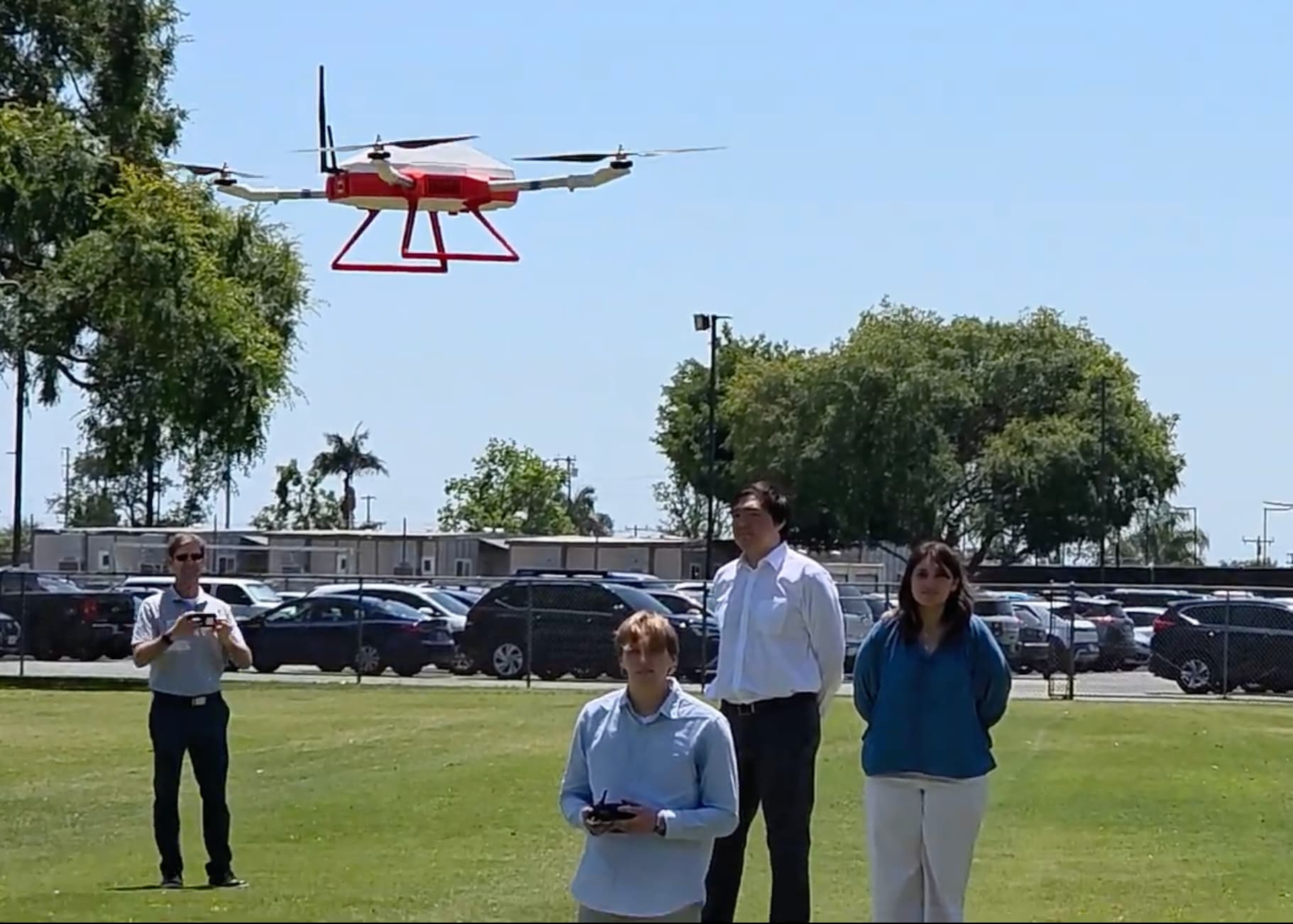
The drone was created to fulfill the students’ Senior Engineering Design Capstone course, where projects are team-based and require significant documentation and oral and written communication. The students designed the drone to be multi-use, not only for campus safety efforts but also for filming or drone shows. Engineering majors Enqi Chen (B.S. ’26), Jordyn Fazekas (B.S. ’26), Nathan Griffin (B.S. ’26) and Tyler Hill collaborated with faculty members Lee and Todd Curtis, associate professor of engineering, to complete the project.
“Since the number of attendees would double our student body during premier events open to the public, [Chief Ojeisekhoba] needed a way to scale inexpensively and be able to respond within minutes to any point of our campus or our perimeter during these events,” said Lee. “This is when he asked if we could build our own drones equipped with night vision capabilities. This was the genesis of the 2025-26 Engineering Capstone team's requirements and design.”
The students retained complete autonomy over the project. Labs in the technology division are furnished with equipment for students to develop machinery like drones, including 3D printers, printed circuit board instruments, and machining tools, giving students hands-on design, fabrication and shop experience as part of their course.
“Our drone was designed entirely by our team, using parts manufactured in-house as well as purchasing off-the-shelf components such as motors, batteries, electronics and propellers,” said Fazekas, who was also a member of the Torrey Honors College. “There was a lot of trial and error, especially in the later stages of development and testing, but overall it was a pretty smooth process that taught us all a lot about project management and communication, as well as managing realistic expectations. It was a real blessing to be able to see our drawings come to life and literally take flight within nine months.”
The students designed the prototype to be a versatile piece of equipment.
“The O Drone is a heavy-duty drone with a swappable payload capability. For whatever needs the user may have, the user may swap out different payloads (overhead lighting system, thermal camera, etc.). Our first client was Yohan Lee and our Campus Safety team, with the use case being surveying hard-to-reach spots on campus — a drone piloted from the Campus Safety office,” said Fazekas.
Since seeing the completed prototype, Southern California defense startups have expressed interest in Biola becoming a local production manufacturer for some of their equipment. The United States Air Force and its UAS (Unmanned Aircraft System) programs have shown interest in whether Biola could expand the drone’s total components to be designed and built in-house for other drone vendors.
Biola's Division of Technology equips students to design, build and lead with world-class excellence and Christian conviction. Students who bring bold curiosity and a drive to make technology more human find their place at Biola.io, the technology division in the School of Science, Technology and Health. Applications for Fall 2027 are open. Learn more and apply today.
Written by Sarah Dougher, strategic communication manager. For more information, email beacon@biola.edu.

.jpg)