Biola University
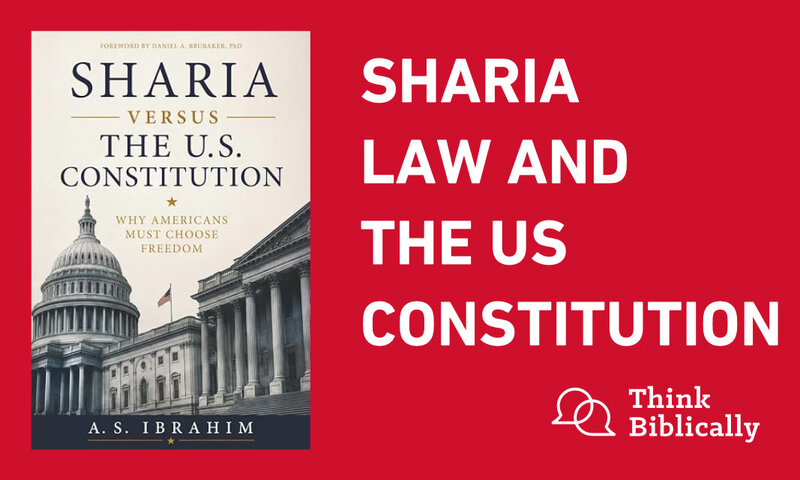
Should Christians be concerned about Sharia law being implemented in the US What is Sharia Law, and is it compatible with the U.S. Constitution? Sean and Scott are shared by Dr. A.S. Ibrahim to discuss his latest book Sharia Versus the U.S. Constitution. Dr. Ibrahim grew up in Egypt, and has two doctorates in Islam, and so he has a unique perspective to speak on this topic.
Episode Transcript
Sean McDowell: [upbeat music] What is Sharia law, and what are some common misconceptions about it? Is Sharia law consistent with democracy? How concerned should Christians be about the advancement of Sharia law in the US and beyond? These are some of the questions we're going to explore today with our guest, Ayman Ibrahim, author of Sharia versus the US Constitution. I'm your host, Sean McDowell.
Scott Rae: I'm your co-host, Scott Rae.
Sean McDowell: And this is Think Biblically from Talbot School of Theology, Biola University. Ibrahim, we had you on campus not long ago, but thank you for joining us by distance to talk about your fascinating new book.
Ayman Ibrahim: I am honored to be with you. I look forward to this conversation.
Sean McDowell: You've written a bunch of books on Islam. First, what got you interested in Islamic theology, history, and now law?
Ayman Ibrahim: Basically, I was born and raised in Egypt. It's, a Muslim majority country. I have tons of friends, all are Muslims. And, then, as a preacher in Egypt in different churches, I wanted to study, more theology, based on my encounters with Muslims. I wanted to do best apologetics ever. So I came to the United States to study theology, and that led me to focus more on the wealth of primary Muslim sources I have access to. And then I discovered, oh, I love that very much, these texts. I want to examine them more. I did one PhD focused on Islamic history, and then another PhD also focused on Islamic history, and that became my career. I write a lot. I engage tons of conversations, and that's how I end up being, interested in Islamic texts, history, and, theology.
Scott Rae: So tell us a little bit how your growing up in Egypt, impacted your view of Sharia law and the contrast between Sharia law and democracy.
Ayman Ibrahim: Excellent question. Egypt, if you look at Egypt now, you will, you will sense that it is very strong Muslim country. Most women in the streets are veiled, and there is a lot of,
Ayman Ibrahim: happenings that show that this is very Islamic nation, and this is precisely what, the context I grew up in. Now, Egypt was not that that way for many years. In fact, my mother and father used to tell me that Egypt was very sort of modern French or, British. But in the late '70s and '80s and '90s, there was a growing, influence of what I call political Islam, and that was the time I grew up in. And when I moved to America, I began to notice some similarities of what I saw in Egypt. So I would say that what prompted me to write this book is growing concern of what I've been seeing in the United States and how I felt that what's happening in the United States now is more like what I recognized in my years growing up in Egypt when the influence of political Islam was growing.
Sean McDowell: This is really helpful. We're gonna get to more of the specifics of some of your concerns of what you're seeing. But maybe we could take a step back and just describe what is Sharia, and what are some common misconceptions that presumably non-Muslims have about it?
Ayman Ibrahim: Very good question. The word Sharia is basically in Arabic mean, the word means straight path. So Sharia is the straight path that Allah has prescribed to Muslims and non-Muslims. So this is what Islamic, the Islamic understanding. So it is the straight path for humanity to follow after God or the deity of Islam. This is the path of divine guidance as revealed in the Quran, the scripture of Islam, and implemented in Muhammad's example. So that's Sharia, and we need to be careful here because Sharia is not basically something related to your heart, your worship. It governs everything. It governs Muslims and non-Muslims. It governs, prayer, worship, and criminal punishment. It governs marriage and war, warfare. It governs, personal piety and legal status of non-Muslims. It has all the views that Muslims consider as the the laws dictated by the divine for humans to follow and for Muslims to apply, whether they are in Muslim land or in non-Muslim land.
Sean McDowell: Now, if I may really quickly as a follow-up, you went out of your way to say Sharia is not just what's in your heart, but applies to law and government and society. Why did you make that distinction, and maybe expound on that a little bit for clarity?
Ayman Ibrahim: Because there is a lot of misconceptions around this topic, and there is many, especially I hear that discussion on the left, pretty like, common that, "Oh, man, Sharia is just personal piety, like keeping kosher." wrong. Or another misconception, Sharia is, so diverse and subject to endless interpretations.
Ayman Ibrahim: Wrong. Only extremists apply Sharia. No. Sharia is both the heart of a Muslim to follow Allah's law in very, devoted way about prayer, giving alms, fasting, going to do pilgrimage, and what will happen if a Muslim leaves Islam, what would happen if a Christian, critiques Muhammad, what would happen if, a woman needs a divorce. There is all these laws that govern everything for the Muslim to live according to Allah's law, and it is written in a way that is, applied and implemented in the life of Muhammad, the the sacred figure in Islam, so to speak.
Scott Rae: Now, Ayman, you also make a distinction in the book between Muslims and I think what you call is Islamists.
Ayman Ibrahim: Yeah.
Scott Rae: And I take it that in the United States there are lots of moderate Muslims-
Ayman Ibrahim: Yeah
Scott Rae: ... Who do not have what what you would call an Islamist agenda. Tell us a little bit more about that distinction.
Ayman Ibrahim: Very true. Scott, people, like Muslims are like any other religious groups. You will find cultural Muslims, you will find some devoted religious Muslims who want just to apply Islam and live and let people live, and you will find extremists also. So, I am not concerned in this book with Muslims. These are human beings. They want to pray, fast, and live their personal lives according to Islamic teaching as they understand it. But there is a dimension, and there is a disposition under the umbrella of Islam that is called political Islam or Islamism. This Islamism is a disposition that wants to take Islam outside of the worship and the devotion of the heart into applying rules and laws in the public sphere. In this Islamism, Islam is not only a religion. It is a religion and the state. It is worship and politics. It is the political ideology that takes Sharia, Allah's laws, out of the mosque and want to implement it in the courthouse. This is what we are talking about here. And honestly, I don't know the percentage of how many Muslims are Islamists or not, but if you really want to follow Sharia as written and as applied over, let's say, 12, 14 centuries of Islam, you will end up with, pretty,
Ayman Ibrahim: difficult actions that, in essence, contradict the US Constitution, and this is my book.
Sean McDowell: Oh, I thought you had a follow-up, Scott. [laughs]
Scott Rae: No.
Sean McDowell: He pointed at me. That's funny. We've done this years, and now and then we'll see things differently. Okay, so you write this in your book specifically. You said, "What I began to see in America filled me with a dread I recognized immediately because I had felt it before."
Ayman Ibrahim: Yes.
Sean McDowell: Now, that sounds pretty dramatic.
Ayman Ibrahim: [laughs]
Sean McDowell: Give us some of the specifics of what you saw and why your reaction was so visceral.
Ayman Ibrahim: So I moved to America in 2007, so I've been here for, like, 19 years or so, and during this time I saw a growing influence of what I see as political Islam. You see Muslim Brotherhood affiliated organizations, no need to name any, operating as sophisticated political advocacy groups, and they are proud of, "Oh, we, have elected 82 politicians in the United States in recent elections." What is that? These Islamists are very serious about influencing politics. I saw Gulf State money coming, buying, endowed chairs in universities, funding university chairs, academic programs. I saw Islamist organizations acquiring all the churches and proudly were turning it into mosques. For an American, what is your problem, guys? Just a mosque or a church, what is the problem? This is for our Western mindset, but for the Islamist perspective and for the Islamist worldview, this is hegemony. Islam is advancing. Look at New York recently. Corporate Ramadan prayer. Ramadan is the holiest month of Muslims, and you find people coming, flooding major squares in New York. Why? They want to pray outside in the streets. Wait a minute. You have 200 mosques in New York and more, and it is freezing cold in January.
Sean McDowell: [laughs]
Ayman Ibrahim: Yeah. So why are they outside? Declaration of hegemony. This is the political, trends that I saw happening in America that made me concerns, and that's why my concern level is high as a Christian living in America. And I wanted to tell people, maybe we need to speak about this, maybe we need to have good conversations. Maybe we need to ask those Muslims why you're doing this, and what are your goals, and listen from them what are the, like, outcomes they are pursuing, you know? So ...
Scott Rae: So let's be a little clearer. The lion's share of the book is about how Sharia law is inconsistent with some of the key elements of democracy. Give us a handful of examples of where you see some of these inconsistencies.
Ayman Ibrahim: For example, apostasy. In America, you have freedom to, change religion. Under Sharia, you can't.
Ayman Ibrahim: In America, you can critique, evaluate any ideology. Under Sharia, you can't. Look at what's happening in Pakistan. In America, you can critique any figure. Under Sharia, there are limits. You cannot insult Muhammad. You cannot, question the Quran's reliability, and so forth. I can go forward, but I think that is the brief answer, and we can unpack later.
Sean McDowell: Okay, so the the clear point is that, like, the US Constitution, First Amendment, "Congress shall make no law respecting an establishment of religion, or prohibiting the free exercise thereof," and of course, speech, press, and so on. That's a freedom built into the Constitution of the United States. You're saying that's inconsistent with Sharia law, which does not give somebody the right, whether born that way or not, to abandon following Islam without some degree of punishment or repercussion. Is that a fair way to state it?
Ayman Ibrahim: 100%, you're right. And if you read the book, you will find major aspects of apostasy, with examples, how apostasy is a major deal in Islamic law, in Sharia, and once you abandon Islam, you are, by Muhammad's statement, you are to be executed. If you insult Muhammad, you are to be also treated in such ways, in, or in different manners, but it could end up with a death, especially if you are non-Muslim. So the answer short, the short answer is yes, you are right, Sean.
Sean McDowell: Can I, can I follow up really quickly?
Ayman Ibrahim: Go for it. Go for it.
Sean McDowell: Yeah, I apologize, Scott. This is important. I wanna, make sure our audience doesn't miss this. In John 18, Pilate asked Jesus, "Are you King of the Jews?" And he says, "Do you say this of your own accord, or did others set you up to it?" Pilate answered, "Am I a Jew? Your own nation and chief priests have delivered you over to me. What have you done?" Jesus says, "My kingdom is not of this world. If my kingdom were of this world, my servants would have been fighting." My kingdom is not of this world. It's a spiritual kingdom that affects the way we vote and pay taxes, Romans 13, Matthew 22.
Ayman Ibrahim: Yeah.
Sean McDowell: But it's not a military kingdom.
Ayman Ibrahim: Yeah.
Sean McDowell: It's not a political kingdom.
Ayman Ibrahim: Yes.
Sean McDowell: How does that relate or not relate to Islam and the role of Sharia law, contrasting that with what Jesus said?
Ayman Ibrahim: You are actually asking a very good question because it touches the heart of the debate.
Ayman Ibrahim: Muslims do not think of Muhammad as only a prophet. He was not only a prophet. He was a military commander. He was advancing. He was conquering. And these two are coming together. So for Muslims, they need to have the state, the politics, the ruling elite, and the worship in one sphere. Whereas in America, you're trying to distinguish between these two spheres. And that's why I would say that, if you're asking the straightforward question, is Sharia compatible with democracy, I would tell you, what is democracy again? Oh, yeah, we the people, somewhat, we the people. In Sharia, what Allah said, what Allah dictated, what Allah prescribed, and how Muhammad implemented this, as written in the tradition. So you have two completely different spheres here, and they are not really going to have, really any overlap here, so.
Scott Rae: Ayman, is this, is this what is meant by the concept you bring up, the concept of shirk, which you call the gravest sin-
Ayman Ibrahim: Very good
Scott Rae: ... In Islam?
Ayman Ibrahim: Yeah.
Scott Rae: How is, how is democracy an example of that, of the gravest sin?
Ayman Ibrahim: So the unforgivable sin in Islam is associating partners with the deity.
Ayman Ibrahim: So democracy, you are saying, "Hey, we can change laws." [laughs] "We can actually remove people and put politicians, and we can actually adjust our laws." This is blasphemy in Islam. This is shirk. Why? Because under Sharia, Allah said that you cannot change that. You cannot touch it. So this is how any hint of changing laws or modifying laws or tweaking laws is viewed as unacceptable in Islam, and they are by default shirk, because you are allowing humans to be partners in the discussion with what Allah dictated and wanted to prescribe.
Scott Rae: Okay, so, what does Sharia law tell us about equal rights for women and the status of women under Sharia?
Ayman Ibrahim: This is a very good question, and again, I wanna assure everybody that you can hear Muslims today say that, "Oh, men and women are equal, and, Allah treats every gender the same." But if you go to what is written in the, tradition of Islam, Muhammad told a group of women, "I have not seen anyone more deficient in intelligence and religion than you." And this is by the estimation of Muslim authorities an authentic tradition. Muhammad even explained here that a woman's testimony in court is worth half that of a man. So you see here how under Allah's law, under Sharia, there is a distinction here. A woman can hardly ask for a divorce. She can ask, but she is not really in control because the man controls everything. In fact, according to the Muslim tradition, Muhammad, clearly, I'm not talking about even the Quran. The Quran has other verses, but Muhammad was clear and stated that, "A people who place a woman in charge ruling of their affairs will never succeed." You see how under Islamic law, under how Muhammad practiced what is viewed as Allah's prescribed laws, distinguish between men and women. So how is this actually embedded in today's life? I would say in the testimony, a woman's testimony is not equal that, of that a man. Inheritance, she does not get the same. In marriage, she cannot divorce a man, except in very few instances and so forth, and authority and... Then finally, the physical discipline, and this is a very hard matter because the Quran actually dictates that a man can, I would say,
Ayman Ibrahim: physically discipline his
Scott Rae: Just say, just say it. [laughs]
Ayman Ibrahim: [laughs] Physically discipline his wife, his disobedient wife, by beating her and by forsaking her in bed and all this, and this is a very strong Quranic verse that modernist Muslims today are really wrestling with. I I value what they are trying to do. Some Muslim, women, Muslim feminist women are saying, "Oh, just don't think about this. Don't... Ignore it, or beat her lightly." I mean, you know. So as you read in the book, you will find a lot of discussion around this dissonance between men and women in terms of how Sharia is viewing both of them.
Sean McDowell: What are the main ways that Sharia is being, you know, spread in the US, if at all? In other words, there are certain Islamists, and presumably not most Muslims, at least in the States, you said, who are just trying to live their lives and have freedom-
Ayman Ibrahim: Right
Sean McDowell: ... And go to school and go on vacation, whatever.
Ayman Ibrahim: Sure.
Sean McDowell: But there's Islamists.
Ayman Ibrahim: Very true.
Sean McDowell: What are the main avenues they're using to advance this?
Ayman Ibrahim: That's a great question. I would say, briefly, political infiltration, supporting and electing Islamist, sympathetic candidates. Legal strategy, I would say also this is clear, using First Amendment protections to shield Islamist advocacy. So whenever you are questioning something that is related to Islam, "Oh, you're a bigot. You're Islamophobe." Okay, did you hear what I'm saying, actually? It's just the buzzwords that are thrown at you. Pushing for Sharia arbitration recognition in civil courts, and there is tons of things happening, like in Britain. I would also say, through academic influence, Sean. The Gulf states, Saudi Arabia are funding chair... Of course, you know from the, as you're teaching in a university, you need money to have momentum and offices and all this. So the Gulf states, especially Qatar and Saudi Arabia, come with huge fund, and hey, you know what? We are building this endowed chair, and the man who, or the one who pays, you know the rest of the saying. So they dictate the conversation. And I would also say, finally, the, cultural normalization of things, converting old church buildings into mosques, corporate public prayer outside, making Islamic scenes seem normal. If you are allowing this that much without checks and balances and without questioning, you're actually not knowing what you're bringing yourself into. We don't want to see what happened in Egypt back in the 70s, 80s, and 90s happen again elsewhere.
Scott Rae: Let me push back on that just a tad.
Ayman Ibrahim: Please.
Scott Rae: 'Cause I'm, 'cause I I suspect some of our listeners might be thinking at this point, "Well, you know, should I be, should I be afraid of my Muslim neighbors for the kind, the kinds of things that they might be advancing in terms of a political Islam?" I mean, I have, I have a, I have a lovely human being that lives across the street from me who is grew up in Lebanon, and I, you know, I have a friendship with him. I want to continue to develop that friendship with him. He's a wonderful man. He's an older gentleman. And he and his wife, they're both lovely people. And I I don't want our listeners to think that we ought, we need to be, we need to sort of live in fear of our, of our Muslim neighbors, because I know there are a lot of moderate Muslims for whom this, as you describe, it is just, it's just a matter of the heart. They have no political aspiration. They want to live in peace and are quite happy to live under democracy. So my question is, the
Ayman Ibrahim: Yeah
Scott Rae: ... In spite of the fact there there are, there are a lot of moderate Muslims, and we just, we don't know how many are intent on advancing a, an, a Sharia-
Ayman Ibrahim: Yes
Scott Rae: ... Agenda, what should our stance be toward our Muslim neighbors in light of that?
Ayman Ibrahim: I would... I wrote this book with total love for my Muslim neighbors. I am, I'm called by Jesus Christ, our Lord, to love my neighbors. And I don't... I have, actually, I have many friends, Mus- who are Muslims, and I would say don't be concerned with your Muslim neighbor. Actually, I would say, have a conversation with them.
Ayman Ibrahim: I would say begin with genuine relationship. Learn their name. Have a meal with them. Don't pretend theological differences do not exist. Distinguish always the person from the ideology. That's what I always say in my conversations. Ask questions rather than delivering lectures. Like, I am completely open to ask my Muslim friend, "Hey, what do you think of taking this, church and turning it into a mosque? What do you think of this, newly elected politician?" Share your own faith naturally. So I think this is my disposition, but at the same time, I would say vote for candidates who understand the distinction between protecting Muslims and inf- accommodating Islamism. I would also say support lawmakers who will scrutinize Gulf state funding education in America. We need that. Support lawmakers that maintain one law for all. We cannot have parallel, like, courts. Ask candidates directly, "What do you think of Sharia? What do you think of this item in Sharia? Why are you having this kind of double discourse? In closed rooms, you are talking about how Islam is superior and how Allah's law in that way or that way, and then outside you're claiming to be, 'Oh, I'm open, I am, neutral,' and all this." We need to ask these questions, you know? So.
Scott Rae: Here's my final question for you. I just wonder, how do you think we should look towards Sharia law as a whole? 'Cause I think there's some voices I've heard who are say things like, "Well, on a local level, a place like Dearborn, since there's majority Muslims or a lot of Muslims, it might be permissible in that arena, but just not on a national level." Others more of like, "No, we shouldn't allow the camel's nose in the door whatsoever, because that would have a domino type of effect." What's your take on that?
Ayman Ibrahim: We need one law for all, Sean. There is a difference between how individual Muslims choose to live and what classical Sharia actually dictates and requires. The question is not whether Muslim Americans can be good citizens. They can, and many are. The question is whether our political legal system in the United States can accept the Islamist infiltration and movements that are advancing as quietly as they can. They are not compatible with the Constitution, period.
Scott Rae: Very well said, and I think our, listeners would do well to pick up a copy of your book, Sharia vs. The US Constitution. This is not my specialty, but I was just surprised and amazed, and I learned a ton by reading it. Enthusiastically endorse it. I think it's a unique contribution. You have a unique voice growing up in Egypt, having two doctors tied to [laughs] Islamic law. I can't think of anybody else to write this. With the love for our Muslim neighbors, but concern about the US and beyond and for Christians, that comes through in this book. So, Aman, thoroughly enjoyed it. Thank you so much for coming back on.
Ayman Ibrahim: I'm really grateful for this opportunity. It has been a joy.
Scott Rae: This has been an episode of the podcast Think Biblically: Conversations on Faith and Culture. The Think Biblically podcast is brought to you by Talbot School of Theology at Biola University, where we have programs online and in person in Southern California and in Phoenix, including Masters in Christian Apologetics and Masters in Philosophy and New Testament and in all sorts of different disciplines. We would love to have you join us. To submit comments or ask questions, please send them to thinkbiblically@biola.edu. Please consider giving us a rating on your podcast app. Each one helps. We hope you'll maybe share this with a friend, and join us Friday for our weekly cultural update. In the meantime, remember to think biblically about everything. [outro music]