Biola University
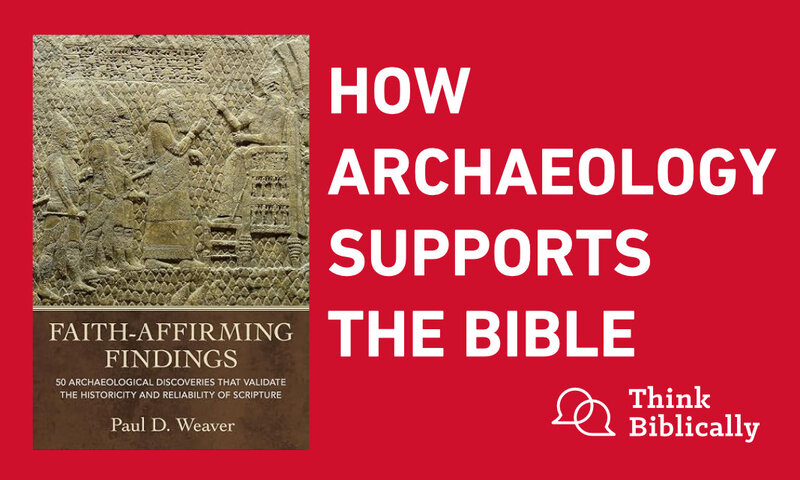
How should Christians think about the discipline of archaeology and how it intersects with our faith? What are the top archaeological discoveries that support the Bible? How do we best respond when a discovery seems to undermine the Christian faith? Our guest today, Dr. Paul Weaver, is the author of the new book Faith-Affirming Findings: 50 Archaeological Discoveries that Validate the Bible.
Prior to teaching at Dallas Theological Seminary, Dr. Weaver taught for eighteen years at the Word of Life Global Bible Institute. Thirteen of those years were on the Hungary campus and five years on the New York campus. In addition to his professorial responsibilities, Dr. Weaver also served in administrative roles (Academic Dean and Executive Dean). Dr. Weaver is passionate about teaching the Bible and training leaders for the church worldwide. He is also the host of the Bible and Theology Matters audio podcast and faith Affirming Findings video podcast. He is married to Jill, and they have a son and daughter.
Episode Transcript
Sean McDowell: [upbeat music] What does it mean to think biblically about archeology? What are some of the latest archeological discoveries that support the Bible? And how should Christians respond if the archeological data seems to be at odds with the biblical narrative? These are some of the questions we're going to explore today with our guest, Paul Weaver, author of the new book, Faith Affirming Findings. I'm your host, Sean McDowell.
Scott Rae: Your co-host, Scott Rae.
Sean McDowell: This is the Think Biblically podcast from Talbot School of Theology, Biola University. Paul, thanks for coming on.
Paul Weaver: It's great to be with you. Thanks for the invitation.
Sean McDowell: Yeah, absolutely. Let's jump right into your book, and I wanna know the backstory before we get into details of the book. What first interested you in studying archeology?
Paul Weaver: Well, I'd say my first interest began as a student here at Dallas Theological Seminary, where I now am a professor in the Bible Exposition department. So I had a course with Dr. Eugene Merrill, Old Testament backgrounds. He did a lot of archeological digs. Then the New Testament, backgrounds and customs was with Dr., Lowery, David Lowery, and so that really got my appetite wet for background and customs, and continued my studies, went overseas, for 13 years. While there, I had the privilege to, see a lot, most of the lands of the Bible, with the exception of, Nineveh and ancient Babylon for some obvious reasons there in modern-day, Iraq. So that kept my interest going, and I continued my PhD studies while, there in Hungary. And, one course I took was in the ... My program was biblical studies, but I, took a course in, a PhD level course in, biblical archeology. And then as I planned my dissertation phase, I wanted to help build this bridge. I saw a need between the commentaries and the realm of biblical studies, a chasm, I would say, between that-
Sean McDowell: Sure
Paul Weaver: ... And the realm of archeology. And so I wanted to help bro- bridge, the gap a little bit, and so my dissertation was on the archeology of Corinth and its, impact on 1 Corinthians. And so that got me into, spending time in Corinth, spending time in the American School of Classical Studies there, in their library there in Greece. And, then, I saw that meeting a need and wanted to continue that and help make this material available, 'cause there's 23 volumes on Corinth alone.
Sean McDowell: Amazing.
Paul Weaver: And so help make that accessible to the everyday person, regular pastor, teacher, and even my colleagues will, I hope, will use some of this content for their teaching classes.
Scott Rae: Yeah. Paul, I had such a good time reading your book because of the archeological discoveries that you mentioned. I've been to about a half a dozen of those, and walked through Hezekiah's tunnel and saw, you know, saw the Qumran caves and some of, some of these great sites that you, that you mention. The book contains 50 of these discoveries that, in your view, validate the historicity and reliability of the Bible. But if you had to estimate, how many total findings do you think there are, and why did you pick these top 50?
Paul Weaver: Yeah, I think this may be the hardest question, you give me all during this program, 'cause we don't like to be general, do we? We like specifics in, biblical and theological studies, archeology. But in the realm of biblical archeology, there are so many, right? Biblical sites alone, Nelson Glueck has been, who was a famous archeologist, has been attributed to him discovering 1,500 sites alone.
Scott Rae: Wow.
Paul Weaver: Right? So, you've got biblical sites, you've got biblical manuscripts, and, of course, as you both know, those, go into to the tens of thousands when you talk about the Old Testament and New Testament, because that fits the category of archeology. Then, of course, ancient artifacts number in the hundreds of thousands that relate in some way, pottery, inscriptions, architecture, coins, seals. So, but then I did focus in on the ones that are very clearly affirming a real person, a real event, a real thing recorded in Scripture. And so I wanted to nail down to the 50 most important that, I think every pastor, teacher, layperson should be aware of. And so I reached out to about 20 different archeologists and New and Old Testament Bible scholars and asked them, "Give me your top 50."
Scott Rae: Hm.
Paul Weaver: And so I, accumulated those to begin with, and I noticed that there was a lot of similarity in the top 40, if you will. And so that really affirmed the fact that these are indeed the ones that are the most important to discuss. Then from there, I did have four criteria that I wanted to use. First, these discoveries had to be do more than just give a better understanding of the cultural milieu, but actually, again, validate, affirm, corroborate a real person, a real event, a real place, a real object mentioned in Scripture. That's first. And then second, I wanted these discoveries to have a consensus, a strong consensus amongst conservative biblical archeologists and Bible scholars. I didn't wanna deal with any sensational ones that might lead people to discount the rest of the contents in the book, and so I didn't deal with some of those more, controversial ones that some people think are authentic, others inauthentic. Third, I wanted discoveries that would actually be useful to pastors and teachers to help their congregant members and their students to have a greater trust for the reliability and historicity of Scripture. And then fourth, I wanted to have an assortment of discoveries spanning the different eras And so I have, different sections. I have the pre-kingdom era. I discuss some discoveries from that period. And then the second section is the kingdom era, which would be the united kingdom and divided kingdom. Then a section on the exilic period, then the time of Jesus, and then finally the period of the apostles.
Sean McDowell: This is really helpful. When I, was able to help my dad update his book, Evidence Demands a Verdict, one of the things that went through my mind is when he first wrote this book, no one had access to this information. Now they do, so what's the purpose in writing it? And it hit me that now people have an overload of information, so if we can bring to them the most valuable information, that's now a service. And you've done this in your book, right? There's 1,500 sites. There's hundreds of thousands if you take inscriptions and pottery and all sorts of findings. If you have someone like yourself who's taken the time to say, "Here's 50 tested archaeological discoveries that validate the Bible," just in itself is a massive time saver of trust for scholars and students and others. I think you've done that well in your book. Now, this podcast is called the Think Biblically Podcast, so I wanna know what it means to think biblically about archaeology, 'cause of course there's archaeology and biblical archaeology. How should we approach archaeology as a whole and biblical archaeology as Christians?
Paul Weaver: Yeah, that's a great question. That would be great place to define what in fact is archaeology. And of course, as you both know, and most of your listeners, it's a discipline of study that seeks to reveal the history and culture of ancient civilizations by discovering and analyzing the remains of those, civilizations. And so then biblical archaeology would be a sub-discipline within that focuses on the ancient texts, sites, and artifacts that relate to the Bible, the lands of the Bible, the events recorded in the Bible. And so how are we to think about biblical archaeology as Christians? I would start by saying we do have some Christian presuppositions that I hold to, and I know you hold to as well, that we have good reasons for them. They're not, it's not a blind step of faith, but we believe the Bible's inspired and inerrant. It is God-breathed. It's without error in the original manuscripts. Again, I think we have good evidence over and over again. I think the archaeological record affirms that over and over again. But, we do come to scripture that. So we're not approaching scripture as
Paul Weaver: some archaeologists and some, skeptics who don't hold to the Bible as being reliable. We also believe the Bible's sufficient for life and practice. And so there's generations of, as you indicate, many, the vast majority of Christianity have not had access to the, embarrassment of riches, as my colleague Dr. Wallace refers
Sean McDowell: That's right
Paul Weaver: ... The textual manuscript evidence. We have the same thing for the archaeological evidence. So that goes beyond the manuscripts, right, to sites and to texts and to artifacts. So, we don't have to have this. We're thankful for it, and we should be, as Christians in the era in which we live, be thankful for what we have. We believe in the perspicuity of scripture. So again, as I introduce this book in the introduction, I make sure to emphasize what biblical archaeology can do, but what it also cannot do, and I think we might talk about that later. But the Bible's our best and most reliable archaeological document, if you will. And I quote Randall Price, who says it this way. "The Bible represents the most complete literary record we possess of ancient times, surviving in one form or another since its first books were penned by Moses some 3,400 years ago. It remains the most accurate and trustworthy account of antiquity in the archaeological record." So we do have, a worldview, as we approach archaeology. And in my introduction, I make that clear what my worldview is, and I'm not ashamed of that, and I wish, more archaeologists would be, put their, cards on the table in that regard. So we do think-
Sean McDowell: Now you're preaching-
Paul Weaver: ... Christianly about this
Sean McDowell: ... By the way.
Scott Rae: That's it. That's it.
Sean McDowell: I love it. Going to one, Romans 1:16, not ashamed of the gospel, baby. I love it.
Scott Rae: Yeah. Now, Paul, you describe two different approaches to archaeology in the book, the, what you call minimalism and maximalism. What are those? And then you particularly outline some difficulties with the minimalist view of archaeology.
Paul Weaver: Mm-hmm. Yeah, so I do think these are categories that are helpful, and certainly there's always a spectrum. And some scholars don't like these categories. Others embrace them. And, but I think for a, especially a a normal audience, a popular audience, these categories are really helpful because you wanna know who you're reading and what are their, presuppositions. Do they have any biases? Do they have a anti-supernatural perspective? And so these categories help. A minimalist is a skeptical scholar who believes that there is only a minimal amount of credibility, credible history recorded in the Old and New Testament scriptures. And so they're gonna, and I use this phrase, say it's guilty unless proven innocent. Right? Guilty of legendary material, guilty of myths, guilty of errors, guilty of maybe even fabrications and lies. And so they would have a anti-supernatural, pre, presupposition as well. So they're gonna, they're only gonna accept in the biblical record as fact or history that which is also affirmed by the extra biblical record, like archaeology and other surviving, texts. Whereas the maximalist, which is myself and yourselves We, believe that the scriptures are historically reliable about the people, places, and events described in it. They, and we accept a maximum amount of the content as accurate, not just that which is affirmed by extra-biblical sources. And so whereas minimalists would say guilty unless proven innocent, I would say the absence of evidence is not the evidence of absence. And so we believe these things. And I'd go beyond that. I'm not just a minimalist, excuse me, I'm not just a maximalist. I also hold to the inspiration and inerrancy of scripture. It's not only historically reliable, but is, useful for preaching, teaching, right, training in righteousness, and, is from God himself.
Sean McDowell: Given that the Bible's 66 books over a span of 3,400 years or so, there's a lot of things in the Bible we have not found. So I understand why some skeptical scholars would be minimalist given that it's religious text. But when it comes to certain examples of archeology that are in your book that we're gonna start about, is over time, those of us who are maximalists are like, "Yeah, we think David really existed. We think his palace was real. We think the events contained in are real." And then the archeology catches up with it. That's kind of an exciting thing, and one of the great discoveries is the House of David stele. Really quickly, do you call it stele How do you pronounce that?
Paul Weaver: Well, depends on the part of the world you're from.
Sean McDowell: Okay.
Paul Weaver: But Stella or stele. I like stele, but I think that's more the British pronunciation.
Sean McDowell: Fair enough. So tell us about, we're gonna walk through maybe if we have time, five or six. So give us kind of like the quick backstory and the drama behind, and significance. We'll walk through a few of these, but the House of David stele.
Paul Weaver: Yeah. That's a great one because as you indicated, there are skeptics that did not believe that David even existed, that he's just a mythical figure created in the minds of the Jewish, people. And I actually have the Tel Dan Stele above
Sean McDowell: Cool
Paul Weaver: ... Here, pointing to it if you're viewing this and not listening to it. The Tel Dan Stele, the, of course, it's a replica of it, not the original. [laughs]
Sean McDowell: [laughs] Good to know.
Paul Weaver: I'd be in prison soon if it was the original. But this is one of those things that's relatively recent. 1993 this was discovered, and the city of, or the ancient city of Dan, of course, is in the north of modern-day Israel. And a tel is simply a mound of dirt that's been filled in over time. I know your colleague there, has done a lot on Tel El-Hasa, the Tel El-Hase. But the Tel Dan Stele is discovered at Dan, and it's also called the House of David inscription because it records the, this reference to the House of David. And that it was discovered in 1993. And so I like highlighting, especially in my book, those discoveries that silence the critics because one minimalist scholar, well-known, infamously said, "I'm not the only scholar who suspects that the figure of King David is about as historical as King Arthur."
Sean McDowell: Ay ay.
Paul Weaver: But- ... Tel Dan Stele silences them. It mentions the House of David. This is written by an enemy of the House of David, by the way, right? Most of the inscriptions we discover are from the enemies, of Israel and of Judah. But he's trying to declare on this victory stele how he's conquered these descendants of David, and if there are descendants of David, kings that descended from the dynasty of David, then there must have also been a King David.
Sean McDowell: Makes sense.
Scott Rae: You know, one of the other great discoveries you talk about is one that we've had, we had a display on our campus. We had the Isaiah Scrolls here, on campus not too long ago. That's a fantastic discovery that lends, I think, a lot of credibility toward the, our biblical reliability. Tell us a little bit about the Isaiah Scroll, how it was found, and the significance of it for today.
Paul Weaver: Yeah, the Dead Sea Scrolls are a fascinating discovery. You could talk for hours and hours about all of the discoveries there. Of course, it's on the Dead Sea, which would be a very dry, arid region where these caves were that, a man by the, Muhammad, a Bedouin shepherd, discovered these. Supposedly, the story goes, that he had lost his goat, and he threw a stone into one of the caves, and instead of trying to scare out his goat, it made a breaking noise, which were these jars, these jars that contol- contained these scrolls. And they discovered 2,500 fragments, and those 2,500 fragments come from 950 different scrolls, which would be both of animal skins, writings on animal skins, as well as ancient papyrus. And so this is remarkable discovery because paper doesn't survive antiquity typically-
Sean McDowell: That's right
Paul Weaver: ... This, period of time. So it's usually, if something survives antiquity, it's written on stone or put on clay and hardened in an oven. But because of the dry, arid climate there around the Dead Sea, along with being preserved in these,
Paul Weaver: in these canisters, these, it preserved these scrolls. And one of the scrolls was the Great Isaiah Scroll, and it's 24 feet long, dated to some date as early as 125 to 150 BC. So this is 1,000 years older than our previous, copies of the Isaiah Scroll. And it shows that the scribes were very careful in their
Paul Weaver: replication and duplication of these scrolls because, these manuscripts because, as Wes Huff has recently been, said in the, and has been taken out of context a little bit, and he said it's word for word, and his point was- Literally, for nine, 95% of the Isaiah Scroll, was, carefully, replicated, and the 5% are very clear what those mistakes, those scribal errors were introduced. Now, we're talking about 1,000-year span of time between the great Isaiah Scroll and what we had recent before that, the Masoretic Text.
Sean McDowell: That's about 500, 600 years before the printing press, so this is all copied by hand. One discovery in the 1940s spans 1,000 years, and we can debate 91, 95, 98% exact. But I think as far as I'm aware, everybody agrees that the care of the precision is remarkable over that span. And that's just one example from the Dead Sea Scrolls. So how about this one? A lot of people don't know, interestingly, that of who Sennacherib is 'cause they probably haven't read Isaiah, but he is up there with some of the great villains of the [chuckles] Old Testament like Pharaoh, Nebuchadnezzar, and of course, discovered, discussed all over Isaiah, and experiences a death like many of the people who stand in opposition to God. But like David, even though he's an enemy of God, he's not a fictional figure. What is Sennacherib's prism?
Paul Weaver: Yeah, as I mentioned, for something to survive antiquity, you etch it in stone or put it in clay and harden it in the oven, and that's what this is. It's a prism that was discovered, written by Sennacherib, and of course, there are multiple Sennacherib's prisms. This isn't the only one, but the one in the British Museum's known as the Taylor Prism. And so, as you know, kings and pharaohs, of the ancient world wanted to make a name for themselves, and so they recorded all of their military conquests on, etch in stone or put in these type of prisms. And this prism was discovered in 1830 by a colonel who was, Robert Taylor, and that's why it's called the Taylor Prism. The British consul, the most famous of the Sennacherib prisms, was discovered by him. It's in the British Museum now. It was purchased, by his ... It was purchased by the British Museum from his widow. But it's, made of hardened clay, ancient Akkadian language, using the cuneiform script, which would be wedge-shaped script. Six flat sides, so it's a hexagon in its shape. And this prism records the military conquests of Sennacherib. And of course, Sennacherib is one of the most well-known of the, and most powerful of the Assyrian kings. And, your listeners might recall, the 10 northern tribes were taken in captivity by the Assyrians, leaving the two southern tribes, Judah, known collectively as Judah, and Sennacherib was the one that was a real and present threat to Hezekiah. And Hezekiah prepared for the attack of Sennacherib, and the Hezekiah's Tunnel and many other things, relate to this as well. The Lachish Relief, so many discoveries relate to Sennacherib. But this, are, brags about his conquests, and it matches very closely to 2 Kings 18, what the Bible records. 2 Kings 18 mentions Hezekiah.
Paul Weaver: 2 Kings mentions the amount of gold that was seized, and silver. So does Sennacherib's prism, and he brags about, conquest, many different cities, 46 different cities. Well, the Bible mentions this as well. But the really significant thing is he mentions nothing about, destroying Jerusalem, and in fact, I mentioned the Lachish, the city of Lachish, the second most important city of Judah. Jerusalem being the pearl, the most important city of Israel, of Judah, was not, conquered, and of course, God promised that that would not be the case. And so does the Sennacherib's prism say anything about Jerusalem being conquered? And, what the Bible tells us in 2 Kings 19, how God, supernaturally, protected and killed 185,000 of the Assyrians, and they ended up leaving. And so is that recorded on Sennacherib's prism? Of course not, right?
Sean McDowell: Right. [chuckles]
Paul Weaver: All that's on there is this detail where it says, "I cooped up, Hezekiah in Jerusalem like a bird in a cage." if he had conquered Jerusalem, he would have, he would have declared that, but the best thing he could do without everybody saying, "We know the truth, you're not, you're lying," is to say that Hezekiah never left Jerusalem. Well, why is that? Because
Paul Weaver: Sennacherib failed to conquer, Jerusalem. And so all of this is remarkably, significant on Sennacherib's prism. Much of it is, affirming details found in 2 Kings.
Sean McDowell: Sean, let me, let me pick up one more of these-
Paul Weaver: Sure, yeah
Sean McDowell: ... That I, that I think is really significant that, our listeners may be tempted to dismiss, and that is because it's such a small fragment. The Johns Ryl- John Rylands papyri is a, is a very small fragment of a part of the New Testament, but it's just, it's just a a very small piece. What's the significance of that? And again, I think it would be easy to dismiss that as being, you know, relatively insignificant because it's so small.
Paul Weaver: Mm-hmm.
Sean McDowell: So tell us a little bit about that.
Paul Weaver: Yeah. I also have this on display up here on my backdrop there, the P52, papyrus. It's also known as the John Rylands papyrus, and it's important because, well, it's the Gospel of John, and it's a codex, so two sides. So if I turned that around, you'd see the other side of this, of this fragment. So P52, it was discovered by Bernard Grenfell. Initially, he collected it along with many other, manuscript fragments. But what it was actually they did not recognize until someone... So it was actually kept in the Manchester, England, in the John Rylands Library in the basement there. And so it took many more years for it to be discovered, the significance of it, when a young student, was going through these, ancient manuscripts, these pieces, and this is just the size of a, of a credit card, right? The size of a credit card, about three and a half inches, tall and two and a half inches wide. And on one side, it's John 18:31 to 33, which is the interaction with, Jesus with Pilate and the Praetorium there. And then the other side is also engagement with Pilate when it talks about the famous thing, what is truth, right? When Pilate says, "What is truth?" This engagement with Jesus. So why is this important? Well, it's dated to around AD 100 to 125 by some, others 125 to 175, some as early as the first century, early in the first century, AD. And so, P52 is the oldest surviving manuscript of any portion of the New Testament as far as, we have, consensus about, and it's about John's gospel. It helps us to better understand the transmission process, again, that Christians were using codexes, now moving from scrolls so they could contain more, of the New Testament books together in one book. And, Colin Roberts is the one that discovered that in the, in the, in the basement of this library in Manchester. And this really... Well, let me read the words of Bruce Metzger, a famous textual critic. He says it this way, "Although the extent of the verses preserved is so slight, in one respect, this tiny scrap of papyrus possesses quite as much evidential value as would the complete codex. Just as Robinson Crusoe, seeing but a single footprint in the sand, concluded that another human being with two feet was present on the island with him, so P52 proves the existence and use of the fourth gospel during the first half of the second century in a provincial town along the Nile, far removed from its traditional place of composition in Ephesus of Asia Minor." So the discovery of the P52 supports the church's historic understanding that the Gospel of John was written by the Apostle John in the late first century.
Sean McDowell: Do you, just kind of side note, do you have a date you prefer for that? 'Cause I hear a lot of people say 125, but I've seen some people expand it from kind of AD 100 to AD 200. What's your best sense?
Paul Weaver: Yeah, you know, I
Paul Weaver: I think it's,
Paul Weaver: you know, I'm not a papyrus, expert. I, but I would step on the shoulders of Bruce Metzger, right, who is. And so I would put that in that, for that 125 to 175 range.
Sean McDowell: Okay. This is fascinating. By the way, John, most scholars would say, is written in the 90s.
Paul Weaver: Yeah.
Sean McDowell: So that's 30 to 80 years.
Paul Weaver: Yeah.
Sean McDowell: A physical portion of John chapter 18, a small portion, but just does show how early this was copied and preserved on some fashion.
Paul Weaver: Yeah.
Sean McDowell: I love to look behind you and see that facsimile. I actually have a facsimile of P52 as well. I've started working with this remarkable company that makes these facsimiles for people, P52- ... P46, P75. To just hold and look at that is really, it's stunning, so I love seeing that over your shoulder. What Do you have a favorite discovery, one that for you, like, when somebody goes, you're an archeologist. Give me your top one," what would it be?
Paul Weaver: Well, that's a hard question as well, right?
Sean McDowell: [laughs]
Paul Weaver: There's so many great ones. Some of them are great stories of things on for how they were found.
Sean McDowell: I'm forcing you to pick. [laughs]
Paul Weaver: So if I'd say just, like, the strength of the value of the discovery itself, I love the Nabonidus Cylinder-
Sean McDowell: Oh
Paul Weaver: ... And the Nabonidus Chronicle.
Sean McDowell: Wow.
Paul Weaver: I I treat them together. And the reason is because, like David, many had denied that Belshazzar ever existed. Daniel 5, if you remember the letters on the words on the wall, the handwriting on the wall that was predicting that, Belshazzar and the Babylonian Empire would be destroyed, would be taken over by the Medes and the Persians, and that actually happened. So skeptics, minimalists said, "Well, Belshazzar never existed." Well, the discovery of the Nabonidus Cylinder and the Nabonidus Chronicle silenced the critics, because you may not be familiar with, your listeners and viewers, of Nabonidus himself, but you're familiar with his son, Belshazzar. And so before those discoveries, we had no specific concrete, extra-biblical, source that affirms that Belshazzar existed. But now with the, these two discoveries, both of the one written in stone, the Chronicle, chronicling the events of Nabonidus's reign, the other, the cylinder, in clay, hardened in clay. Four of those were discovered. And and so both of them mentioned, Nabonidus and his son, Belshazzar. Now, the Chronicle goes even further because it not only tells us, affirms that Belshazzar is a real person that we always, believed and to be true, and now we have archeology to, catch up, as you mentioned, with what the Bible says. But then the Chronicle mentions Nabonidus was down in Arabia for 10 years while he put his son in charge of the Babylonian Empire in Babylon. And so this helps not only, affirm Belshazzar existed, but it also explains why Belshazzar offered His wise men third place in power if they could interpret these three words. Not first, because Nabonidus was first, not second, because Belshazzar was second, but third in power. And so they were not able to do it. Then a second time, Belshazzar offers Daniel third place in power. And then in the text a third time after Daniel does interpret those three words, then he makes Daniel third in power. And so Christians all through the ages have said, "We don't understand what- why, but we know the what." He was offered and given third place in power. Of course, it only lasted a day 'cause Darius and Mead came that night. But, we know now the why. And so, I say biblical archeology helps us lot with the whys. We know the what. I do believe in the perspicuity of Scripture. Scripture is clear in most of the details, as best, you know, in the most important details, but now we know the why.
Scott Rae: Paul, one final question for you. What do you do when the archeological record seems to be at odds with the biblical text?
Paul Weaver: Yeah, I would start by saying the absence of evidence is not the evidence of absence, right? Just because we don't have something that mentions, Abraham by name on a text doesn't mean Abraham didn't exist. So, again, think how do we think as Christians about biblical archeology, we should expect the further and further back in time you go, the less and less material remains you have. That's the case with every civilization, not just the- ... Characters of the Bible. And so we shouldn't expect to have, evidence for Adam and Eve on stone, right, or of of Abraham. And as we get ... Of course, we have more and more evidence as we get closer and closer in time and as kings and pharaohs wanted to make a name for themselves. Furthermore, that's not something that God wanted the Jewish people to do, right, to make a name for themselves like the Babylonian kings and the Pharaohs were doing. And so most of what we know about Israel, about Judah, about even the leaders and kings of Israel and Judah are from the enemies of Judah, of Israel. And so I'd start by saying the absence of evidence is not the evidence of absence. By the way, we might find more evidence in the future, but we should do just as Christians have done in the past, before archeology came. We believe the Bible is historically reliable. I think we have good evidence for it, and so we should, accept it at face value. And so when the ... There ... So archeology also is, requires interpretation, doesn't it? And so it's not, ... And so I love the statement of Nelson Glueck who basically says that, "Every archeological discovery has never, not one, has controverted, biblical reference. Scores have time and time again, may have confirmed in clear outline or exact detail historical statements in the Bible. And by the same token, proper evaluation of biblical descriptions has often led to amazing discoveries." So you can actually use the Bible to discover things. So I'd say, there is an interpretive process involved, and just because an archeologist with a PhD behind their name or a scholar that may not have a high view of Scripture says something is contradictory doesn't necessarily mean it is.
Scott Rae: It's amazing how the Bible is actually a commentary on archeology from time to time.
Sean McDowell: It can be. In fact, you've given three examples of people, had they started with the Bible, wouldn't have doubted Sennacherib, and of course, the house and existence of David, and then the example in Daniel as well. And these are three Old Testament examples dating back 600, 700,000 plus years. So I love that. That's awesome. Go ahead.
Scott Rae: Just one one more thing. I'm just curious. When the, when, an archeological discovery shows the critics have been wrong, do they admit it publicly?
Paul Weaver: [laughs] I think David's a good example.
Paul Weaver: They're not going to go out and typically not gonna put it in writing, but they, I think, will acknowledge when it ... Although there's some that do dig in their heels and still don't want to acknowledge certain things. But like David's an example. Okay, now they say, "Well, he's just a little chieftain, right, of a little tribe, not a king of ... United monarchy." Right? And so that's kinda hedge their bets a little bit there. And that's why I like the discovery I talk about the, in the, in the book as well. This near the, Elah Valley, Qeiyafa, has been discovered, an ancient city there that has two gates, and it's at the time of David. And that affirms that, I can't go into all the details for the time constraints here, but, that it was more than just a chieftain. This was a Jewish city, not a Philistine, 'cause there's no pigs, no remains of
Paul Weaver: idol worship there. This was built by David and abandoned. So it's only one period of time, so it really gives you a understanding of ... That, that's the clearest understanding when you have a city that's only during one period of time and no levels of civilizations on top of it that can confuse it. So anyhow, all that to say,
Paul Weaver: Khirbet Qeiyafa is one that has, they moved the goalpost a little bit, and, now they're less willing to acknowledge that this was a city by David
Sean McDowell: Paul, this is great stuff. Appreciate you coming on, talking about this. Appreciate the book. I can only imagine the amount of time to sift through 50, get careful, accurate discoveries, have helpful photos. So people could find information on all of these by searching ChatGPT, but yesterday when I was prepping for a talk on Daniel, I did a little search and found a few false things that popped
Paul Weaver: [laughs]
Sean McDowell: ... And was just reminded how important it is to have a good source. So this, there, the, like I learn new things in this. I'm not remotely an archeologist, but I've been studying and covering this for a while. So I think there's some that experts will learn stuff from, but you're really writing to kinda pastors and students and those who wanna go a little deeper in a very understandable way. There's something also unique that comes along with this book. Tell us briefly about it.
Paul Weaver: Yeah. I really did write this not, I did write this for a regular person, a pastor, a teacher, a Bible study leader. Of course, skeptics can read this, and I approach them and address them as well. But, my target audience are believers that can use this in their preaching and their teaching, incorporate these details to help confirm and affirm the historicity and reliability of Scripture. So with the book, every chapter ends with a QR code that goes to 50 videos, actually 51 videos. And also, in the introduction to the book, I have my email address where people can send me an email, and I send them 51 PowerPoint presentations that they can incorporate very easily into their preaching and teaching ministries.
Sean McDowell: Amazing. Thanks for putting that together. That is so helpful. So friends, check out Faith Affirming Findings by Paul Weaver. Thanks for coming on.
Paul Weaver: Thanks for having me.
Sean McDowell: This has been an episode of the podcast Think Biblically: Conversations on Faith and Culture. The Think Biblically podcast is brought to you by Talbot School of Theology at Biola University. We have master's degrees online and in person in apologetics, in Old Testament, in marriage and family, in spiritual formation, and in so many other disciplines. We'd love to have you join us. To submit your comments and ask questions, which we address Friday with our weekly cultural update, or suggest issues or guests you'd like us to include, please email us at thinkbiblically@biola.edu. Please consider giving us a rating on your podcast app. Every single rating helps. And consider sharing this with a friend. Remember, join us Friday for our weekly cultural update. Thanks for listening, and remember, in the meantime, to think biblically about everything. [outro music]