Biola University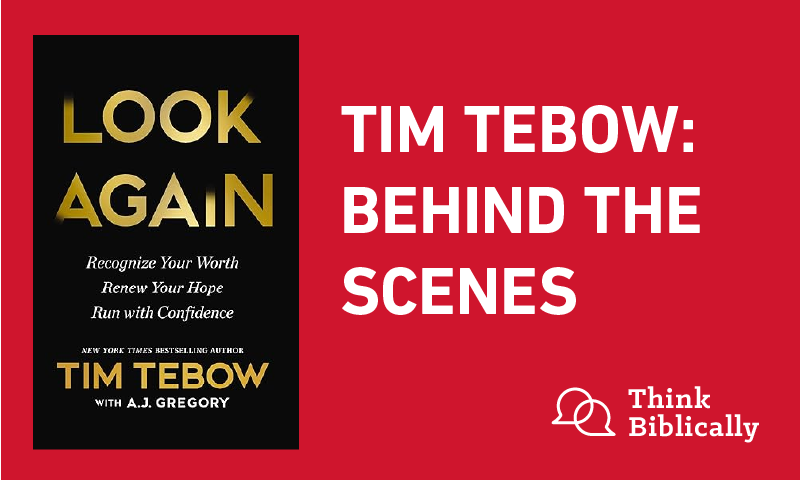
Tim Tebow is known for being a Heismann Trophy winner and an NFL quarterback. But he also spearheads one of the most influential anti-trafficking organizations today. He has a new book out, Look Again, in which he talks about the importance of understanding human value and caring for the vulnerable amongst us. Sean and Tim have a fun, intense, and impactful conversation.
Episode Transcript
Sean McDowell: [upbeat music] Think Biblically listeners, we have a treat for you. All of you are gonna know the name Tim Tebow, because in 2007, he was a Heisman Trophy winner, played in the NFL, but there's a lot about his life and his work with individuals who have disabilities, his work in trafficking, that is literally unbelievable. I'm actually recording this intro after we had the conversation, and there was a point where both of us were looking at each other in tears because he shared a story of a girl who's been trafficked. And yet, in this interview and conversation you're gonna see with Tim and I, there's some incredible hope rooted in his belief in Jesus Christ. We talk about his new book, Look Again. This is a part of the Think Biblically podcast. Check it out, and consider sharing with a friend. [upbeat music] Tim Tebow, many people were first introduced to you in 2007. You won the Heisman Trophy, quarterback for University of Florida. You also would write Bible verses on your face when you played, and you talked about Jesus every chance you got. It's been almost two decades since that time. How are you the same, and how are you different from that guy we first saw?
Tim Tebow: Well, Lord willing, I'm very different, because of His grace and, because of the reconciliation, and trying to grow with Him- ... And trying to screw up a little bit less every day [chuckles] . Although I still fall very short, and I'm just so grateful for His grace and the way that He has loved me, and the way that He has worked in my heart, and in my life, to hopefully, better know Him, but also what He wants me to do, and who He wants me to care for, and what He wants me to say yes to. I think that that was a r- very special time, in my life for a lot of different reasons that, you know, so grateful for the- ... The platform that God gave me, during those years,
Tim Tebow: Which is really special. And that platform led to some highs and some lows, and during the time, it probably would've been hard to say that I was grateful for all of the lows in that time.
Sean McDowell: That's fair.
Tim Tebow: But I would say, actually, through those, I really feel like God has taught me so much in those moments- ... And even more so than He ever did in the highs.
Sean McDowell: One of the things that struck me about your book, and I actually numbered it, in, like, the first five to six pages, there were six times you specifically said, "I fell short, I failed." Like, that was obviously intentional. That's kind of a theme in this book, that somebody picking it up saying, "Heisman Trophy winner, NFL quarterback," like, the success that you've had, obviously, there's online criticism, but I don't think a lot of people would think that narrative would be so prevalent in this book. Why is it there?
Tim Tebow: Because if I ever point people to myself- ... I will let them down. But if I- ... Point people to Jesus, He will never let them down. And the longer someone looks at me, the greater chance they have of being let down. But I know that King Jesus- ... Will never let them down, and so that's the heart and the hope, is not point people to me or any other,
Tim Tebow: People on planet Earth. It's to point them to King Jesus, and, because He is where we find our hope, and in Him, we know that there's an anchor for our for our soul, and that it's firm and secure. In me, I know that I'll let people down. I was, When I was a freshman at college, I, remember being very convicted so many times where I'd walk through the Gator Walk where all our fans, and they would be-
Sean McDowell: Yeah
Tim Tebow: ... Say, "Hey, you know, Tebow, hey, I just want you to know, you're our son or you're our daughter's role model."
Sean McDowell: Wow.
Tim Tebow: And I would have this thought-
Sean McDowell: Wow
Tim Tebow: ... "No, not if you knew me on my worst day." "I wouldn't be their role model." "Not if you knew my worst words, my worst actions- ... My worst thoughts, my worst days- "I wouldn't be their role model." And there was so much about that. Then, there would have the thoughts of pride, 'cause you'd have all these people wearing your jerseys, and you'd have the thoughts of-
Sean McDowell: Oh, yeah
Tim Tebow: ... Of fear, of doubt, of, man, the whole world is... Or not the whole world, but the whole country's gonna watch based on whatever happens over the next three hours, and I'm either gonna get way too much praise or way too much criticism for something that happens in three hours. And I used to listen to a song almost every single game, probably every single game in college, by Casting Crowns called "The Voice of Truth."
Sean McDowell: Love it.
Tim Tebow: Because I knew all of these voices- ... That they were calling out to me, voices of insecurity, voices of shame, voices of guilt, voices of doubt, voices of pride, and I would listen to that song so I could remember the voice of truth. I remember some of the lyrics were, "The voice of truth tells me a different story. The voice of truth- ... Says, 'Do not be afraid.' The voice of truth says, 'This is for my glory. Out of all the voices calling out to me, I will choose to listen and believe the voice of truth.'" And you see, when we look at God's Word, we're reminded that when we know Jesus, we're no longer defined by our scars, we're defined by His. You know, we're, we're- God doesn't remind us of, our sins. He reminds us of our name as a son and daughter of the King- ... The King of the world, who will forever reign, and that's what He calls us. And I love when we look at Scripture, how He has so many of these interactions with sinners, and the world calls them by their sin over and over again. We were just reading on the way-
Sean McDowell: That's right
Tim Tebow: ... Here about Zacchaeus, right? And the world would call him by his sin. Jesus didn't call him by his sin. He called him by his name, and He said, "No, no- ... You come down from that tree." And Zacchaeus said, "No," but in just a few days later, He's, He's, "You come down from that tree, 'cause I'm going up that tree, and I'm paying for all those sins," you know? And I just... It's just so important that we remember the voice of truth.
Sean McDowell: ... See, I didn't know this until we were at an event maybe a year ago in Florida, and I saw you s- you speak, and I was like, "Oh, he's got a preacher voice in him."
Tim Tebow: [laughs]
Sean McDowell: Like, I love it. It comes out. You're preaching a little bit.
Tim Tebow: That's your heart, and-
Sean McDowell: That's your passion
Tim Tebow: ... I was so sick. [laughs]
Sean McDowell: You were sick that day.
Tim Tebow: I was so sick, and you were so kind. I do not think it was very good, but, God's grace got me through it-
Sean McDowell: No
Tim Tebow: ... So.
Sean McDowell: I don't think people would've known if you hadn't said anything. You've obviously got a gear of toughness to push through stuff, that there's no question about that. By the way, you mentioned your jersey, about, people would wear it in pride. I have to be honest with you, it took a lot of self-restraint not to wear a Chargers jersey today, even though you're a Broncos guy. I was like, "I won't do that to him."
Tim Tebow: That's okay. You can rock it.
Sean McDowell: So-
Tim Tebow: You can show loyalty for your team.
Sean McDowell: No, I just-
Tim Tebow: No shame in that game.
Sean McDowell: Fair, fair enough. Now, you describe your dad in ways that reminds me a lot of myself. I heard you talk about your dad that day in Florida, a year and a half ago, and you describe him in your book, which we're gonna get to, as your... I think the l- title was Your Greatest Superhero.
Tim Tebow: Yeah.
Sean McDowell: That's exactly how I feel about my dad.
Tim Tebow: Yeah.
Sean McDowell: Hands down, he's a living superhero to me. Tell me about your dad and how he shaped you.
Tim Tebow: I would say, less about my dad from what he taught us and more about my dad from what he showed us.
Sean McDowell: Okay.
Tim Tebow: I can't remember a morning that when he was in the country or home, that I didn't walk into the kitchen for breakfast and see my dad reading the Bible. Um-
Sean McDowell: Wow.
Tim Tebow: If I ask my dad about the Gospel, anything about the Good News of the Gospel, he can't start talking about it without getting emotional.
Sean McDowell: Wow!
Tim Tebow: After years and years and years-
Sean McDowell: Huh
Tim Tebow: ... Of ministry and evangelism and highs and lows in it, of praise and criticism, the Gospel has got such a strong hold in his heart and in his mind. I asked my dad to share with our team a couple of years ago on a certain passage, and, he showed up, and he was ready to do it, and I said, "Dad, how are you feeling about it?" He goes, "Oh, really, r- I feel pretty good." And I was like, "Okay, awesome." He was like, "Yeah, I stopped, and I, and I reread the whole book about three times this morning." [laughs]
Sean McDowell: [laughs]
Tim Tebow: And I was like, "Dad, you've preached on this so many times." "I know, but I wanted..." You know, it's just so important to him. The Bible is- ... Such his lifeline- ... And the love of Jesus, and to be able to watch him give his entire adult life to people that could never do anything for him is why he's one of my greatest heroes, if not my greatest hero, is because, he served so many people that could do- ... Nothing for him, and he did it with courage, and he did it with boldness, and he went into places, that they said, "Don't go- ... And if you preach the name of Jesus, we're gonna kill you."
Sean McDowell: Wow.
Tim Tebow: And he would get up, and he would tell them how much God loves them.
Sean McDowell: He'd do it.
Tim Tebow: Um-
Sean McDowell: Wow
Tim Tebow: ... I remember one of my favorite stories was, Dad was preaching one day in a, in a village, and, a guy was in the back of the village, and he started making his way forward with a machete, and he got right in front of my dad, and as he was walking closer, my dad just felt this kind of prick on his heart to start talking about forgiveness, so he started preaching about forgiveness. And the guy gets right in front of my dad, and he starts to get emotional. He looks at my dad, he said, "I just want you to know I was sent here to kill you, but now I want to ask if you would forgive me."
Sean McDowell: Oh, my goodness.
Tim Tebow: And, and then to be able to see my mom and my dad, live out the call that God had for their life in such a real way, and to see what stewardship looks like and to see what caring for the Gospel and for the, for the Good News of the Gospel, especially those that have never heard it, looks like. I remember twice in my, life, and probably more times, but they don't always tell me these things, but twice I got to see it when we were living overseas.
Sean McDowell: [laughs]
Tim Tebow: My, my mom said to my dad, "We only have a few more dollars," and my dad said-
Sean McDowell: Wow
Tim Tebow: ... "It's okay. Give it away." And both of those-
Sean McDowell: And you remember seeing him say that, like, you have an image of him doing that?
Tim Tebow: Yeah, I was very young.
Sean McDowell: Okay.
Tim Tebow: But-
Sean McDowell: Wow
Tim Tebow: ... And both times that this happened, um- ... We had neighbors that came over, and they brought over dinner, and they'd knock on the door and answer the door and say, "We don't know why. We just felt like God told us to come and bring you over dinner."
Sean McDowell: Wow.
Tim Tebow: And you could just see God's faithfulness show up and just- ... Their generosity and their mindset and his love for the Gospel and- ... Because of that willingness, even though he was criticized. He was, he was an outcast from his family. He was this radical-
Sean McDowell: Wow
Tim Tebow: ... Christian that nobody wanted anything to do with.
Sean McDowell: Was he a pastor, evangelist? What was his, like, profession?
Tim Tebow: He was a... Yes, all the above. [laughs]
Sean McDowell: All the above. [laughs] Okay.
Tim Tebow: He, he went to a Young Life camp when he was, finishing high school, and, was the first in his family to accept Christ and was this radical Christian, then went to University of Florida and started sharing the Gospel with everybody.
Sean McDowell: Love it.
Tim Tebow: And then he went to seminary and followed Dr. Earl Radmacher all around-
Sean McDowell: Oh, wow
Tim Tebow: ... And studied under Dr. Radmacher.
Sean McDowell: Interesting.
Tim Tebow: And, and then he became a pastor, and then he went on a short-term mission trip to the Philippines, and he knew God called him there, and so he picked up four kids and moved to the Philippines, and then they had me there. And because of his faithfulness, over 30 million people have accepted Christ.
Sean McDowell: 30 million people?
Tim Tebow: Mm-hmm.
Sean McDowell: Okay, I have a million questions for you about this, but let- you tell a story... I heard you share this on the Jordan Peterson podcast, read it in the book, in the Philippines, a story of your dad and a boy that you say affected him for months. What happened to this boy that he saw? And tell me if I need to give you more details, 'cause sometimes I tell stories in my books-
Tim Tebow: Is it the-
Sean McDowell: ... And people forget
Tim Tebow: ... The story of the boy with the cardboard box?
Sean McDowell: Exactly.
Tim Tebow: Yeah. Not months, years.
Sean McDowell: ... Oh, okay.
Tim Tebow: Still, still would affect him to this day if I brought it up to him, and that's what-
Sean McDowell: Really?
Tim Tebow: -the sincerity, yeah. So one day he was meeting with some of his, local evangelists in the Philippines- ... In the middle of Manila, and Manila is known for having the worst traffic in the world, like, by far, the worst traffic.
Sean McDowell: Nicest, nicest people. They like selfies.
Tim Tebow: Nicest people. It's amazing.
Sean McDowell: I would never drive there. [laughs]
Tim Tebow: [laughs] Yeah, I don't-
Sean McDowell: And-
Tim Tebow: I don't have that courage.
Sean McDowell: Yeah, I wouldn't either.
Tim Tebow: No, no chance. And so they're in the middle of Manila, and this crazy traffic, and he's meeting with some of them, and he looks through all the traffic into the- ... Intersection, and he sees a little boy that's lying there, and he's covered in soot, and you know- ... All the oil and gas and the filth that's covered him. And he's asked all of his pastors, "Hey, you know, does anybody know the story about that boy? Does anybody know that boy?" They said, "No, no," and he just feels this prompting on his heart, "That's your son." And he goes through all the traffic and gets out there and brings one of the pastors to interpret, and he walks over, and this little boy's sleeping, and right beside him is this little, tiny cardboard box full of just old trinkets. And, uh- ... He's laying there, barely covered with a tiny bit of clothes, and he just taps on him, and the young boy wakes up, and he said, "H- you know, hey, son, I... You don't know me, and I don't know you, but I want you to know that I love you, and if you would like it, I would love to adopt you into our family. And I promise that I will do my best to love you and give you everything, that I possibly can- ... And I will treat you as one of my sons and as one of my children. If you would like it, we would love for you to be a part of our family." And the little boy gets up, and he picks up his cardboard box full of mostly things that we would throw away, and he turns, and he runs away. And my dad never sees him again.
Sean McDowell: Never saw him again.
Tim Tebow: Never saw him again. And he came home, and he tells us the story, and he's told us many times.
Sean McDowell: Just repeats it. It's like a theme-
Tim Tebow: It's a-
Sean McDowell: ... Kind of in his life in some ways.
Tim Tebow: And the point of why he was telling us wasn't to tell us what happened that day, but how so often in our lives, that is us with God. God said, "Hey, I love you." "I wanna give you my best." "I want you to be a part of our family." And, and we pick up our trinkets of what we- ... Think are so important, what we think is the next promotion or the next praise or the next team or the next platform or whatever we think, but ultimately, in the grand scheme, they're stupid trinkets- ... That mean nothing for eternity, and we pick it up- ... And we run from the Father because we think that those things are more important than the Father.
Sean McDowell: That's a, that's a powerful story, and that theme goes through a lot of your book. We're gonna come back to some of those themes. I have one more question for you. Our dads sound pretty similar: radical experiences with Christ, revolutionaries, just wanting to share the gospel wherever they went.
Tim Tebow: Yes.
Sean McDowell: In fact, my dad knew Dr. Rodalker. I went to school with his son, which is interesting. But I'm curious, I went- even though my dad was an apologist, I went through a period of doubt- ... Where I actually told my dad, I was like, "I don't know if I really believe this is true." I had to figure it out for myself. He didn't freak out. He's like, "I love you. Seek after truth." Like, he gave me the exact response he needed. Did you go through a period of doubt where you're like, "Is this really my faith?" Or what were the seasons or experiences that made your faith real to you, that give you the boldness you speak about it with today?
Tim Tebow: Well, I don't know that I have boldness. You know, when we look at the word boldness, and we bring it back to the Greek, the word pigma, and it means to put it all on the line, to do what is necessary, and I've never had to put it on the line to do what is necessary. I don't... You know, I've won- ... A couple awards for being bold for my faith, and the first thing I said when I accepted it, "You got the wrong guy." [laughs]
Sean McDowell: [laughs]
Tim Tebow: "You absolutely have the wrong guy." I know a lot of friends, family members, loved ones, and heroes of the faith that are out there putting their life-
Sean McDowell: Amen
Tim Tebow: ... On the line for the gospel. I just got a video, about an hour and a half ago of, 12 people that were just martyred for their faith-
Tim Tebow: ... Laying dead in a street. That's courage and boldness. What, we have it because you get criticized and maybe on some social media or something? No, that's the wrong perspective that we have, that it's... That's not boldness. Like, whatever I've done is not boldness. It might be, like, a tiny stand here or there. No, what they're doing around the world, that's boldness. And, so sorry, not to answer your question, [chuckles] but I was-
Sean McDowell: No, a-
Tim Tebow: I just-
Sean McDowell: ... Answering as you want.
Tim Tebow: I don't think that I've, I've ever had to be really bold for my faith. My dad- ... Loved ones, and other, friends, and people that love the Lord around the world, yeah, I believe that they're bold. I'm not. But what was the question I didn't answer already?
Sean McDowell: Oh, I was asking about, like, what were the seasons-
Tim Tebow: Oh, the faith
Sean McDowell: ... In which owning your faith-
Tim Tebow: I-
Sean McDowell: ... Doubting experiences.
Tim Tebow: Yeah, I think to back, to back up, it would probably be to even when I accepted Christ, before I accepted Christ. You know, we grew up going to church-
Sean McDowell: How old were you, by the way, when you say that?
Tim Tebow: I was six, about to turn seven.
Sean McDowell: Six, turning seven, okay.
Tim Tebow: Yeah, and I, [chuckles] for the young kids, six, seven. [laughs]
Sean McDowell: [laughs]
Tim Tebow: And we grew up going to church all the time, Sunday morning, Sunday night, Wednesday night, hit a couple Bible studies in between, and over and over again, my parents, would say, "Hey, Timmy, you heard what Dad said or the pastor said. Do you wanna say yes to Jesus?" And over and over again, I would say, "No, Mom, not... No, Dad, I'm good, I'm good, I'm good." "I'm good, I'm good," until one night I was lying in my bed, and I knew that I was a sinner that desperately needed a savior, and I got up early, and I ran to go see my mom, and I grabbed my mom and said, "Mom, I gotta ask Jesus to come into my heart now." She said, "Okay, let me go get your father." I said, "No, Mom, we don't have time." [laughs]
Sean McDowell: Are you serious? [laughs]
Tim Tebow: I was totally serious. I was kind of intense then, too.
Sean McDowell: [laughs]
Tim Tebow: And, so we got down on a blue couch on the west side of Jacksonville, Florida, and I asked-
Sean McDowell: Amazing
Tim Tebow: ... Jesus to come into my heart, and do you know it's crazy? He did.
Sean McDowell: Huh.
Tim Tebow: I asked him to forgive me, and he did.... And so I'd say I think where probably a lot of the speculation was even before it. But then I would say even in that time, I don't know if it was doubting as much as it was just not having clarity.
Sean McDowell: Okay.
Tim Tebow: Like,
Tim Tebow: Like, "God, what do you want us to do?" And I think actually a lot of the biggest decisions of my life, I haven't had clarity. And, you know, there'll be a lot of people that say, "Well, God's not a God of chaos, he's a God of peace, and he's a God of clarity." But for me, in a, in a lot of decisions, I haven't had a lot of clarity in certain things. And I really feel like for me, it's been because I'm kind of a doer and a getter and a, and wanting to get it done.
Sean McDowell: Mm-hmm. Mm-hmm.
Tim Tebow: And, like, if I know I'll go do this, and I feel like God's done that specifically for me- ... Because it's, "No, don't trust your own plan or your own ideas or your own athletic ability, but trust me." And I remember I was trying to make a really hard decision one day, and I'd been praying about it for years and years.
Sean McDowell: Yeah.
Tim Tebow: And I got home, and I was like, "Dad, I have d- been praying about this for years, and I have no idea if I made the right or wrong decision." I had a timeline, and I had to make it. I could not wait. And, you know, I asked pastors and theologians and all of these people that we were friends with- ... And I had no peace about the decision I was making. And I remember he looked at me, and he's like, "You, you think walking by faith, that you're gonna know every decision before you make it? Sometimes you just gotta make it-
Sean McDowell: Yeah, right
Tim Tebow: ... And trust that God actually is in it, even when you don't feel it or can't see it."
Sean McDowell: Yep.
Tim Tebow: "But that's actually what walking by faith means." And, that was very impactful for me. And, you know, some people are like, "Well, God made this super clear and clear," and I'm like, "That [chuckles] has not been a lot of my experiences and a lot of the hard decisions in life." but I also feel like, it's also been one way that it's really humbled me and drew me a lot closer to Him. So I'd actually lean on Him rather than me just figuring it out and doing it.
Sean McDowell: I love it. So you'd say at six, seven, became a believer-
Tim Tebow: Yes
Sean McDowell: ... And had, maybe had questions, failures along the way, like everybody else, but it has been a trajectory of following Jesus and not really doubting that, really for your life since you were six.
Tim Tebow: I think, I think the biggest problems for me-
Sean McDowell: Mm-hmm
Tim Tebow: ... In my walk with Christ is taking Him off of the throne and putting other things on the throne. It's n- it wouldn't be as much-
Sean McDowell: Yeah
Tim Tebow: ... That I didn't believe. It's just that I wanted something else more. Like I wanted a game or a championship or a title, and so I'd put these other things on the throne. And I... "No, I love Jesus, but he's like, three or five or seven." And sometimes knowingly and sometimes not even knowingly, just being more passionate about something else than I was about my relationship with Christ and the call that He has for me. If I just really try to step back and take an honest look, I think that's probably been a lot of my biggest weaknesses in my walk with Christ, is just He wasn't- ... Always in the proper place.
Sean McDowell: Let's talk about your book, Look Again. I haven't read others of your books. Your team sent me this. Because I'm a professor, I spend a lot of my time in academic books and studies. There's some serious depth in this book. You did a lot of research behind it. You're talking about the image of God and what it means in Hebrew, and trends that have taken place, like aware of scholarship that's going on. That's a compliment. Like, I read this this morning, and I told my wife, I'm like, "This book is really-
Tim Tebow: That's just impressive that you read it-
Sean McDowell: ... Good"
Tim Tebow: ... In a morning. Like, that's crazy.
Sean McDowell: Well, yeah.
Tim Tebow: Like, you're talking to a dyslexic-
Sean McDowell: [laughing]
Tim Tebow: ... Left-handed homeschooler. Like, I could never read that in the morning, so.
Sean McDowell: Okay, hang on. Tell me about that.
Tim Tebow: Y'all are laughing way too hard. [audience laughing]
Sean McDowell: We gotta... We don't normally have a live audience. We have a live audience here, if you hear people chuckling in. Can I ask about that?
Tim Tebow: Yeah.
Sean McDowell: You mentioned that you're dyslexic.
Tim Tebow: Yes.
Sean McDowell: How has that affected you? Now you're an author. Like, how does that work?
Tim Tebow: Well, I'm grateful for so much technology, because-
Sean McDowell: Okay
Tim Tebow: ... I couldn't actually take a pen, put it in my hand, and write on paper and have it make sense or be legible. Like, even the Bible verses-
Sean McDowell: Wow
Tim Tebow: ... That you're talking about, I wrote on the eye black, like, I couldn't even write those and have them legible. I'd have one of our trainers write-
Sean McDowell: Really?
Tim Tebow: ... John 3:16 or Philippians 4:13 or whatever verses.
Sean McDowell: Wow!
Tim Tebow: Yeah, so I, uh-
Sean McDowell: Yeah
Tim Tebow: ... I'm grateful now in the writing process, I put on my headphones, and I'll go to the gym, or I'll do something that's very easy that I just know how to do- ... Like the back of my hand, and I'll just have something on my heart, and I'll share it, and we'll record it, or I'll call my ghostwriter, and I will speak it to her, and she'll ask questions, and then she'll record it all-
Sean McDowell: Gotcha
Tim Tebow: ... On our phone conversations, and then we just print it out that way, and then I'll go through, and I'll start to make edits from it.
Sean McDowell: Amazing.
Tim Tebow: But I just- it's so different, and I love it. I could never take a pen-
Sean McDowell: Wow
Tim Tebow: ... And actually, like, write it all out. Could never do that.
Sean McDowell: That is so interesting to me. Good for you for leaning into that. The title of the book is, Look Again, and early on, you, there's... Oh, here it is. I'm a question guy. Anyone who hears me speak and talks, I'm always like, "Let's talk about questions, learn questions."
Tim Tebow: Yeah.
Sean McDowell: So Gospels and Acts, there's 340 questions-
Tim Tebow: Yeah
Sean McDowell: ... Jesus asks. Letters of Paul, 262.
Tim Tebow: And he only answers it, like, eight times or something, right?
Sean McDowell: That's right, very few he actually answers. So you said it right here. You said, "I want to ask you a question that's challenged me over the past 15 years, one I can't shake." And the question, which obviously is at the heart of this book, which, again, is called Look Again: How do you see people?
Tim Tebow: Yeah.
Sean McDowell: Why has that question haunted you for 15 years, and how do you answer it, if you can answer it at this point?
Tim Tebow: [sighs] Well, I would say that the greatest way God has impacted my life, is through-... The suffering and hurting people, and especially the overlooked, the trafficked, the exploited, the abandoned. When I was 15 years old, I was in the jungles of the Philippines on a mission trip, and I met a boy who was born with his feet on backwards, and because of that, his village treated him as less than insignificant, and they believed he was cursed, 'cause he was born that way. And I knew that day that he wasn't a throwaway to God. But I felt like God was pricking on my heart, saying to me, "It's not enough to just feel something. What are you gonna do about it?" And I knew that day that I loved sports. I loved the game. I loved to win. I hated to lose even more, and I loved-
Sean McDowell: [chuckles]
Tim Tebow: ... Trying to be the best and be my best and-
Sean McDowell: Yeah
Tim Tebow: ... Win championships and try to win MVPs. But I really felt... I, and I couldn't have probably explained it at this moment- ... But what was starting to happen in my heart was God pricking my heart, saying, "I have a more important MVP for you to chase. It is not a most valuable player, it's the most vulnerable people." "I don't just want you to feel something, I want you to do something." And that, I came back from that, and it just, it radically impacted my life. That young man accepted Christ with me that day- ... And, it changed the way that hi- the village heard the gospel for the first time, and it changed a lot of the way that some of the people, the way they viewed him, in hearing the gospel. And it was this [sighs] challenge, turning point in my life of the first time that I would say I felt a call for something-
Sean McDowell: Oh, wow
Tim Tebow: ... And how, and how I-
Sean McDowell: Okay
Tim Tebow: ... Would define calling, I believe is one of the more accurate biblical forms, "An urgent and divine invitation to accept responsibility for-" ... "a particular task." And, that's how we as a foundation talk about it, "An urgent divine invitation to accept responsibility for a t- particular task." And for me, it's been for caring for the MVPs, the least, the last, the lost, the thrown away, the exploited, the ban- ... The abandoned, the trafficked, and that was- ... Really the start of it. And then God has, in His, in His kindness, reminded me of that many times when I've lost sight of that. There has been many stories that I could go back to, where I was reminded where the greatest work that He's done in my life was through the suffering of humanity. And I've known, when I've stepped in, one, I've had the greatest heartbreak, but also the greatest fulfillment, if that makes sense-
Sean McDowell: It does, yeah
Tim Tebow: ... At the same time.
Sean McDowell: Amen.
Tim Tebow: And, and it's where I've, more so than a game, more so than, it, you know, any of the championships or trophies or any of that stuff- ... It's where I felt like this was what I was created to do. Like, like as a practical, tangible thing. Hon- and I know what's to have a relationship-
Sean McDowell: Mm-hmm
Tim Tebow: ... With Christ and make Christ known, but if there's a practical way of, like, living out your purpose, and we talk about that, the reason something is created, used, created, or done, like, you know? And so, like, when I feel like, "Man, this is what I was created for," in a practical sense, it is stepping into where the most vulnerable people are and letting them know that they might be vulnerable, but man, they're valuable to God.
Sean McDowell: Is this the young man, his name you had in here, that I think you have a picture up on your wall, like, at home? Is that who it is?
Tim Tebow: Different one. That's Fransky.
Sean McDowell: Oh, okay.
Tim Tebow: The first one's-
Sean McDowell: Tell, tell us about him then-
Tim Tebow: The first one-
Sean McDowell: ... If you will
Tim Tebow: ... Was Sherwin.
Sean McDowell: Okay.
Tim Tebow: This one, the way that I open this book, this is with Fransky, another really, special boy, to me and a lot of people. Many years ago, in Haiti, there were some women that were walking, and they heard what they thought was a wounded dog or an animal- ... That was in pain. They went to where they, heard this sound, and it wasn't an animal. It was a three-year-old boy that was, on a mattress on a front porch, covered in mosquitoes, with, club feet, neurological problems, and was abandoned. His mom didn't come back till the next day. He weighed 13 pounds, and that's as heavy as what a-
Sean McDowell: Yeah
Tim Tebow: ... A three, four-month infant is.
Sean McDowell: Yeah, yeah.
Tim Tebow: And, make a long story short, our friends, Mike and Missy, with My Life Speaks, were able to take him into their care, some ministry partners of ours in Haiti. And when I would be there, I would be able to carry this sweet boy, Fransky. He never had the ability to walk or talk a day in his life, but I would carry him around everywhere, and man, his smile would brighten any and every room he ever went into. And he hated when I would put him down, so I'd pretty much carry him [chuckles] around the whole time I was there.
Sean McDowell: [chuckles]
Tim Tebow: I just like, "I'll consider it my workout," right?
Sean McDowell: Get a workout in, yeah. [chuckles]
Tim Tebow: Get a workout in, and I'd carry him everywhere.
Sean McDowell: [chuckles]
Tim Tebow: And, and then when Fransky was nine, six years later, he became ill, started throwing up. Our team took him to a local clinic, and Mike and Missy and all of their team took him to this clinic, and they wouldn't take him in, 'cause he was less than insignificant, and he was cursed to them. So they took him to a hospital. That hospital turned him away. They took him to a second hospital. They admitted him, but they weren't treating him. They weren't caring for him- ... So because of the same reason, "Well, we'll admit him, but we won't care for him." So they got him transferred from there to a third hospital, and that hospital admitted him, but within a few minutes of being admitted, he passed away. And,
Tim Tebow: I don't know what's, worse when I think about it- ... That, Fransky dying from a likely treatable virus or being treated like a virus-
Sean McDowell: Whew
Tim Tebow: ... As if he was the problem. And we have a portrait of Fransky in our TV room in Jacksonville, Florida, where we live- ... Because it's a place where many times I-... I go and me and my wife will watch a show or a game, or-
Sean McDowell: Yeah
Tim Tebow: ... I watch a lot of sports, and I love it, but it's an easy place for me to lose perspective, right? [chuckles] And if, like, Florida loses again to Georgia this year, I'll lose perspective again. [laughing]
Sean McDowell: [laughing]
Tim Tebow: And so when I- w- but why I framed it there is it's Fronske smiling with a crown on his head, because that's how I'm supposed to see him- ... As infinitely valuable, as loved, as treasured, as made in God's image, one of one, in love, by love, and for love. And so when we walk in and walk out, you can't help but see him- ... As a perspective-
Sean McDowell: That's awesome
Tim Tebow: ... Changer and giver to me, and I really- ... Wanted to start this book with his story because it radically impacted my life. I hope and pray it will impact more lives, but the reason for that is so many people, because of what they have been told and what they have been, people have been shared and because of cultural views, they viewed him as less than. But the awesome thing about Fronske's story is his mom, who abandoned him, after he passed away, she showed up to the funeral, and the streets were flooded- ... For this cursed boy because their mind, and their heart, and the lenses of their eyes had been changed. For this cursed, abandoned boy, the streets were flooded for his funeral, and the mom that abandoned him showed up and said, "Hey, if you need a place to bury him, you could bury him in our family tomb."
Sean McDowell: Huh.
Tim Tebow: And why that's so important-
Sean McDowell: Wow
Tim Tebow: ... Is because their mind, and their heart, and the lenses of their eyes were changed, and that's what my hope and my prayer is with Look Again, that people's lenses will be changed, that we would stop and actually look again- ... And truly see the worth and the value of all of humanity. Because when we do, there's something that'll happen. We will treat them that way. You see, you really do treat people the way that you see them.
Sean McDowell: Amen.
Tim Tebow: So we don't actually see people as valuable. If I was to say to you, Sean, "Hey, I just dr- I dropped a penny. Like, I really need your help. Sean, we gotta look everywhere to find a penny," you would look at me and be like, "Bro, Tebo, you're an idiot. Like, let it go."
Sean McDowell: [chuckles]
Tim Tebow: "It's, it's not valuable." But if I said, "Hey, Sean, my wife, Demi, she lost her diamond ring. I need your help. We gotta find it. We gotta flip over the chairs, and we gotta find it,"- ... I bet most of the people here would help us look for that. Why? Because you know that it's-
Sean McDowell: Yeah
Tim Tebow: ... Valuable her- to her, but it's also valuable... It's innately valuable. But we treat people like pennies instead of w- infinitely more valuable than any diamond ring that's ever been created.
Tim Tebow: So when we leave here, and we go see people, we just see someone for their actions or see something for what they can do to us. We see someone... And we base a lot of our value on people, on the things that they do that we believe are valuable or not valuable, instead of seeing them for the value of how God sees them, the infinite worth and value. That's the heart of Look Again.
Sean McDowell: Amen. Well, the subtitle is Recognize Your Worth, Renew Your Hope, Run with Confidence, but it starts with recognizing your worth-
Tim Tebow: That's right
Sean McDowell: ... Being made in the image of God.
Tim Tebow: That's right.
Sean McDowell: Now, you present in here, and I was pleasantly surprised and encouraged by this. There's been a lot of conversation about what the image of God means-
Tim Tebow: Mm-hmm
Sean McDowell: ... And some shifts in how people understood it. By the way, a little plug, led by some Biola and Talbot folks, by the way.
Tim Tebow: There's no doubt.
Sean McDowell: Like, you gave some-
Tim Tebow: Carmen Imes was awesome in this. She was a really big, inspiration for a lot of this. Dr. Longman, Dr. Copan, Dr. Byrd- ... Dr. McDowell, b-
Sean McDowell: That is Kathryn McDowell, not me.
Tim Tebow: Yes.
Sean McDowell: Like, I saw McDowell, I'm like, "This wasn't me." [laughing]
Tim Tebow: [laughing]
Sean McDowell: Just in case anybody listening, gotta punt that one. Although you gave a shout-out to Morton Carpenter, which was cool. But I do want to, I wanna ask the first part about recognize your worth. Before we come back to what the image of God is-
Tim Tebow: Yeah
Sean McDowell: ... I wanna know, what do you think are some of the lies that we've been told?
Tim Tebow: That some lives matter less.
Sean McDowell: So-
Tim Tebow: That some lives matter less.
Sean McDowell: Okay. That sums it up. So today, basically, the lies about worth are that some lives matter less than others, and that really captures it.
Tim Tebow: I think that's part of it.
Sean McDowell: Okay.
Tim Tebow: I think another lie would be that your opinion equals your value. Like, if I agree with your opinion- ... On faith or on politics, then you're more valuable. That's not a biblical [chuckles] view of humanity. Unfortunately, that's a societal view. But if people say, "Well, we don't really do that," well, of course we do. Like, look at, look at the world right now. You have over 50 million people that are trapped in human trafficking. You have se- over 700 million people that are malnourished right now. You have 400 million people that are gonna be sexually abused or exploited around the world this year. You have 153 million orphans or abandoned kids around the world. You have, And if they say, "Well, what about here in the States?" Like, you know, w- just in one month, here in the month of April, 100, over 111 unique IP addresses downloaded and shared, child rape videos under the age of 12. So if we actually valued people, we wouldn't be doing that. We're seeing them for what we can gain, profit-wise or gain pleasure-wise, not value for how God created them. ... And obviously, there's a lot of people that love people here.
Sean McDowell: Sure.
Tim Tebow: I'm not saying that.
Sean McDowell: Sure.
Tim Tebow: There's a lot of amazing people, but we have a fight right now in our society on how we truly are going to see people- ... And then how we are going to treat them. And I could go on, and on, and on-
Sean McDowell: Yeah
Tim Tebow: ... The way we talk about suicide, third leading cause of death in, for young people.
Sean McDowell: That's right.
Tim Tebow: And the lack of purpose, and meaning, and significance with young adults- ... The level of depression for so many, all of that has to do with how we see ourselves. Right? I don't think it's solely that, but a big piece of it is truly how we see ourselves and how we see other people.
Sean McDowell: So let's talk about that, because at kind of the heart of this book, early in the chapter, you talk about what the image of God is not, and what the image of God is. Tell us how you see it.
Tim Tebow: Well, can I back up and tell you-
Sean McDowell: Sure
Tim Tebow: ... How I was, uh-
Sean McDowell: Do it
Tim Tebow: ... Inspired for this? In 2021, we were having Night to Shine. Night to Shine is our worldwide celebration for individuals with special needs, and this is coming out of COVID, so we had something called a Shine Through. So instead of all the kids walking the red carpet, they would drive through this red carpet. And, we're standing out there, and we're cheering like crazy, and all these, like, Corvettes and awesome cars are driving-
Sean McDowell: [laughing]
Tim Tebow: ... All the kids through, and all the crowds are going crazy for them. And there's this red Corvette that's driving by, and there's this girl with blonde hair in the backseat standing, and she's waving her arms and going crazy, and I'm losing my voice yelling for her and cheering for her. And she's in this red dress and blonde hair, and the car drives by, and I didn't even know that our team at the foundation and all the churches were working together to put bumper stickers on the back of the cars. I didn't know this. But the car drives by, and on the back, I couldn't help it, I got emotional when I saw it, 'cause I see this girl, and then I see the bumper sticker on the back, and it says, "Royalty on board." And I thought, "Man, that's it." "That's it." And so that really led me into starting to dive into what does it mean to be made in the image of God? Because we have the privilege of serving- ... So much of the world that the world has overlooked. You know, 16% of the world has a disability, and I start to think, because I start looking into it, and then I remember growing up, the different messages. As in so many times, people talk about the image of God is that we are a relational- ... We're relational beings for a relationship with God and relationship with one another.
Sean McDowell: Mm-hmm.
Tim Tebow: Or we're rational beings, that we have- ... With logic and sense, and we can, you know, think through problems and strategize, or that it's functional. We're called to rule, and reign, and subdue the Earth then. And I think all three of those things are part of it.
Sean McDowell: I agree.
Tim Tebow: But I started to think, "That, that can't be all," because what about so many of my favorite people on planet Earth that can't do all of those- ... To the same extent? Are they made less of the image of God? And I believe the answer is absolutely not.
Sean McDowell: Agree 100%.
Tim Tebow: And but I wanted to study it-
Sean McDowell: Yeah
Tim Tebow: ... So that I'd have evidence for it.
Sean McDowell: Yeah. [chuckles]
Tim Tebow: And so, the first one that I got to read was, Dr. Michael Bird.
Sean McDowell: Mm-hmm.
Tim Tebow: And he really opened my eyes to the royalty view, and so we started to study it, and then Carmen Imes wrote a book about it.
Sean McDowell: Yeah, yeah.
Tim Tebow: And so we started talking to more and more people, and then you actually find out that a lot of the Old Testament ancient Near East scholars actually have somewhat of a consensus on this, r- you know, royalty opinion-
Sean McDowell: Mm-hmm
Tim Tebow: ... But it's not in the mainstream world. I've never heard a pastor talk about it.
Sean McDowell: No, he's not.
Tim Tebow: And actually, in talking to some of them-
Sean McDowell: That's right. Yeah
Tim Tebow: ... Catherine McDowell, and Carmen Imes, and so many-
Sean McDowell: Yep
Tim Tebow: ... They said, "Thank you. Please go tell the world." And you start to think, "Man, all of these scholars that are in these, you know, seminaries and universities, this message isn't getting to your mainstream churches, and boys and girls," and it really was a burden for me. I mean that in a, in a good way-
Sean McDowell: Yeah
Tim Tebow: ... To be able to-
Sean McDowell: Sure
Tim Tebow: ... To share this. And so when we look at it, and really one of the big evidences for this is when you look at it, in the ancient Near East, the term image of God or image of was used. So when we look at, an Assyrian king in the 1500s, who would been the image of Rah, a god that they believed in, or the 600s, and a, an Egyptian pharaoh would be the image of, image of Rah or image of Bel, different gods that they believed in. And so you would look at it, and so it was a term, even in statues all over, i- that the i- the image of blank or the god that they believed in, was a term that was used for kings or for monarchs.
Sean McDowell: Mm-hmm.
Tim Tebow: And so for someone that would be reading Genesis, and they see that we were made in the image and likeness of our Creator, that God loved us enough to make us in His image- ... They would've probably, for the most part, only seen that for kings or for monarchs, for royalty. But now, the God of the Bible is making this statement for all of humanity. And then some people will say, "Well, that was just before the Fall," but it's not true. It's in Genesis 1:5 and 9.
Sean McDowell: That's right.
Tim Tebow: And, and so when we look at it... And we understand it, how in the ancient Near East, they would've read about the God of the Bible in Genesis. It would've been a term for royal worth. Like, he loves us enough- ... That he would make us in his image and likeness. We only see this for kings or for monarchs, but the God of the Bible is saying this about us. If you wanna change the, and truly recognize your worth, it starts by seeing yourself how God sees you. And then when we fast-forward that to the New Testament, and we look at the life of Jesus, that Jesus came on the greatest love story rescue mission of all time, to redeem and reconcile us from our sins- ... And when we do that we are adopted into the family of God, that he is our Father-... Then guess what? We're also royalty as sons and daughters of the King, right? So it starts in Genesis, and it, you know, finishes in the cross, that His heart for us is one of royalty. And when we know Jesus, we are royalty-
Sean McDowell: Amen
Tim Tebow: ... As sons and daughters of the King.
Sean McDowell: I love it. I- so I wanna make sure people are tracking with this, is sometimes the traditional understanding of the image of God are certain capacities that we have for reason, relationship, maybe creativity, maybe emotional depth, and I agree with you that that's a part of it.
Tim Tebow: A part.
Sean McDowell: Like, to be the royalty and reflect God-
Tim Tebow: Yes
Sean McDowell: ... We have to have those capacities. There's a line in the book where, like, God didn't pick a zebra.
Tim Tebow: That's right.
Sean McDowell: He had to pick somebody with our capacities.
Tim Tebow: That's right.
Sean McDowell: But the image of God was reserved for the king-
Tim Tebow: That's right
Sean McDowell: ... 'cause the king was like the god that they believed in, who would visibly represent that king to the people.
Tim Tebow: Yes.
Sean McDowell: So if they wanted to know what the king was like or what God was like, look at the king.
Tim Tebow: Look at the king.
Sean McDowell: And we miss that when we read Genesis.
Tim Tebow: Mm-hmm.
Sean McDowell: It's like, no, God made not only men, but men and women-
Tim Tebow: Yes
Sean McDowell: ... Is radical.
Tim Tebow: That's right.
Sean McDowell: Human beings actually are royalty on Earth.
Tim Tebow: Yes.
Sean McDowell: We know what God is like in part by looking at human beings, of course, fully in the person of Jesus. [chuckles]
Tim Tebow: Yes.
Sean McDowell: But that flips it, and I think part of your concern that you expressed was if we limit the image of God to, like, certain capacities that we practice, then in people's minds, if somebody with a disability can't do those things, maybe somebody's not as smart, maybe somebody can't do other things people can do, we tend to say they have less value. That's the metric of the world-
Tim Tebow: It is
Sean McDowell: ... Rather than royalty being on us, and that's kind of the heart of what you're saying. Look again, it's like, let's start at the basis-
Tim Tebow: Yes
Sean McDowell: ... See ourselves as God sees us, as royalty.
Tim Tebow: Yes.
Sean McDowell: That captures it.
Tim Tebow: We are created to be God's image before we do anything. Like, obviously, we are called to do things. It's not an anti-work. It-- actually, this book is very challenging to people about work. But before you go work or do anything, you were made in God's image with royal worth. Like, I would also view it as the same thing as the gospel, right? That we don't have to work for salvation, but we do get to work from salvation, right? We have been saved from grace. It is not of our work. We can't boast about anything.
Sean McDowell: That's right.
Tim Tebow: We didn't do anything for it. King Jesus did everything for us. But because He has done this for us, we want to go share this with people. But because we were made in God's image, and He sees us with this royal worth, and He loves us this much, and He cares for us this much, now we want to go live that out and love people and try to represent Him as best we can.
Sean McDowell: Love it. We're human beings, not human doings.
Tim Tebow: That's right.
Sean McDowell: But doing comes out of understanding our being, which comes from God, not our... You say it so many times in the book, not our works, not our effort, not how we look, not our successes, who we are. One thing I want to ask you about that I-- before I ask you this, I love that you went there, and what I mean by going there is you didn't shy away from talking about evil. Like, I actually think, not so much in our culture but in the Church, sometimes we don't really go there and call evil for what it is. So I'm gonna read a couple things, the way you describe it here.
Tim Tebow: Oh, please do. I like it.
Sean McDowell: 'Cause I want, I want people to hear it. And you say-- so I'll read this one first, and then I'm gonna ask you why you framed it this way. So you're talking about the killing of, in the gas chamber and of the Jews-
Tim Tebow: T, T4
Sean McDowell: ... And of many of the- yeah, T4, exactly-
Tim Tebow: Yeah
Sean McDowell: ... Many people who had disabilities, and you say that, "People could justify the chemical showers, saying, 'They're not even human beings. They're animals in the form of humans.' "
Tim Tebow: Of humans.
Sean McDowell: "275,000 children and adults with special needs were killed, and if you include all possibilities, it could be up to-
Tim Tebow: A million
Sean McDowell: ... A million."
Tim Tebow: Yes.
Sean McDowell: Like, that was new to me. But the way you describe this, you're talking about, this Latin American landfill. And you said, "There were about 9,000 tons of garbage, yogurt containers, used sanitary products, diapers, rotting meat collected each day. It wasn't unusual to see dead bodies buried in the trash. One day, a dead baby was even found. Toxic waste from the site oozed into Guanabara Bay." Like, I could go on and on, but clearly this was intentional. Tell me about the thinking behind it and why you kind of don't hold back on the nature of evil in this book, which is ultimately a book about hope.
Tim Tebow: [exhales] Good question. Where do we start with that?
Sean McDowell: I was wondering- ... When you're gonna tell me, "Good question."
Tim Tebow: No, it's-
Sean McDowell: I've been trying hard. [laughing]
Tim Tebow: [laughing] It's, Let me start at a different place. If,
Tim Tebow: A little while ago, I was playing in a charity golf tournament in a state I won't mention, with some of the most powerful people in the state. As we were playing early in the round, something terrible happened to, 12 little girls in a location, and I get a call from one of our team members, and we're trying to s- to step in and help this situation. And I say, "I'm sorry, guys, I have to step away for a couple of holes- ... And see what we can do to h- to help." And so I'm talking to them. Some of them overhear a little bit of the conversation, and I finish, and I come back, and I say, "So, so sorry, guys." And they say, "No problem. Can you tell us a little bit what's going on?" So I share a little bit of some of the work that we're doing, and specifically this case of the fight against trafficking and exploitation. And they go, "Oh, no, don't tell us. Don't tell us, don't tell us, don't tell us, 'cause this, that reminds me of my kids. I don't want to hear it. I don't want to hear it. I don't..." And-
Sean McDowell: Interesting
Tim Tebow: ... I, um-... I, [chuckles] I probably shouldn't have. [laughing] I was, I was in a little bit of emotional and frustrated state.
Sean McDowell: Sure.
Tim Tebow: And I probably wasn't as humble as I should have been-
Sean McDowell: Right
Tim Tebow: ... Or would've liked to have been. But I responded to them, people that could step in and step up and help so many people, God has blessed them with a whole lot. And I responded to them after they said that, and I said, "If those girls could hear you right now, what hope do you think that would give them?"
Sean McDowell: Good for you.
Tim Tebow: And, probably wasn't the most humble thing [chuckles] I've ever said, but I was just so- ... Frustrated. One, at the evil that was taking place, but two, the people that are supposed to be, that are in a place to step up- ... And fight back against evil, and to be able to step into the fight, and they want to say, "No, no, don't tell me, don't tell me. I don't wanna know, 'cause it's gonna remind me of my kids." Yes, that's exactly who it should remind you of. And guess what? When it reminds you of them, you should urgently get in the fight that much more so. And so why we talk about evil in this book is 'cause there is a lot of people that are in terrible situation. There's, there are a lot of evil that takes place every single day. You know, while we're sitting here talking, you know, one study says that every girl that's in human trafficking gets raped 5.3 times per day.
Sean McDowell: Wow.
Tim Tebow: And don't you think for that girl or her family, that she would want us to respond urgently as fast as we can? Yeah, I think she probably would, 'cause that day is a living hell. And I think for believers and people that are called to step up and stand up to this fight, and by the way, I also believe that it's everyone. Like, when we actually look at the life of Jesus and what He tells us to do, when we look at that 70% of His earthly re- publicly recorded miracles were for who we would call the MVP, the most vulnerable people. Over 60% of His publicly recorded miracles are for those who are afflicted. Today's day and age-
Sean McDowell: Right
Tim Tebow: ... It would've been some form of special need or something like that.
Sean McDowell: Mm-hmm.
Tim Tebow: When we look at Matthew 25, when we look at Matthew s- or, Isaiah 61, when we... So much of this, like... And I love Matthew 25, because- ... It's one of the few things in Scripture that Jesus doesn't use something else as the example. He uses Himself as the example. "That whatever you've done to the least of these brothers and sisters of mine, you have done unto me." Like, when we are caring for the least of these, it is personal to Jesus. Like, h- it's... And so if it's personal to Him, I hope it's personal to me. And we are also told in Scripture that God is near to the brokenhearted, and there's a lot of people that talk about the different things that that means, but all I know is if God is near to the brokenhearted, then I should be, too.
Sean McDowell: Oh, I love it.
Tim Tebow: And that's where I wanna be.
Sean McDowell: I-
Tim Tebow: And s-
Sean McDowell: ... I applaud- keep going.
Tim Tebow: Yeah.
Sean McDowell: Yeah.
Tim Tebow: But anyways, to, why we should talk about evil, because if we don't talk about it, if we don't look at it, if we don't strategize, if we don't step into it, then how will we ever push it back? Like, when's the last time- ... That a businessman thought, "You know what? I'm not gonna do any research, and I'm just gonna get into a random category, and I'm just gonna start a business. So I'm gonna start a restaurant. I'm not gonna do any research. I'm just gonna do it." No! If we want to- ... Actually understand it and bring hope into the darkness, bring light into the darkness, then we have to actually be able to get into it to understand it. What is happening? What are the proclivities? W- you know, when we talk about human trafficking, primarily, human trafficking is for profit. Exploitation is primarily done for pleasure, right? You gotta understand the areas of what we're stepping into, of how we can best fight it. W- you know, when we talk about child sacrifice, why is that taking place, right? When we step into these places of evil, like, we are called, I believe biblically, to also have strategy, not just be like, "I'm just... You know, I wanna be here to help." No, like, we are called to be innocent, but also shrewd, to have strategy, to have wise, to have wisdom, which is applied knowledge- ... Like, for these areas, if we really wanna push it back. And I believe, as believers, we are called to step in and fight this evil.
Sean McDowell: Amen. And by the way, I know you-
Tim Tebow: Sorry, I also get fired up when I talk about it. [chuckles]
Sean McDowell: Keep going, man. I think your response had nothing to do with pride. I think it was completely appropriate. Good for you. I think that was boldness, by the way. You might not accept it, but I think that was bold. The other thing is, if we don't talk about evil, the gospel doesn't make any sense.
Tim Tebow: Right.
Sean McDowell: If we don't understand the-
Tim Tebow: That's exactly right
Sean McDowell: ... Level of death and evil that's out there, and what-
Tim Tebow: The gravity
Sean McDowell: ... We've been saved from-
Tim Tebow: That's right
Sean McDowell: ... We're not gonna be moved like you or dad every time he thinks about the gospel, to tears.
Tim Tebow: I think there's three things when I think about the gospel that we should truly understand that totally changes the game: what we have been saved from, who we've been saved by, what we've been saved for, right? Now, it's not everything encompassing-
Sean McDowell: Yeah, okay
Tim Tebow: ... But man, they really change the game. What we have been saved from. Christianity is not average to a little bit better. It's dead to alive. Like, the gravity and the weight of that is so heavy, that I was an enemy to God, and there's nothing that I could do about it. But God showed up on this rescue mission-
Tim Tebow: ... And took on sin and death, and defeated it, and offers us... One of the stories I'll share sometimes to give a picture of that is when I was a boy, make a long story short, I got caught in an undertow, and then my brother tried to save me and got caught in the undertow, and we're floating to the middle of the ocean. And as we can barely see land, we can hear the alarms go off, on land, and we're getting farther and farther away. And make a long story short, finally the boats get out to us, and, you know, they pull out there, and they have the rescue boats, and they have the little buoy thing with the rope-
Sean McDowell: Oh, yeah
Tim Tebow: ... Tied to it, you know?
Sean McDowell: Yeah, yeah.
Tim Tebow: And they throw it to us, and
Sean McDowell: The life
Tim Tebow: ... Man, you, the life thing.
Sean McDowell: Yeah.
Tim Tebow: And we grab the buoy, and they jump in and come get us, and we're just so grateful. That's Christianity- ... That we were, uh-... On our way to the, to destruction. There's nothing we could do. We could have never swam our way back. We could never wake- in our power- ... I could never have swam back. Like, I'm not even a good swimmer. I'm more of a sinker than a swimmer. [laughing] Like, we could never do it. But the life raft was thrown, and we grabbed it and held onto it, and that life raft was thrown by King Jesus. "Hey, I love you so much, I took the sin and the shame, and here- ... I did this for you. Say yes to it." There's nothing we could do, so understanding the weight of the Gospel, like what we have been saved from, eternal separation from God, then who we've been saved by. Man, it's a King that loves us so much, that would put on flesh, live a life that we couldn't live, choose to die a death we deserved to die. Didn't want to do it, but did it anyways. Like, for the joy set before Him- ... He endured the cross, despised the shame, finished His race, and then He sat down at the right hand of the throne of God. For the joy set before Him. And my-- what was the joy set before Him? In my opinion, the joy that was set before Him was making you and me right with His Dad. Right? And in the same way that He had a joy in going through the hardship, we should have a joy in going through our hardship for whatever He's called us to. For us, in the fight against evil, and exploitation, and trafficking, and sacrifice, and all these things, what's the joy? Man, bringing someone to a safe place, bringing them to wrong- long-term healing, being able to share the good news of the Gospel. Bringing someone to a safe place, man, like, that's so incredible. Like, what's the joy set before us? You know, I think if Jesus had to have a goal and a vision when He's going to the cross, guess what? We should have a goal and a vision set before us when we wake up every single day as well. And then the last thing, um- Keep going ... What we've been, what we've been saved for. Preach it. What we've been saved for, and that is obviously a relationship with Christ, a home in Heaven. Amen. But it's also... One of the things that my pastor, Pastor Joby Martin in Jacksonville, Florida, awesome pastor, always says is, he said, "Once you have been rescued," you know, you accept the free gift- ... Of eternal life, "once you have been spiritually rescued, you're now on the rescue team." You're on the rescue team. Guess what? What have we been saved for? The rescue team, the great commission to go share the Gospel with people that are starving for it. We get to be hope carriers to the world, but so often we just stay silent. Why? I know for me, I've done it so many times in my life, and a few years back I was sitting there, and I was, like, just really convicted. Why so many times in different places have I stayed so quiet so many times? And I was so convicted, and I really started to think about it and thought, "I really believe it's because many times in my life, I have cared more about what people think about me than what they think about Jesus." That's a great word. That's a great word. Now, you talk about that in the back of your book. Part of the challenge to apathy is the regret that you have of not speaking up sometimes. I hate that about times in my past. I'm like, "I should have been more bold. I should have spoken up." And of course, God has grace- Yes ... For that. No question about it. We learn from it, and we move forward. That's a great, that's a great word. Now, I wanna ask you about Operation Renewed Hope. Yeah. But let me do it in a little bit of a different angle. Please. You tell a story, and I thought, "You know what? That has never happened to me." What I mean by that is, you tell a story of baptizing a trafficking survivor. I baptized my son a couple months ago, one of my favorite experiences, some friends and others, but I've never baptized a trafficking survivor. Tell us how that s- experience was so impactful, and then maybe the backstory of what Operation Renewed Hope does. Sure, well, actually, I've gotten to baptize quite a few survivors now- Amazing ... And, probably one of my favorite things on planet Earth that I've ever gotten to do. It's incredible. And, I had the opportunity quite a few times, and I just- ... Told people, "I know. Y- hey, have your pastor do it. Please, have your..." And I've g- I've done it for a few other close family members now, but, I've gotten to baptize a lot of the survivors that we're so fortunate to serve, and h- really heroes of mine. And this came about because, we're there, and we're celebrating. We're on the beach, in Jacksonville Beach, and we're just cheering for them like crazy, and someone said, "Timmy, would you- Huh ... Please baptize us?" And I'm like: "I can't say no, but- [laughing] ... I, you sure you don't want..." You know, I say, "Yeah, of course." An honor. I couldn't make it through. I was crying- ... [chuckles] pretty much every time. Oh, yeah. And that's just so sweet. And, one of our core values at the foundation is that we embrace the joy and the burden of the calling. And I do not believe that it is the right thing to just do one. I believe you have to do both. Like, we know the joy of the Lord is our strength, and we know that we can rejoice in all things. Again, Paul tells us to rejoice, and we know that, we get to have joy. We get to have joy in the wins, but we also know there's a heavy burden. We're fighting against a lot of evil, and there's a lot of hard things, and bad things- Sure ... And evil that takes place, and you have to balance both of those. There's a joy, and there's a burden. There's a burden to get to as many. There's a burden just to get to one more. And, and we deal with a lot of those things, but man, in this moment, this was the joy part. [chuckles] Oh, my goodness. This is the joy part. Oh, yeah. It's just like... You're like, "Man," and some of their stories of what they have been through, that I can't even share and, But I can share, um-... Several of them have, changed their real identities- for a lot of reasons, but sha- several of them have changed it to different names. One of them changed it to a name that means Princess of the Lord.
Sean McDowell: Wow.
Tim Tebow: So she literally changed her physical identity also because her spiritual identity-
Sean McDowell: Man
Tim Tebow: ... Was changed. And when that just hits you, it's just, it's surreal. And it's-
Sean McDowell: Talk about royalty and understanding the image of God. [chuckles]
Tim Tebow: That's right.
Sean McDowell: There it is-
Tim Tebow: That's-
Sean McDowell: Full fruition.
Tim Tebow: There it is. Yes, it's so special. So one of my favorite things that I've ever gotten to be a part of, really special.
Sean McDowell: Oh, man, that's, that's incredible. How... You're seeing-- you wrote about it, but probably what you wrote here is 2% of the evil and suffering that you see.
Tim Tebow: Yeah.
Sean McDowell: I'm an apologist. I teach a class on why does God allow evil?
Tim Tebow: [chuckles] I know you do.
Sean McDowell: It's like the biggest question that people ask.
Tim Tebow: Mm-hmm.
Sean McDowell: Like, how do you personally... I guess this is a two-part question: Does it ever make you go, "God, I'm seeing so much darkness," like, "Why don't you answer this?" And question God? And how do you just answer when someone goes, surely skeptics go, like, "You're working with sexual trafficking and all this terrible stuff. How can you believe in a God when you see this terrible stuff?"
Tim Tebow: [sighs] It, it's a longer conversation for sure, but the first thing I would say is when people-- someone mentioned it to me yesterday, actually- ... About, pain- ... About people's pain in a lot of these areas, and the first thing I said is, "God knows exactly what our pain is like."
Sean McDowell: Amen.
Tim Tebow: He experienced more pain than we could ever possibly fathom. God is not far off and where He doesn't understand. No, no, we serve a God that knows the pain that we've gone through. We, we serve a God that put on flesh and lived this life and went to the cross and took on all of the sin of the world, of all time, took it on Himself because He loved us that much. Like, we serve a God that knows what pain is. Th- w- and so I'd that's the first thing, but we also serve a God that shows up in the hard places. And I have seen God do more in my life in the hard places, and I have seen God show up in so many incredible ways. And another thing I would mention is, man, when you see light and dark meet, you're reminded light wins every time.
Sean McDowell: I love that.
Tim Tebow: And it's not close. Like, just every time you go flip on a light, you should be reminded- ... Darkness vanishes. And
Tim Tebow: When you get to see the life change and the transformation that happens, W- one of my, favorite, survivors, I'm not allowed to have favorites, but-
Sean McDowell: [chuckles]
Tim Tebow: ... Yes, I do.
Sean McDowell: [laughs]
Tim Tebow: One of my favorites, who's really impacted my life, is an amazing young girl, and from the age of 9 through 15, she had to go through this hell. She would go to school during the day, and she would come home, and she would have to do terrible things almost every single night for almost seven years. And thank the Lord that she was safeguarded and brought out of that situation, and we've had the opportunity to care for her for many years now, and she's an incredible young girl.
Sean McDowell: Unbelievable.
Tim Tebow: And now she's going to Bible college, and-
Sean McDowell: I love it
Tim Tebow: ... And now she is, and she's-
Sean McDowell: Wow
Tim Tebow: ... She wants to either be-
Sean McDowell: Cool
Tim Tebow: ... A lawyer to help boys and girls that are in her situation-
Sean McDowell: That's great
Tim Tebow: ... Or be in ministry- ... To help boys and girls in her situation.
Sean McDowell: Well, it sounds like both are a kind of ministry. She's gonna have to pick which one. [chuckles]
Tim Tebow: Yes, they are. She's gotta pick which one.
Sean McDowell: [chuckles]
Tim Tebow: And honestly, I think she's probably gonna do both.
Sean McDowell: I love it.
Tim Tebow: But in the middle of her evil that she was going through, she wrote this. I may have a hard time getting through it.
Tim Tebow: She wrote, "Rescue me. Help me. Monsters are chasing. Can't you see? Monsters are whispering. Can't you hear? Monsters are shouting, 'You're nothing.' Can't you feel my pain? Monsters are pushing. End it all. Just jump. Can't you hear all the whys I'm asking? Monsters are laughing. You're all alone in this. Can someone please rescue me?"
Sean McDowell: Ooh.
Tim Tebow: And so when you get to see a life that's been through that, and now she's thriving, you see what God can do.
Sean McDowell: 9 to 15 years old.
Tim Tebow: Yeah.
Sean McDowell: By the way, does anybody look at you and say, "Tim, truth is relative," after hearing stories like this? There's no right and wrong. Does anybody tell you that, or amidst these stories, it's so obvious there's right and wrong and good and evil?
Tim Tebow: Yeah, no one really, no one really brings that up, and I think the more you step into spaces like this, the less people ask those questions 'cause it's so-
Sean McDowell: Yeah
Tim Tebow: ... Clear.
Sean McDowell: It's a sanitized question away from reality.
Tim Tebow: It is.
Sean McDowell: Like the people you described earlier, that, "I don't wanna hear about it."
Tim Tebow: Yeah.
Sean McDowell: There's a relativism there, but when you see it's clear there's evil.
Tim Tebow: Yes, that's evil.
Sean McDowell: There was a text that, Charlie Kirk sent out. An atheist was responding to him, and he goes, "You know, I'm starting to believe in evil and that Satan is real." And he said, "If Satan, then God."
Tim Tebow: That's right.
Sean McDowell: That evil is a piece of evidence. We know that's unjust. We know there's something wrong with that.
Tim Tebow: We do. There's something innate in our heart-
Sean McDowell: Yeah
Tim Tebow: ... In our soul that God has placed us, that we know in our conscience that this is wrong, that this is evil. And I've never been with someone, that regardless of their background or their faith or their knowledge of Scripture, that's like, "No-... Evil's not real. No, when you're there, you know these things are evil. You know that when you see a baby that's being raped, this is evil. When you know that there is a child that is being sacrificed for the, for profit or for pleasure, you know this is evil. C- you know that. Well, if there is such a thing as evil, then we know there's something that is good, too.
Sean McDowell: Amen.
Tim Tebow: And it should push us to that.
Sean McDowell: Amen.
Tim Tebow: It should drive us to that. And I actually believe that it has really helped me in my relationship with Christ, and just calling, in the fight against it. I actually believe that it has made my relationship with Christ stronger.
Sean McDowell: Okay, so tell me about that. How do you not get either just calloused, where it's like, "I just have to do my job, and I don't let it affect me," on the other hand, where it's like every single story just wrecks you, and you can't function? Like, how do you maintain your heart that you can still cry over this without getting jaded, without your sanity, growing closer to the Lord? Like, like, give us an inside view of how you kinda navigate this pain and are drawn closer to Christ amidst it, rather than further away.
Tim Tebow: 'Cause God loves her more than I ever could or I ever will. Because God loves her that much, and He has commissioned me to go care for her. That's w- our last core values, we call them our five plus one. It's six of them, but I like the number five for grace, and our plus one is always our mentality. We wanna have a plus one mentality. It's always plus one, and our plus one core value is, "We bring our best because monsters are chasing her, written after her," after this girl. That
Tim Tebow: There are people with the goal to do evil, and Sean, one of the more frustrating things to me is, many times, people with the goal to do evil work better than people with the goal to do good.
Tim Tebow: And we see it all the time. And why? In my opinion- ... It's because many times we care more about the credit than we actually do about the mission. But if we truly just cared about the mission, not the credit, then we would rally together. We would have all sorts of people. But think about it, I-- you probably have some different experiences, but my just personal experience, not saying this doesn't happen a lot, but my personal experience of seeing a lot of people rally together, I mean, like a, like a lot, was when Billy Graham came to Jacksonville, Florida, when I was a young boy, and- ... And all the churches put down everything they were doing. Everybody showed up at the Jaguar Stadium, and man, Billy Graham preached unbelievable. So many people got saved.
Sean McDowell: Yeah.
Tim Tebow: Billy Graham left, they all went back to doing their things. What if we had that mentality, though? What if we actually... Man, it's a, it's about the mission. It is about caring for all these boys and girls. It is about the Great Commission. It is about loving God and loving people. What if we actually had the Great Commission and the Great Commandment? What if we said, "We're gonna stand on these things, and we're gonna have differences"? I told you earlier, my dad's my greatest hero and role model, and we'll sit there and talk, and we disagree with things. But we let those disagreements, in the big C Church and in universities and all of this, get in the way of us working together. What if we actually just stood on the Great Commission and the Great Commandment, and we said, "Hey, let's rally. Let's find ways to work together. Let's actually be the Church," not a building on Sunday, but the ecclesia. But actually, a body of believers that are gonna stand on the line for people and go to work for people. What would happen? Like, if we just had all of the churches in America say yes to one foster care kid, you wouldn't have kids in foster care, if all of them just said yes to one. Like, why can't we do that? Are you freaking kidding me? Like, we could do so much. And you know what it reminds me of, is I think there's... And first, I wanna say that I think there are so many people that are doing amazing things.
Sean McDowell: Sure.
Tim Tebow: There are so many heroes. I'm not trying to say that to everyone, but I'm saying the principle of working together, we could go so much further, farther, faster. And I do think there are a lot of people praying for it, but one story that I like to tell about that-
Sean McDowell: Please
Tim Tebow: ... Is Desmond Doss. Do you remember the story of Desmond Doss, the movie, what's it called? Where he was this, the soldier in the Battle of Okinawa that wouldn't pick up a gun and shoot.
Sean McDowell: Oh, yeah!
Tim Tebow: He's got a movie that was, um-
Sean McDowell: Yeah.
Tim Tebow: Oh, what's his-
Sean McDowell: We just watched it. Help us out.
Audience Member: Hacksaw Ridge.
Tim Tebow: Hacksaw Ridge!
Sean McDowell: Hacksaw Ridge.
Tim Tebow: Hacksaw Ridge. Thank you. Good job-
Sean McDowell: Exactly
Tim Tebow: ... Audience. What I love about that is during the Battle of Okinawa, and I was just weeping when I'm watching what, Hacksaw Ridge, because I was like, "Man, this is what the Church is supposed to do." He's crawling while he's praying, "Lord, please help me get one more," and he gets one more, brings him back. "Lord, please help me get one more." You see, what we do as a church is, we either go and we crawl without praying, or we sit there and we're like, "Lord, please go get one more."
Sean McDowell: Yeah.
Tim Tebow: But I think he does it right. He's praying while he's acting. "Lord, please help me get one more, but I'm on the move." I think that's what we have to do as a church.
Sean McDowell: I love it. There's so much of the division is sideways energy that just distracts from the mission that you're talking about here. So I think, I think you're right about that. W- let me ask you this, couple more questions, and then, and then we'll wrap up. One of the things you talk about is not everybody is, like, contributed to the Holocaust or trafficking, but then you talk about how, the way you phrase it here... Let me see if I can pull it up. "People say things like, 'I would never be a part of that,' which is k- a kind of justification. 'I'm not as bad as that. I'm fine.'" You included that. Like, how do you respond to that in you when someone goes, "I would never do something that bad, Tim. I'm good"?
Tim Tebow: Maybe not, but you'll walk by or around, or you won't step in.... And for evil people to flourish just takes good people to do nothing. I think it's Frank Turek said something like, "Evil isn't, something of itself. It's the absence of good, the absence of God." I don't know. I still gotta process that, but-
Sean McDowell: He ripped that from Augustine, but-
Tim Tebow: Probably
Sean McDowell: -Frank probably said it, just for the record.
Tim Tebow: [laughs] But when you think about that, right? And I still gotta process that, but if we don't step in and step up for the gospel- ... For the cause of the MVP, for the suffering, for the abandoned, for the looked past, for just the person that we see every day that nobody talks to, right? If we don't do it, then we are letting evil flourish. And so you might be someone that's... Yeah, yeah, you didn't abuse or hurt a kid, but you also didn't step up. You let it happen on your watch, or you let someone that you knew was suffering, and you didn't share a kind word. You didn't show up in that moment. And, and I'm not just talking to them, I'm talking to me. I have done this. That's my testimony. And as a church, a body of believers, my heart, my prayer, especially when it comes to this part about this book, is that it w- the first part would be one of the greatest encouragements, but the second part would be one of the greatest challenges. That when we would see the valuable to God that's vulnerable to people, how could we not do something? I don't know. If we really see them how God sees them, how could we not? It should stir us to move, to act, to do something. What are we gonna say at the end of our lives? You know, we're looking back on our life or in heaven, looking back, "You know, God, I really loved them." If He says, "You did? Then why didn't you do something?" "Well, God, I knew your Word, and I loved you." "But then why didn't you love who I told you to love?" Like, you... We, we gave our greatest effort and passions to all sorts of other things that aren't gonna last for eternity. You know, I'm just reminded of, like, 1 Corinthians 9:24 or 5, like, we're, we're running these races to win, except we're not running for things that are gonna last forever. There's only a few things that are gonna last forever. My dad would always talk about it, God, people, His Word, and rewards. Are we living for things of eternity? And I've lived for a lot of crowns and trophies and championships that have nothing to do with eternity, and I just hope when I, get to heaven, that won't be what my greatest passion was for. But if I went home now, unfortunately, my greatest suffering, which is what passion means-
Sean McDowell: That's right
Tim Tebow: ... Would be for a silly game. And if my life ends that way, then oh, how I missed the mark.
Sean McDowell: In many ways, that was kind of a mic drop moment, Tim, but there is one more question that I want to ask you-
Tim Tebow: Yeah, come on
Sean McDowell: ... If that's all right.
Tim Tebow: Of course.
Sean McDowell: Early when I asked you what are some of the biggest lies of our, about identity in our culture, you said, correct me if I'm wrong, something like, "We don't value all people the same or equally."
Tim Tebow: Yeah, it's totally true. We don't.
Sean McDowell: Is that right?
Tim Tebow: Yeah.
Sean McDowell: Okay, so in other words, we use some people-
Tim Tebow: Yes
Sean McDowell: ... Rather than we love-
Tim Tebow: That's right
Sean McDowell: ... People.
Tim Tebow: I totally believe that, and we get it backwards. Instead of loving and valuing people and using stuff, we use people, and we value stuff.
Sean McDowell: Amen. I love it. Now, part of my question for you is, in the book, you talk about a lot of the evil that's in the world, but then you don't let other people off the hook. So trafficking is using somebody for their pleasure. Not loving them, it's using them.
Tim Tebow: That's right.
Sean McDowell: Well, bullying is the same kind of thing.
Tim Tebow: Absolutely.
Sean McDowell: It's the same spirit-
Tim Tebow: Yes, it is
Sean McDowell: ... Of using somebody. Looking at pornography is using somebody.
Tim Tebow: Absolutely.
Sean McDowell: So it's the same kind of spirit.
Tim Tebow: Yes, it is.
Sean McDowell: That's one way to the question asked earlier, you're pushing back, going, "Wait a minute, you might not do trafficking, but in your life, do you use people?" It's the same spirit that leads to that, and that's what we often miss. But you have a big platform. I'm guessing everybody wants to use you. They want your time. They want your attention. They want your affection. They want your money. How do you guard your heart and navigate when you sense that the very thing you're talking against in this book [chuckles] people are constantly doing with you?
Tim Tebow: That's a good question. I don't know if I've been asked something like that in a long time.
Tim Tebow: I think there's a lot to it, and I think I would start by saying it's just so important to be in God's Word and around God's people and have actually, have, people that are gonna speak into you- ... And al- and allow that, not just, people that are gonna talk to you, but speak into you. Um-
Sean McDowell: Love it
Tim Tebow: ... There's a really big difference. Um-
Sean McDowell: Totally.
Tim Tebow: I really believe, "He who walks with wise men will be wise, but the companion of fools will suffer harm, and in a multitude of counselors, there is wisdom." I really believe in that. And then it also goes, this question would also go to how do we make decisions? And for me, how do I make decisions is, what has God really called me to, and how can I step into that and move the needle the greatest? And even if I'm being used in a way, by somebody, but if... Y- I will be, I will be used if we can go rescue more kids.
Sean McDowell: Love it.
Tim Tebow: Like [chuckles] I'm okay with that.
Sean McDowell: Love it.
Tim Tebow: Like, you know, I, we will-
Sean McDowell: Yeah
Tim Tebow: ... W- I'll do whatever so we can safeguard and care for a lot more boys and girls, you know? And so, uh-... I think every one of those, every decision's probably a little bit different, but I think you try to back it with God's Word, and then ultimately, really try to stay in a place where I have people around me that iron sharpens iron, so one man sharpens the face of his friend, right? And actually have that, right? When, when we talk about that, a lot of people talk about that iron sharpens iron, so one man sharpens another. But the literal translation is iron sharpens iron, so one man sharpens the face of his friend. It's very personal and close, right?
Sean McDowell: Yeah.
Tim Tebow: Someone sharpening your face, like, that ain't far away, right?
Sean McDowell: [laughing]
Tim Tebow: It's very personal and close. And how is iron sharpened? It's done under time, force, and precision, right? Now, you have to have the people around you that over time, they're sharpening you. It's done with force. It's- it ain't pillow hitting pillow. It's iron hitting iron, right? Like, I feel like too often in, you know, the church world, it's pillow hitting pillow. It's like, oh, man, you know, always so much encouragement, and encouragement, it's a wonderful thing. But we also have to challenge, and we have to grow, and we have to push. Like, how is someone that plays sports grow to be bigger, faster, stronger? You tear it down.
Sean McDowell: Right.
Tim Tebow: You literally go to the gym, and you are torn down to come back stronger. Right? And then, and then precision. Like, you also have to open up so they can hit the weaknesses, you know, the proclivities, the areas that we have that are weaknesses, the pride, the impatience, the lust, the bad thoughts, the impatience, whatever, all that we d- we have all have different proclivities. You've got to have the people that speak into all those different areas of your life, and I think all of that plays a part of this.
Sean McDowell: So you, Tim Tebow, have truth speakers into your life that aren't impressed with anything you've accomplished, aren't impressed with anything you do, and are like, "I'm gonna speak truth to you," and you invite that?
Tim Tebow: Yeah, we have
Sean McDowell: Amen
Tim Tebow: ... Quite a few of them.
Sean McDowell: Good for you. That's a great word. Did I miss anything on the book-
Tim Tebow: No
Sean McDowell: ... That you want to talk about?
Tim Tebow: I loved it.
Sean McDowell: Highlight?
Tim Tebow: It was awesome. I don't, I don't... Yeah, Care, it was, awesome.
Sean McDowell: How else can people follow and support Night to Shine or Operation Rude Hope if some people are motivated? I really hope people get the book. I mean, honestly, I was up this morning, probably 4:30, reading it.
Tim Tebow: Wow. [chuckles]
Sean McDowell: The moment my wife came down, I was like-
Tim Tebow: Sorry you had such a hard morning. [laughing]
Sean McDowell: Well, I'm honestly, I'm kind of a morning guy anyways, but I just jumped right into it, looking forward to this. And the moment my wife came down, I'm like: "Did you know this? And you hear this story," it's really well done.
Tim Tebow: Thank you, man.
Sean McDowell: I don't read a lot of popular stuff. There's stories, it's personal, it feels autobiographical, and there's some depth and scholarship behind it. So check out Look Again. But how can... People are like, "We wanna follow what you're doing"? Maybe some people are like, "We wanna support this financially."
Tim Tebow: Oh, that's so kind.
Sean McDowell: Tell us how we can get behind you.
Tim Tebow: Yeah, you can go to timtebowfoundation.org and check out the different ministries and how we're working. And I would encourage them to get involved with us. If you feel called, we'd love it, but I would encourage you to step into some fight somewhere, in some area, to push back the evil and the enemy, 'cause we all are called to that. And so wherever you're feeling called, I would challenge you to step up and step in.
Sean McDowell: That is a great mic drop moment to stop on. Now, don't stop the recording. We have an audience here, and I was thinking on the spot, can we record the questions-
Tim Tebow: Yeah
Sean McDowell: ... Just for fun?
Tim Tebow: For sure.
Sean McDowell: I mean, we might as well include it. I don't... Do we have a mic? Will that pick up questions, do you think?
Audience Member: Yeah. This, it won't amplify, but it's for the questions. But if anyone doesn't wanna be on camera, right now is probably a good time to step out.
Sean McDowell: Oh, if you don't wanna be on camera, you can step out. Keep the mics rolling. We're just doing this spontaneously.
Tim Tebow: [chuckles]
Sean McDowell: We've never done this in studio, man.
Tim Tebow: No, this is great.
Sean McDowell: This is kind of fun, so-
Tim Tebow: I love it.
Audience Member: All right.
Sean McDowell: If it, if it goes well, and it has been off- going off and so far. If you don't wanna be on camera, sneak out now or forever hold your peace. Great job, by the way.
Tim Tebow: Thank you, brother.
Sean McDowell: Fantastic job.
Tim Tebow: Appreciate you.
Sean McDowell: Really.
Tim Tebow: Thank you.
Sean McDowell: Really well done. All right, so we're get- we got a few questions. Keep them to the point, somewhat succinct. Again, to quote Frank Turek again, he says, "The first question's often tough," so let's skip straight to the second one. [laughing]
Tim Tebow: [laughing]
Audience Member: Okay, perfect.
Audience Member: Want some more water?
Sean McDowell: Okay.
Tim Tebow: Yes, I will actually.
Sean McDowell: Um-
Tim Tebow: I ran out of water.
Sean McDowell: All right, well, first, I just wanna say thank you. I really appreciate, just your tenderness. I really sense your tenderness, just- ... The way you love the Lord. I think it's beautiful and very powerful. But my question is, something that I struggle with in my own life and something that you talked about that you struggle with is this idea of you have Jesus on the throne, but then you have things that are above him on the throne.
Tim Tebow: Mm-hmm.
Sean McDowell: And these things get put above him on the throne. And so it's one thing to recognize those things being above him on the throne, but what does action look like for you-
Tim Tebow: That's a good thing
Sean McDowell: ... When you recognize those things?
Tim Tebow: That's a good question. What's your name? I'm Jack. Jack. Yeah. Tim. Good to see you, Jack. Nice to meet you. That's a really good question, and I would- I don't wanna give you a cookie-cutter answer, like, just, you know, "Just pray about it," or, "Get in God's Word, and it's gonna instantly be perfect," 'cause that hasn't been the case for me. Because there are certain things that I really have a love for that I would, I would always have to fight. But one of the areas that I've found in a very practical way that have helped me to change my heart, that God has used to change my heart, is serving. So I had a friend, I have a friend, but we used to do it even more, that when something bad would happen to either one of us, like I get cut, or he loses a job, or we have a disappointing- lose a family member, something like that's disappointing that happens to us, there was no conversations. We instantly, we had to go serve-
Sean McDowell: Huh
Tim Tebow: ... Together. We were going to serve. There was no... You can't argue, you can't make an excuse to get out of it. We were going to find a way. We were gonna go, you know, if we needed to, put throw on a hat and a disguise, but we were going to find a place to go serve. And what had happened, you know, and this happened quite a few times, 'cause I've gotten cut a lot. Um- [laughing] It's, it's not that funny. [laughing] is-... There's something that it starts to change your heart and change your perspective. 'Cause most of the time when we're doing that, it's because our perspective is skewed. And, and it just- there's something so... I don't, I don't know h- why God does it, but just when you go serve, there's something that He does that it's God's economy, not ours. Our economy, the more you take, the more you have. God's economy, the more you give, the more you have. It's just different, and when you go serve, there's something that God does with it. And God can do whatever, whenever, however He wants. But I don't hear a lot of testimonies of young people that are like, "You know what? Saturday night, I was watching Netflix, and God really spoke to me." [laughing]
Audience Member: [laughing]
Sean McDowell: [laughing]
Tim Tebow: Just don't hear it a lot. But you know what I hear all the time? "Man, you know what? I was on this mission trip," or, "We were on this service project, and I felt so convicted," or, "I felt like God wanted me to do this." I don't know why He does that, I just see that happen a lot. And so that's just a practical way of Him impacting my life, and I don't know if it's a good way to answer your question, but that's... It's really impacted me a lot, and so, like, when I'm feeling like-
Audience Member: It's a great answer
Tim Tebow: ... "Man, I'm just missing the mark," I'm like, I, we- I have to go find a way to go serve someone, somewhere, somehow.
Sean McDowell: I think that's a great answer. By the way, your joke about getting cut, you start chapter eight-
Tim Tebow: [chuckles]
Sean McDowell: ... You said, "In 2015, I was playing for the Philadelphia Eagles. Scratch that. I was trying to play for the Eagles." [laughing]
Tim Tebow: [laughing]
Sean McDowell: Look, I've never been cut, because nobody has asked me to play for the Eagles.
Tim Tebow: [laughing]
Sean McDowell: So I consider it a badge from where I sit.
Tim Tebow: I love it.
Sean McDowell: Maybe you see it differently.
Tim Tebow: I love it. Not at all.
Sean McDowell: All right-
Tim Tebow: That's awesome
Sean McDowell: ... Let's do another question.
Audience Member: Thank you, Jack. You talked earlier about [clears throat] lacking clarity at different points in your life. What do you run to? How do you make decisions when there's a timeline?
Tim Tebow: Great-
Audience Member: Yeah, what do you go to?
Tim Tebow: Great question. What's your name, brother?
Audience Member: Jackson.
Tim Tebow: Jackson. Jack and Jackson.
Audience Member: Yeah.
Tim Tebow: I like it.
Sean McDowell: Hello, Jack.
Tim Tebow: Jackson, Tim, nice to see you. Well, I would go to a few of the things I mentioned earlier. "He who walks with wise men will be wise; companion of fools will suffer harm." "In a multitude of counselors, there is wisdom." Our second core value for our foundation and our family is we value and seek wise counsel. I really believe that it is imperative that if we want to be wise or make wise decisions, we have to have wise people around us. I can speak from my own example. There are so many times I'm so caught up and emotionally invested in something, it's really hard for me to see the forest through the trees. And there has been multiple times- ... Multiple times, that, a group of pastors around me have seen it so much clearer than me. I'll give you one example. I had to make a decision on something. I called eight of them, and eight of, seven of them said, "No, don't do it," and one of them said, "Wait." I had no clarity with it, but they saw it so clearly that I could have confidence with no clarity, because they had such confidence- ... In it, and that gave me confidence to make the decision. Does that make sense? And so that was a... That was such a gift, because all of... I was so cl- caught up and close in it, and I couldn't see it, but they all could see it. "Timmy, do not do this. Do not do this," you know? And one of them said- seven say no, one said wait. Guess what? I got- that was an easy decision to make, because I put them in a place where they're a wise counsel, and so if they're a wise counsel to me and it's so clear to them, and for me to go against that, now I'm just stupid, you know? And so that's one way that I, that I do it, 'cause, you know, I'm blind in that decision, but they could see for me. And I know that they love me, but I also know that they love God more than they love me. And so that really helps, and I don't- but, you know, and I don't know who you'd have in your life, but I'm sure that you would have professors, and friends, and other people that you could ask to be that. And I have never met someone that really loves the Lord and loves people, that if you ask, "Hey, I'm struggling with making a decision. Do you mind if I talk to you for a minute?" Guess what? I bet you a lot of your professors would love to hear you out, and talk to you, and help you.
Sean McDowell: Oh, for sure.
Tim Tebow: I mean-
Sean McDowell: Yeah
Tim Tebow: ... You know, I just- I think they probably would. But the question is, will we actually go to them to get wisdom? So [inhales] I don't know if that really answers your question, but that was the first one that popped in my head, Jackson.
Audience Member: Great.
Tim Tebow: Thank you, man. Appreciate you.
Sean McDowell: That was a great word. We went from Jack to Jackson. If the next person is named Jacksonville, this is a whole setup. [laughing]
Tim Tebow: That's exactly right.
Sean McDowell: But I guess we'll find out. We have another question?
Audience Member: What's up, Tim?
Tim Tebow: Hey, man.
Audience Member: Um-
Tim Tebow: What's your name?
Audience Member: I'm Silas.
Tim Tebow: Silas? Awesome.
Audience Member: Yeah.
Tim Tebow: Tim, nice to see you.
Audience Member: When you were in the locker room or just in the field setting, what were some ways you were able to evangelize when that wasn't the priority of the people around you?
Tim Tebow: [tsks] that's a good question.
Tim Tebow: I think it really s- would try to start, and I did this very imperfectly, but it would start by trying to earn their respect first.
Tim Tebow: So give, like, an example, when I got to University of Florida, there was an alpha male, and it was our middle linebacker, Brandon Siler. And Brandon Siler was one of the best linebackers in the SEC, one of the best in the country, and everybody on the team looked to be Si. And so I went up to Brandon, early on in my time there, and I said, "Hey, whatever you do, can I do it, too? Can I do it with you?" And he's like, "Does your quarterback want to do this stuff with me?" [laughing] And I said, "Yeah." And I would start to do extra with him, and work out with him, and do extra things with him, because I knew for a couple reasons. One, I knew if I could earn his respect, I could earn the team's respect. Number two, once we got to the season, that I knew that he's one of the best players in the SEC, and if I did everything that he did, then it was also gonna give me a whole heck of a lot of confidence once we came time to playing in the SEC. So it was, it was to help earn respect, and it was selfish, 'cause I wanted to be as prepared as I could be.
Sean McDowell: [laughing]
Tim Tebow: And so that doesn't really answer your question, but it's a s- a start of trying to earn people's respect, and then you get the chance to-... Talk about deeper things when it, you know, comes up, or people go through hardship, or there's tough times or adversity, and now things of the Lord come up. And one, and football is a place where you have people from all sorts of backgrounds that come together, and man, it get- you get very vulnerable, 'cause you go through two-a-days, and all of a sudden you're talking about a whole lot of different things- [laughing] ... Than you are just in workouts. And, so I think it started with that. And then in the right times, you wanna be able to share. But I also, was someone that would try to be kind of careful with how and when I would do that. 'Cause you- I also didn't want to feel like, "Man, I'm showing up every day," and they're like, "Pfft, I'm not gonna... I don't- I'm not gonna talk to him, 'cause it's just gonna- I'm gonna hear Bible."
Sean McDowell: Sure.
Tim Tebow: You know? And I think it's just try to have a little discernment, and I think I did that very imperfectly. But I would... You know, I was very fortunate that we also had some amazing chaplains that, um- ... Were with us that really did an amazing job of loving on the team, too. And that made it really awesome to be able to say, like, "Hey, you know, why don't you go talk to PL," who is one of our chaplains, you know? Like, and- ... So sometimes there's, it can be a really, you know, it doesn't have to be you that shares what the... It might be another person they're more comfortable with, 'cause they gotta come back and be in the huddle with me or something else, right? [laughing]
Sean McDowell: [laughing]
Tim Tebow: And so there's, like, a balance and a nuance to it. Never that you wanna be ashamed of the Gospel, but it's a unique situation a little bit.
Sean McDowell: Thank you, Silas.
Audience Member: Good answer.
Sean McDowell: Yeah. Good question. Let's do one more. Yeah, that's okay.
Audience Member: Hi, I'm, I'm Landon.
Sean McDowell: What's up, Landon?
Audience Member: So, what are some ways you've been able to stay grounded in an industry where they value, like, worldly things so highly?
Tim Tebow: Landon, that's a good question. First and foremost, it's because I nailed Jesus to the cross, 'cause the whips that whipped him should be named after me. And, I think that's,
Tim Tebow: [exhaling] that's- that would be first and foremost. I think also when we think about humility, I know you asked about being grounded, but I think being grounded and humility go together. Modern-day psychologists talk about humility as taking an accurate picture of one's self, and when I take an accurate picture of myself, I'm a sinner that was an enemy to God, but he went to the cross and reconciled me to make enemies friends. And, like, that's just... I take an accurate picture of who I was before Jesus, and it changes everything. And I think when we take an accurate picture, like truly an accurate picture of who we are and an accurate picture of who God is, that is humbling, and it changes so much for us. And then I think God's humbled me [chuckles] in a lot of ways, too, of things- ... That I've put on the pedestal, and been reminded it just doesn't matter.
Sean McDowell: That's a great answer. Thanks for asking.
Tim Tebow: Thank you, Landon.
Sean McDowell: Appreciate it. [upbeat music] Tim, you nailed it, my friend. I really appreciate you here-
Tim Tebow: Appreciate you, man
Sean McDowell: ... In Southern California. Your team reached out. Of all the places you could go to, you came to Biola, be on the Think Biblically podcast-
Tim Tebow: I'm grateful, man. Thank you, brother
Sean McDowell: ... Be on my YouTube channel. Man, this is an absolute treat. We can't thank you enough.
Tim Tebow: It was so fun. Thanks for having me.
Sean McDowell: So-
Tim Tebow: I so appreciate it.
Sean McDowell: We'll do it again-
Tim Tebow: Yes
Sean McDowell: ... Anytime you're back in SoCal.
Tim Tebow: I love it.
Sean McDowell: So-
Tim Tebow: Thank you, brother
Sean McDowell: Thanks, brother.
Tim Tebow: Appreciate you.
Sean McDowell: You bet. [clapping] [upbeat music]