Biola University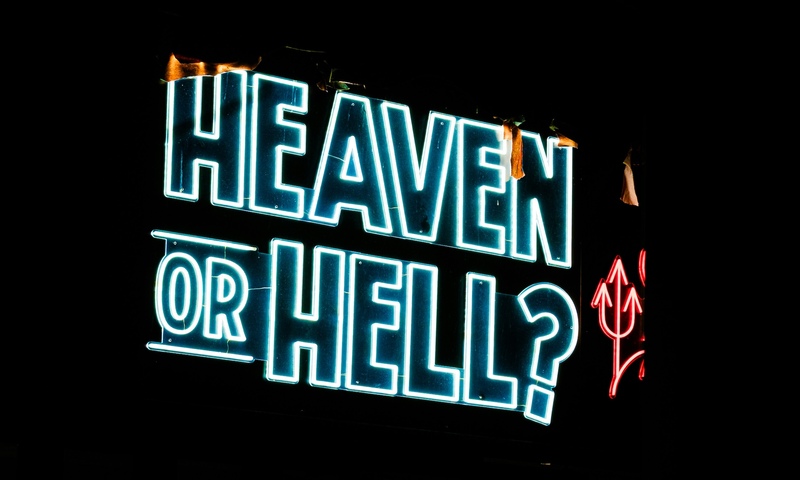
This is a Q&A blog post by Talbot School of Theology’s Visiting Scholar in Philosophy, William Lane Craig.
Question
My question was related to Hell. The specific question is: Why is there a dichotomy of Heaven or Hell?
A lot of people ask how can a loving God send people to Hell or how can Jesus be the only way to Heaven or something like that. My problem is different. I don't understand why there are only two options.
This is specifically for your theology, and not for universalism or annihilationism.
I've heard you defend Hell by using a criminal analogy. A criminal is facing a death penalty for his crimes but he can be offered a pardon. If he freely chooses to reject the pardon he will be killed.
It seems to me that when it comes to eternal life or eternal conscious torment, it's a very strange dichotomy. I understand that eternal life with an infinitely loving God would logically be the best thing, it would be perfect, there can be nothing better. I understand that. But why can't a person simply say "I do not want eternal life. I do not want eternal conscious torment. I simply want to literally die when I die. "
I simply cannot see how there's a free choice when you only have two options and one of them is eternal conscious torment.
Obviously, one could say God loves us all so much, he wants a relationship with us, he wants us to be eternally happy with him. It's illogical not to want that. Setting aside the huge issues with the difficulty of choosing to believe something that you think has insufficient evidence for, I still think this defence of God fails.
People often also defend Hell by saying you freely choose to separate from God and God simply grants that. Ok, but why can't God grant the free choice to die when you die. To simply not live on. I understand that you can say because it's obviously better to live with God and that I simply do not know the immeasurable good of knowing God. I still think that people should have the choice to simply say that they do not want eternal life or eternal conscious torment.
The dichotomy to me is just awfully troubling. This also seems troubling to me for the Molinism you defend, because it seems to me unfair to bring someone to Heaven if they haven't given themself to Jesus. If they do not want eternal life, but never received the Gospel, why do they have to be punished for eternity?
Your defence of Hell also revolved around how rejecting an infinite God is an infinitely evil sin or something like that and how people in Hell will keep doing that. But I don't understand how it's possibly a sin to say "I just want to die when I die". I simply do not see how there is free will if you, no matter what, have to live for eternity. Simply for existing, something we have no control over, we are forced into living for eternity, against our will. No matter how wonderful Heaven is, no matter how infinitely loving God is, without the ability to simply say "I will live a good life and do my best to follow the moral law you want me to. But when it ends, I just want it to end", I can't see how the system is remotely fair.
William Lane Craig’s Response
I can understand your frustration! I remember thinking, when I was a non-Christian, upon hearing the Gospel message, “I didn’t ask to be born! Why do I have to face a choice like this?” But although I considered my situation agonizing, I never thought it unfair of God to offer me such a choice, as you seem to. The reason for the difference between us is that I had, I think, a more serious concept of sin and considered myself to be a sinner before a holy God.
It seems to me that what you’re missing is the fact that we have already been tried before the bar of a perfectly just Judge, pronounced guilty and sentenced to our just desert (John 3.18). To recall the criminal analogy, a convicted criminal does not get to choose the sentence he wants! True, our system of justice permits plea bargaining with regard to sentencing considerations, but such an arrangement is really a compromise of perfect justice, which God neither needs nor permits.
So you don’t get to pick and choose your sentence! You may want to just die and be done with it, but that would be a compromise of God’s perfect justice and, therefore, a violation of His essential nature. If you refuse His gracious pardon, then you must bear the just punishment for your sin. To let you just die would be to let you off scot-free and to violate His essential justice.
It seems to me that you need to reflect more seriously about sin. Do you realize that when someone says, "I do not want eternal life. I do not want eternal conscious torment. I simply want to literally die when I die," he is expressing his antipathy towards God, which is unspeakably evil? Rather than say, “Thy will be done,” he says, “My will be done!” Such a person has no interest in knowing God and is willfully resisting the Holy Spirit and God’s every effort to draw him to Himself.
Certainly, you have a choice between heaven and hell. You will determine your own destiny. The fact that one of those choices is insanely bad does not imply that you do not have a choice. It is shocking how many people do choose to resist God’s grace and irrevocably separate themselves from Him forever. When you say, “people should have the choice to simply say that they do not want eternal life or eternal conscious torment,” you are forgetting that you already stand under the condemnation of a perfectly just God and can no more choose your sentence than a condemned criminal can choose his.
Your final paragraph confirms that you do not have a serious grasp of sin. To say, "I just want to die when I die" expresses utter indifference to God and is therefore deeply sinful. Indeed, it is the very essence of sin, to want nothing to do with God. It’s true that you are not free to determine whether you exist or not. But you do have the choice to respond to God’s love and forgiveness and enter a life more wonderful than you can imagine or to shut your heart against God’s grace. It’s not a matter of trying to live “a good life and do my best to follow the moral law.” It’s a matter of recognizing that that very moral law serves to condemn you as a moral law-breaker and turning to God to save you. Christ died for our sins, and by placing our trust in him as our Savior we can avoid the punishment we deserve.
This Q & A and other resources are available on William Lane Craig’s website.