Biola University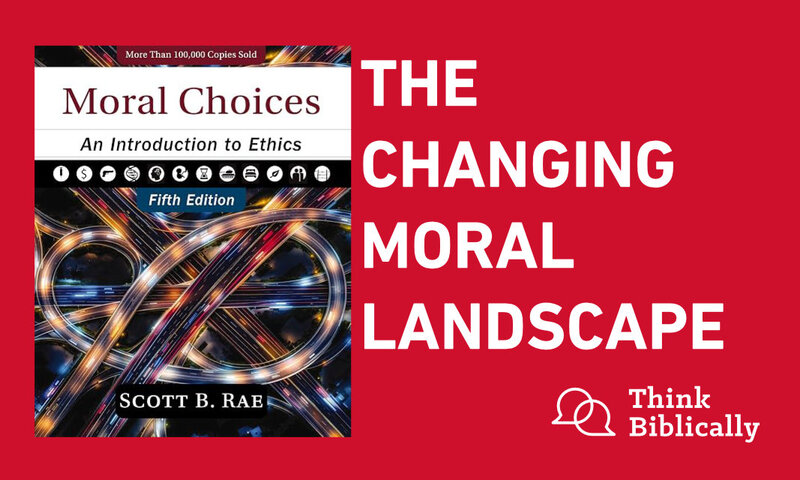
How has the ethical landscape changed over the past few decades? What new issues and technological challenges have emerged that Christians need to think about and respond to biblically? In this unique episode, Sean interviews Scott about the latest update (5th edition) of his best-selling book Moral Choices: An Introduction to Ethics. They discuss Scott's journey to becoming an ethicist, whether there are any issues Scott has changed his mind about, and what he considers the single toughest ethical issue today.
Episode Transcript
Sean McDowell: [upbeat music] Artificial intelligence, transgenderism, immigration, social media, socialism. The moral landscape has radically shifted in the past few decades. How can we best address the new technologies and ethical questions that have emerged with this generation? My guest today is also my colleague, friend, and co-host from the Think Biblically Podcast. Dr. Scott Rae, you are one of the leading Christian ethicists in America. You just released the fifth edition of your book, Moral Choices, which is one of my go-to texts on moral issues.
Scott Rae: Appreciate that.
Sean McDowell: I wanna say thanks for coming on. I, you know, I guess-
Scott Rae: [laughs]
Sean McDowell: ... That's a way to say thanks for coming on. But it's good to be in this chair, and I'm really eager to ask you some questions about your life, about how ethics has shifted, and the new update to this book, so this will be fun.
Scott Rae: Yeah, looking forward to it, and I'm happy to come on, so. [laughs]
Sean McDowell: All right, good All right, so let's start with your story, and I'm not sure I've asked you this personally. Why did you decide to become a professor, a consultant, and an author specifically in the area of Christian ethics?
Scott Rae: Well, Sean, it wasn't exactly a straight line journey.
Sean McDowell: Okay.
Scott Rae: Because when I... Basically when I graduated from college, the plan was for my, for my brother and I to come and take over the family business eventually.
Sean McDowell: Did you study business, by the way?
Scott Rae: Economics.
Sean McDowell: Economics, okay.
Scott Rae: Yeah, and you know, in my theological journey I never realized that my background in economics was gonna do me any good- ... Until it came full circle again, but that's a, we'll get to that in a minute. And so I decided, you know... I'd had some experience teaching the Bible, and it had gone well, and when I was a college student. And had some some people who built into my life, encouraged me with doing that. So I thought, "I'd like to go get a year's worth of training, and just to have, just to get a little bit more to be able to do this well, and then I'll I'll do that in, you know, kind of a gap year kinda thing. And then I'll go into the business and, you know, do what the, sorta the plan was." well, one year became two. And I realized after a year I didn't really have enough, and so two became three.
Sean McDowell: Okay. [laughs]
Scott Rae: And then by that time, you know, my heart had shifted a bit.
Sean McDowell: Oh, okay.
Scott Rae: And I And my dad saw that. And to his credit, he never, he never questioned it. He never gave me one- ... Bit of grief that the plan had changed. And so I started, I started out teaching. The only, the only teaching job I could get was just a ThM. Was a place where I was raising my own support. And it was a great experience. I developed friendships with J.P. Moreland for example.
Sean McDowell: Yeah.
Scott Rae: We were teaching at the same place. And then I started out doing... I was, I was, did my ThM in Old Testament. I started teaching languages and Old Testament. And realized that if I was gonna do doctoral work in that area and continue to teach, I would be dealing with a lot of questions that nobody was caring about.
Sean McDowell: Hm.
Scott Rae: At least that was, that was my perception.
Sean McDowell: That was your perception.
Scott Rae: That was my perception.
Sean McDowell: Okay.
Scott Rae: Now, obviously our Old Testament faculty here at Talbot are dealing with a lot of questions that a lot of
Sean McDowell: Course
Scott Rae: ... Really care about.
Sean McDowell: Of course.
Scott Rae: But I didn't see a track- ... To where I could be relevant and be, you know, and be true to my theological background at the same time. And so what I was looking for was an area where I could bring my theological background to bear on the issues that I was reading about in the front pages of the newspaper. And this is where, my, the interest in ethics developed because, you know, back... This was back in the, you know, the mid to late '80s when IVF was... Wasn't even, wasn't even 10 years old. And surrogacy, that was the stuff. TV miniseries were made out of these surrogacy cases-
Sean McDowell: Oh
Scott Rae: ... That had just gone off the rails. And so, and you know, end-of-life technology was just beginning to get, you know, get a lot of traction. And at that time, bioethics was the field I ended, I ended up in mainly, was, had been co-opted. It was started out in a religious cradle but had been co-opted by secular philosophers. And so having a, having a, the theological voice that would impact issues that the average person was reading about every day. In fact, I you know, several years later, I told my dean, "If you ever think about letting me go, just keep reading the paper."
Sean McDowell: [laughs]
Scott Rae: [laughs] and so that's sort of how it started, and I wanted something where I could, you know, I could be relevant to the issues of the day, but also where there was room for my theological and biblical background to have, to have an impact.
Sean McDowell: So my dad is more than a decade older than you are, and one word I use for him is pioneer, because he's writing apologetics books and talks when nobody had really done that at that time. It was new, and it was novel, and he was trying things. In many ways, you're kind of a pioneer. I can pick up a fifth edition of your book, Magus' book. There's textbooks that address these issues and podcasts, but really when you wrote the first edition, were you kind of not inventing out of thin air, but writing stuff in a way that you couldn't just find and copy and paste, for lack of a better term, and just nuance?
Scott Rae: I think, Sean, among evangelicals, I think, largely yes.
Sean McDowell: Yeah.
Scott Rae: That was probably more true in the area of business ethics than in bioethics, because the the number of evangelicals writing in business ethics was a very small fraternity- ... When I first started out doing that. Quite a larger one in bioethics, and the the tribe was mainly Catholic-
Sean McDowell: I was just gonna ask
Scott Rae: ... At the time.
Sean McDowell: That makes sense.
Scott Rae: Because the papal encyclicals had dealt with a lot of these issues. There were a few Protestants. You know, Paul Ramsey was a well-known Protestant in the, you know, in the seven, you know, '60s and '70s who was writing on some of this. But it was still a relatively small fraternity. The Center for Bioethics and Human Dignity was founded in the You know, probably mid-'80s. That I think was the impetus for a lot of evangelical involvement in ethics. But in terms of some of these other areas, you know, that was, you know, evangelicals I think were a little later to the party.
Sean McDowell: That's fair. So let's go... You wrote a book called Moral Choices: An Introduction to Ethics. Now, I think most people would say, "I know what ethics is. Check. Move on." Let's slow down, define our terms. What do we mean by ethics?
Scott Rae: Well, Sean, I distinguished between ethics and morality. You know, most people use those terms interchangeably. I catch myself doing that periodically.
Sean McDowell: Sure.
Scott Rae: So I don't, I don't give people a lot of grief for doing that, but technically they're different things. Morality has to do with the substance of right and wrong.
Sean McDowell: Okay.
Scott Rae: You know, the actual content of right and wrong. Ethics has more to do with how you get there. It's more the process by which you discover right and wrong, and using that term discover instead of create right and wrong, that's a big difference to make.
Sean McDowell: A huge difference, yes.
Scott Rae: Because the task of Christian ethics is the task of discovering right and wrong, not the task of creating it on your own.
Sean McDowell: Okay, so ethics and of course metaethics, you kind of muzzled in metaethics, which is a branch beneath ethics more largely.
Scott Rae: Correct. It's one specific field that has to do with, it has to do with the language of morality, and it has to do with how you actually discern what a normative ethic would be. You know, and most of, most of the book actually is doing normative ethics, which is the establishing of moral norms and applying them to specific issues and scenarios.
Sean McDowell: Okay. Good stuff. So when it comes to, say, we're doing ethics, we're kind... You're kind of doing two things. You're laying out here's different systems of ethics, here's what a Christian system is, and then here's how we would apply this to IVF, surrogacy, business, war-
Scott Rae: Right
Sean McDowell: ... Et cetera.
Scott Rae: Normative ethics would include both what I think is classically referred to as a moral philosophy, but it also, it also deals with, what we, what we've come to call applied ethics. And so the the book, the book actually covers both of those things. So the first three or four chapters deal with the foundations for ethics, how to think about morality, what's a Christian ethic, how to, you know, what are various ways of thinking about right and wrong. But most of it is the application of that foundation to the various issues of the day.
Sean McDowell: That makes sense. Okay, good. So let... Here's a question sometimes people will say is they'll just say, "Why be moral?" Why does thinking about ethics and becoming an ethical person even matter?
Scott Rae: Because most of us would not choose to live in a world where morality didn't matter.
Sean McDowell: Okay.
Scott Rae: Okay? Because, as I lay out in the first chapter, it's either you... It's either a concern about morality or it's the Lord of the Flies- ... Where might makes right, and, you know, morality comes at the edges of power. And most people don't wanna live in the world that the Lord of the Flies characterizes, where morality doesn't matter. And we, you know, we are, we are fundamentally moral beings. God has, God has made us to be moral beings. There's the laws written on our hearts, Paul tells us in Romans 2. And so we all, we all have a moral sense. Now, it's been corrupted by sin, of course, and the, so the lenses through which we see morality are somewhat clouded, probably, and they're probably more clouded for some people than others. Where I would say the lenses for somebody like a sociopath who is incapable of having a moral feeling, though I say those lenses are pretty well clouded over-
Sean McDowell: Yeah
Scott Rae: ... And they don't see anything. That's... The Bible describes those people as their conscience being seared and be, I mean, being rendered useless. That's what that's what I think that term means. So, now, I think, I think still today we largely, although I think that's, this is eroding in in America and in the West, I think it's still somewhat strong in other parts of the world. We connect being moral with being a good person and having a good life and being in a good society. This is where the ancients, Sean, I think really had it right. Because the ancient Plato and Aristotle and the ancient Greeks explicitly connected virtue with a good life. You could not have a good life if you weren't also a virtuous person. And I think that largely I think is still intact today. We look at somebody who, somebody like Mother Teresa, who doesn't have anything that our culture values as being important, yet I think we still consider her as a moral hero. Where I think we would look at somebody who maybe is at the top of their profession but is on their third marriage, alienated from their kids, has a drinking problem, you know, that, you know, has a paucity of friendships. I think we would look at that person as the way my seminary mentor described it, as they, you know, they climbed to the top of the ladder only to find out it's leaning on the wrong wall. And the wall it's leaning on is not the wall where we would consider that a good life. Or even, I don't, I don't even think we'd consider that person a success. A professional success, but somebody who is a personal life disaster and a professional success, we still look at them with jaded eyes. And I think correct, correctly so.
Sean McDowell: You know, I ask you the question why be moral? It's only a question somebody asks, like, in a classroom [laughs] that's divorced from real life.
Scott Rae: Exactly.
Sean McDowell: The moment I walk into real life, it's like driving a car, I want other people to be moral. Going to a bank, I want people to be moral. I get married and I make a commitment, I want people to be moral. It's such an obvious question that it's almost like I don't need to convince you you need to be moral, I need to just
Scott Rae: Show you
Sean McDowell: ... To the surface.
Scott Rae: Yeah.
Sean McDowell: You already know this and you value this. But you're right, it gets to the heart of the question, what is the good life? What is the life worth living? And I think we know across cultures that we can't separate that from being a moral person. Even if we differ over some of those particulars, it's still a piece of it. So if we wanna live in a society for which we can function, and if we wanna live the good life, you can't escape the question, why be moral? Now, with that said, let's go, let's get a little more in detail in your book. What would be a uniquely Christian approach to ethics, and how does it differ from both atheism and other faiths? And I realize within Christianity there's different approaches to ethics. So what are some of the big key pieces that help us have a Christian ethical framework?
Scott Rae: Well, for one, it, the, main thing I think that distinguishes a Christian ethic from everything else across the board is how it's grounded.
Sean McDowell: Okay.
Scott Rae: A Christian ethic is grounded first and foremost in the character of God. And it's a sort of simple proposition actually because we have the morality that we have because we, because of the kind of God that we, that we worship. So for, you know, for example, you know, we say love makes the world go round, which is true. But the reason we're called to be loving people is because God is fundamentally that kind of God. We say that we value forgiveness, because it heals fractured relationships, and that's true. But the reason that forgiveness matters like it does is because God is fundamentally a forgiving person. And that's the way it is for all, I think all of our moral demands. And the commands of God fall out of his character. They reveal his character, but they also follow from his character. That's why we say God's commands are not the ultimate source for morality. They're a penultimate source. God's character is log- I think logically prior to his commands. And then the you know, the specific moral principles that we develop fall out of those commands as well. But that's, I think, fundamentally what sets Christian ethics apart from everything else across the board. That's not to say that people who take different approaches to ethics can't be moral people, can't have ethic-
Sean McDowell: Of course
Scott Rae: ... Ethical standards and guidelines.
Sean McDowell: Of course.
Scott Rae: It's just how they're grounded is actually what makes the difference.
Sean McDowell: So this is kind of a metaethical question, that God exists, God is real. So we have a version of what's called moral realism. These are not things we invent, they're things, to use your language earlier-
Scott Rae: Yeah
Sean McDowell: ... We discover. And then second, this God has revealed himself and his desire for the world either through Scripture, or definitely through Scripture, also through the natural world. So the starting place of who God is, how he's made us and how he has revealed himself, is going to be distinct to a Christian world view than when it gets to some of the particulars of, like, virtue ethics versus some other-
Scott Rae: Right
Sean McDowell: ... System. That's where
Scott Rae: But the way you framed that is really important.
Sean McDowell: Okay.
Scott Rae: Because, you know, God has revealed his moral standards both in his word and in his world. And I think the Proverbs talk about how he's revealed, like you described, in the natural world. But then the natural, quote, "natural world" is broader than just what we might think because the world of human interactions also is included in that. 'Cause the Proverbs talks about, you know, looking at the looking at the ant and how the ant, how diligent the ant is and to take a lesson for the sluggard from that. But it also, later on in Proverbs, makes the same moral application to the sluggard, but it's from the realm of human relations. It's from the realm of a person who is not diligent in their work and is basically going bankrupt. And so take, the proverb is saying, "Take a lesson from what you observe about how God has revealed this in his world." And also, Sean, throughout the prophets, the prophets hold the pagan nations surrounding Israel accountable for as many of the same things that they're holding Israel accountable for.
Sean McDowell: Mm-hmm.
Scott Rae: Which suggests that, you know, that unless God is unjust, it suggests that they have some access to God's moral standards even though they may not have access to Scripture itself. And just not having access to Scripture does not give, does not give different cultures a pass on moral accountability to the standards that God has revealed in his world. And one of the best contributions that C. S. Lewis ever made in his book The Abolition of Man, it's the appendix that a lot of people don't read.
Sean McDowell: It's brilliant.
Scott Rae: ... Brilliant. Where he describes all of the things that ancient civilizations and more contemporary ones have in common morally. And I'm convinced that the number of things we actually have in common morally far outweighs the number of, places where we have differences. And just like you were describing, just the way we function in real life presumes all sorts of levels of trust morally speaking. I mean, I trust that my bank is not gonna abscond with my money. I trust that, you know, when I drive on the correct side of the road, everybody else is gonna do the same thing. And those levels of trust all have a moral foundation to them.
Sean McDowell: Yeah.
Scott Rae: So I think just being out in the real world, like you describe, you see how important, the moral framework is by which most people, we can't function without it.
Sean McDowell: Hm. I interviewed J.P. Moreland recently. You guys go way back to grad school, and one of the questions I asked him is just how the apologetic landscape and philosophy landscape has changed over the past four decades plus. What would you say to that question framed in terms of ethics?
Scott Rae: Well, that's why, that's why I got five editions out of this.
Sean McDowell: Yeah. [laughs] Okay.
Scott Rae: [laughs] And
Sean McDowell: There'll probably be six and hopefully seven, and...
Scott Rae: I hope. And you know, about every seven years or so, we would put out, come out with a new edition.
Sean McDowell: Okay.
Scott Rae: Or we would start, basically, we'd start, we'd start writing it.
Sean McDowell: Hm.
Scott Rae: And by the time it was published, hopefully it was not out of date.
Sean McDowell: Hm.
Scott Rae: And I actually worry, Sean, with this edition that some of the stuff I wrote about social media-
Sean McDowell: Artificial intelligence
Scott Rae: ... And about artificial intelligence-
Sean McDowell: Oh
Scott Rae: ... Would be out of date by the time the book made it through the editorial process and actually got to print.
Sean McDowell: So is that one of the changes, just the speed of ethical change-
Scott Rae: It's huge
Sean McDowell: ... Is faster than it
Scott Rae: Much,
Sean McDowell: ... Let alone 40 years ago.
Scott Rae: It's much faster. Although the, you know, in in every, in every decade you've had things that caught us by surprise.
Sean McDowell: Hm.
Scott Rae: So the fact that, you know, reproductive technology would take off like it did in the '80s I think caught most people by surprise. The fact that the and end-of-life issues would be so prominent and we would, we'd be pushing for laws to legalize assisted suicide in the '90s became, it just, it just, it came so fast.
Sean McDowell: Hm.
Scott Rae: And how same-sex marriage went within a decade from being, you know, voted down in
Sean McDowell: California, Prop 8
Scott Rae: ... Of all places-
Sean McDowell: Yeah
Scott Rae: ... To being, you know, just-
Sean McDowell: Hm
Scott Rae: ... Almost universally accepted culturally. You know, and then the you know, the trans stuff in the, you know, in the 2010s and early 2020s, you know, the what I would call the trans hysteria that swept Europe and North America, just was astounding in the speed with which it took place. The other thing that I think has really changed is that I don't think it's true that moral relativism is the fundamental way that culture thinks about right and wrong.
Sean McDowell: I agree, but I'm intrigued to hear why you say that.
Scott Rae: Because I think there's a new absolutism that has taken hold in the last probably 15 years. Cancel culture, I think, is the, is the ideal example of that.
Sean McDowell: Hm.
Scott Rae: Where if you don't, if you don't meet every tenet of the ideology of your tribe, you're out and you're canceled. And it, and the cancel culture, you know, may be less of a thing than it was 10 years ago, but it is still a thing. You know, our friend Jonathan Haidt, was nearly denied, the opportunity to give a commencement address at a, at a, at a local university because of his controversial views about the coddling of the American mind.
Sean McDowell: Hm.
Scott Rae: And the students who didn't like thinking of themselves as having been coddled, really wanted to see him canceled. Now, the the commencement address went on, but he ruffled a lot of feathers, and I think, in my view, justifiably so.
Sean McDowell: Hm.
Scott Rae: So I think there's a new sense of moral absolutism that I think, I think is actually more stringent maybe on the secular side than it is on the religious side.
Sean McDowell: Oh, more stringent. So you see it on the left and the right.
Scott Rae: Both.
Sean McDowell: But you do think it's more stringent
Scott Rae: I think it, yeah
Sean McDowell: ... The secular side
Scott Rae: ... It's more... What's the best way to put that? It's more strident.
Sean McDowell: Hm.
Scott Rae: And it's more, it's more, it's, I mean, the absolutes are more absolute.
Sean McDowell: Hm.
Scott Rae: And God help you if you transgress some of those things. Because I think the idea that somebody would still be canceled, you know, maybe is now more just part of the landscape as opposed to being something that's new that we just, you know, we're just getting used to.
Sean McDowell: Okay. So big changes are the speed of change. We're not moral relativists. Moral absolutism. Obviously just the technologies have exploded-
Scott Rae: Oh, yeah
Sean McDowell: ... Things like social media and-
Scott Rae: Yeah. The new issues are being created all the time.
Sean McDowell: Hm.
Scott Rae: So that's a, that's a constant. And every edition has had new issues-
Sean McDowell: And yeah
Scott Rae: ... That I've had to address.
Sean McDowell: One of the ways I look at apologetics, I say there's timeless issues and there's timely issues. There's also, when I look in the back of the issues here, it's like abortion. That, at least since I've been around, the '70s, has been a huge issue. Economics hasn't gone anywhere. Creation care hasn't gone anywhere, although it's changed. War hasn't gone anywhere. But social media, clearly new wrinkles. So there's some of both, it sounds like, as you see it.
Scott Rae: Right. Right.
Sean McDowell: Okay. That's fair. Give me, give me an example, one or two, of an influential competing ethical system that differs from Christianity, one that you think is prominent, whether it's relativism, expressivism, some other kind of common ethical framework that seem, utilitarianism, that seems to kind of pervade our culture.
Scott Rae: Sean, I think there's really only one that people are capable of living with consistently.
Sean McDowell: Hm.
Scott Rae: And that, I think, is a, is, you know, the broader category we call consequentialism-
Sean McDowell: Hm
Scott Rae: ... Of which utilitarian ways of thinking Are the primary ones. And I think this is pri- it's primarily the way atheists and the non-religious folks who care about having some sort of moral standards, that's the way fundamentally they think about morality.
Sean McDowell: Yeah.
Scott Rae: And it's, the way it's done, the way it's being done in the culture, I would call this, pardon my French here, I would call this a bastardized utilitarianism because people are not so much weighing the the harms and benefits of a certain moral decision or a moral criterion. They are essentially not... The weighing is not taking place. It's become, it's it's devolved into a do no harm, type of ethic, where as long as you're not doing something that is overtly harmful, explicitly harmful to people, everything else, you know, everything else is permitted.
Sean McDowell: Yeah.
Scott Rae: Whether it, you know, whether it provides any benefit or not is less relevant than whether it's, whether it's causing harm. And I think you know, one of the examples we just, I tell you, we just read about in this volume was debating the existence of God, had, and one of it was about the moral argument for God, and the person who was arguing against theism was arguing on the basis of this it was exactly this bastardized utilitarianism. Because they say as long as what you're doing doesn't cause harm, everything's permitted. What I wanted to say was, who says that avoiding harm should be a moral principle? Where does that come from? And either it comes from a moral intuition that we don't do harm, but I'd like to say, you know, where did that come from? So that just pushes it back a step. But who says that avoiding harm should be a moral principle or a moral standard? And I think, I think, again, I think utilitarianism it smuggles in, the way I put it in the book, it smuggles in moral principles and values and virtues in order to make a discussion of consequences work. Because who says that a certain consequence is beneficial? You know, what makes a certain consequence harmful? It's only because we have a prior commitment to principles that we've smuggled into that a utilitarian system actually works. But that, I think, is fundamentally how people in the culture view morality. Now, you have, you talked about expressivism, where people, you know, people will basically say that our our moral language just is vacuous. Just doesn't mean anything. It doesn't refer to anything. It's just, it's just our emotions. It's basically moral cheerleading for positions you like to hold. But nobody lives with that, you know? And I would say expressivism dies the first time somebody is a victim of injustice. Because if you're the victim of injustice, you're not, you're not having a debate about moral systems any longer. You have become a profoundly virtue or principle-oriented person because if you, if you push a person hard enough, you will, they will simply say, "No, I'm the victim of injustice, and that was just flat wrong."
Scott Rae: And they're they, may see that as a what we call a brute fact. It doesn't need any justification. I think there are probably some moral positions that are like that, where our friend Bill Craig says if you know-
Sean McDowell: Right
Scott Rae: ... If, you know, if you think sexual assault is okay, you don't need an argument, you need a therapist. I would say you probably need a mental institution, if that were the case. So anyway, I think I would say utilitarianism is the way most people who care about morality still think about it without being explicitly Christian. Now, to be clear, the Bible does have, consideration of consequences. You know, but it's, but I would say it's the caboose on the train, not the engine that drives it.
Sean McDowell: Oh, that's fair.
Scott Rae: So the, and the Proverbs, for example, appeal to consequences for living a life of wisdom, and and a life of wisdom in the Proverbs is, by definition, a life of character and an ethical life. So I think there's a place for considering consequences, but it's not the thing that drives the train.
Sean McDowell: You said there's pretty much only any one ethical system that people can kinda live out, and I think you'd agree with me that they could come close to living out, but not really live out. Because even in the harm ethic, it kind of assumes that I have some kind of duty to you, namely not to harm you. Where does that duty come from? Now, evolution could give us a feeling of that duty, but it couldn't ground that I have an actual duty. If I don't harm you, that assumes you have some rights. You have some value. Well, those are not physical things. Those can't evolve. They don't pop into existence. So even this minimalistic harm ethic, which doesn't come close to what you said earlier about the good life, would anybody really say the good life is somebody who just didn't harm anybody else? [laughs] I think we'd be like, "No, the good life is somebody who has virtue and has done good to positively, in education, or in communications, or in healthcare," like they've positively contributed, which tells us we just kind of intuitively know that this minimalistic harm ethic is bankrupt, and it's not enough. But it maps onto this autonomy, this kind of self-directed moral life which we see, so praised, I think, in at least Western culture and beyond today.
Scott Rae: Well, but and we say, Sean, we say that we value autonomy, we value being able to make up our own moral rules for ourselves, but we really don't believe that. Because nobody lives that way. And you, and again, you, all you have to do is become a victim of injustice to realize that if your moral rules justify that, then I have been wronged. And I have been, I have been objectively and subjectively wronged. And those, I think, that's a charge that I think we can sustain. And I, and again, I think the bar, the bar needs to be considerably higher than just not doing harm. I remember I was, one of the hospitals I consulted with, they had an integrity officer. An integrity office, which I thought, being the ethics guy there, I was kind of interested to see what-
Sean McDowell: Yeah
Scott Rae: ... What does this person do? So I said, "Tell me about what your job is." I so appreciated that she was so forthright and so honest about what the answer was. She said, "My sole job in this integrity office is to make sure that our top executives don't go to jail."
Sean McDowell: [laughs]
Scott Rae: And I couldn't help myself. I said, "Really, I'd really like to think the bar is higher for an integrity office, that it ought to have something to do with ethics and values and what we value as an organization. It, hopefully it's a lot more than ending the calendar year without indictments being handed down-
Sean McDowell: Oh, man
Scott Rae: ... To our executives." And I think that's that minimalist ethic, but nobody lives that way.
Sean McDowell: Yeah.
Scott Rae: Nobody. I mean, again, you just have to become the victim of injustice to realize that that minimalist ethic is not gonna do you any good.
Sean McDowell: You know, it's interesting. If we believe in autonomy, you have the right to live how you want to. That's one moral rule. But if now I have the right to live however I want to, and I have to respect your autonomy, now this is a rule that goes beyond the individual and says we are all bound to follow this, now there's something beyond autonomy directing the way that we're supposed to live. That's why you can't just practically and philosophically reduce it to one principle. It doesn't work.
Scott Rae: Well, and we, you know, what do we say to the person who says, "You know, I believe that my calling is to be the most effective administrator of torture in the world"? What would we say about that as an exercise of autonomy? You know, I think we would say there are some, there are some exercises of personal autonomy that, go outside the bounds, and that we shouldn't allow autonomy to be an absolute. And autonomy is as soon as you, as soon as you bring other people into the picture and have conflicts where my autonomy conflicts with yours, then if it's not, if it's not about power, then we have to have some way to arbitrate between those claims of autonomy. And it's only with a moral system that gives- ... Us a way of ranking those things that we have the ability to do that without resorting to violence or resorting to the exercise of some sort of power system.
Sean McDowell: That's where back to the first question I asked, a Christian ethic would say we have the duty to love other people, not just resist harm, but love other people, and I think that resonates with what we know is the good life, someone who's loved others well. Now, I want to ask you this question. I asked you this, gosh, probably when I was in your class [laughs] in the '90s.
Scott Rae: [laughs]
Sean McDowell: When it was, I don't know, maybe second, third edition, whatever it was. And,
Scott Rae: Now, you may, that may have been the first
Sean McDowell: ... The white one with the dark on it I think is the one I remember.
Scott Rae: That one was, that
Sean McDowell: Was the second
Scott Rae: ... The second.
Sean McDowell: Okay.
Scott Rae: That was the second.
Sean McDowell: So you talk about euthanasia, abortion, gun control, the environment, artificial intelligence. Which issue do you think raises the most difficult, like, thorny ethical questions that is just so hard to untangle? Which one is just the most difficult, and why that issue?
Scott Rae: It's not one of the ones you named.
Sean McDowell: Okay.
Scott Rae: Actually. And it's been, it's been that, it's been this way for a while, and I don't think we've made much progress on it, and that is, it's the issue of human enhancement.
Sean McDowell: Oh, okay.
Scott Rae: In fact, we just saw the, what was the title of it? The, I think they called them the Enhancement Games, which was a a series of Olympic-style events for people who were totally on all sorts of, performance-enhancing drugs.
Sean McDowell: Wow.
Scott Rae: And it was, it was supposed to be this parallel. It just, it just happened, like, a week ago. And it was, you know, they made no apologies for it. They said, "We're the steroided-out group." and it's now, that's now become a little bit more of the mainstream. Now, they're not gonna be allowed in the Olympics or any, or the-
Sean McDowell: Yeah
Scott Rae: ... The World Cup or anything like that. But how we, how we determine what ways of enhancing otherwise normal traits is ethical- ... I think, is still, has still not been determined. Now, this, the good news here is that our theological resources give us some help that the debate in the secular culture doesn't give us because the secular culture that's debating this, and there's a lot of good, a lot of good that's come out of that, but they distinguish between treatment and enhancement. And we use medicine to treat things that are clearly-
Sean McDowell: Mm-hmm
Scott Rae: ... Diseases. But we also use medicine to enhance otherwise normal traits. So for example, we use, we use beta blockers to help people who have social anxiety disorders, and just to calm their nerves when they're in public.
Sean McDowell: Sure.
Scott Rae: Guess who else is using them.
Sean McDowell: Tell me. The-
Scott Rae: Concert musicians.
Sean McDowell: Oh, okay.
Scott Rae: Concert performers. Guess who else uses them? Neurosurgeons- ... To calm their nerves before they operate on your brain. Now, I, you know, I'm not crazy about some of these off-label uses, but I admit, I sort of like the idea of my neurosurgeon-
Sean McDowell: [laughs]
Scott Rae: ... Having extra calm nerves.
Sean McDowell: I don't disagree. [laughs]
Scott Rae: You know, so and we have, you know, I mean, for another example of this is, Ritalin, which is used to treat, ADHD.
Scott Rae: The last surveys I've seen is roughly 15% of college students take Ritalin off prescription. They borrow it from friends, or they buy it from friends who are being treated for it twice a year. Guess which two times of year those are?
Sean McDowell: What, finals or?
Scott Rae: Final exams.
Sean McDowell: Yeah.
Scott Rae: Finals in the fall-
Sean McDowell: Yeah
Scott Rae: ... And finals in the spring-
Sean McDowell: Yep
Scott Rae: ... To give them an extra jolt of concentration. I've actually heard, Sean, a, an African American woman in the, in the field who was suggesting that we use, we make these enhance, enhancement, these mental enhancement, technologies available to disadvantaged communities to help level the playing field, which is putting it much more in the mainstream.
Sean McDowell: That's really interesting
Scott Rae: ... Which I, which there, you know, there's a sidebar on that in the book-
Sean McDowell: Wow
Scott Rae: ... On her point. Now, what makes this so tricky is that the line between treatment and enhancement just got really fuzzy on some of those things. You know, are we treating, social disadvantage, socioeconomic disadvantage as a disease that we need to have a treatment for, or are we, are we saying that's enhancement? You know, I don't, I don't, I'm not quite sure how to think about that. Or even take something as simple as, you know, male pattern baldness. You know, I'm not so sure I want to call that a disease that we have to treat, but it's certainly not, it's not the norm.
Sean McDowell: Yeah.
Scott Rae: So where's the line? And so our theological resources, I think, help us here because the things that are the result of the general entrance of sin, I think, are conditions that we can say medicine should be treating. But the things that are not are things that we ought to accept as the givens of life and not try to enhance our way out of those things. And so, you know, we do, we do a lot of things that we accept to enhance otherwise normal traits. We do, we do exercise. You know, vaccines enhance our immune system. We've got all sorts of things we do. We memorize the scripture to enhance our spiritual awareness and sensitivities. You know, but where does, where do we draw the line between using technologies where- ... You know, we can say that we accomplish these things through hard work and effort, but also with a major technological boost to it? And so that I think is still, I think still remains unresolved. And with our autonomy culture the way it is, I don't, I don't have a lot of hope-
Sean McDowell: No
Scott Rae: ... That we're gonna put a lot of guardrails around this. And particularly, Sean, when it comes to parents giving their children the best opportunities they have to succeed in life, I think parents will have very little ability to resist some of these enhancements when they're made available for their children.
Sean McDowell: And it might favor the rich and wealthy in ways it doesn't others-
Scott Rae: Undoubtedly
Sean McDowell: ... And create a greater gap.
Scott Rae: Undoubtedly, it will create a, it will further exacerbate the gap between the haves-
Sean McDowell: That's already there
Scott Rae: ... And the have-nots.
Sean McDowell: If you want us to do a deep dive on this is really interesting, and explore this, put a comment, let us know, send us an email. I've not seen somebody really walk through this, and I did not expect that answer. I'm intrigued. I sat next to this huge guy years ago, and he was a Christian. He said he's the world record bench press holder-
Scott Rae: Huh
Sean McDowell: ... Non-steroid. And it made me think, I wonder what the difference is between steroid [laughs] and non-steroid. Anyways, that would get us aside. I have a couple more questions for you. How do we decide of the issues covered in this book what ethical issues Christians can just agree to disagree on, and which are more non-negotiable that we might consider heretical and we should divide over?
Scott Rae: Yeah. I think, Sean, the issues where, for one, the Bible doesn't speak as clearly as we would like it to, those I think we can agree to disagree on because there, we can, we can disagree about what exactly the Bible teaches on some of those. I think, for example, I think what our immigration policy should be is one of those because- ... The Bible doesn't give us specific policy prescriptions. It gives us more broad, general moral principles. How we apply those to immigration policy, I think, is something we can agree to disagree about.
Sean McDowell: Okay.
Scott Rae: I think another criteria I would use is to what does the Bible make its appeal in, when it gives the particular moral standard that it does? So for example, in marriage, you know, the Bible makes its appeal for heterosexual marriage in Ephesians 5 based on an appeal to the analogy with Christ and the church. So if it's, if it's appealing to something that is timeless and specifically theologically grounded, then I think that makes it more, I think that makes it less negotiable. Now, another example of this would be on the death penalty, and Genesis 9 makes an explicit appeal for the life for life principle to human beings made in the image of God.
Sean McDowell: Mm-hmm.
Scott Rae: Right? Now, I think we can disagree about exactly what that
Scott Rae: that there's a lot of, lot of debate about that. And I think we can, we can debate about whether the procedural parts of the death penalty fit with a Christian morality. And I think there's room to raise questions about some of those things. But I think in general, I would say that the the Bible supports in a, it supports the general notion of life for life not being immoral based on the fact that human beings are made in the image of God. So I think the more explicitly it appeals to something that is timeless and theologically grounded, the less negotiable it is.
Sean McDowell: Okay. Fair enough. Good stuff. Clarity of scripture is important. How theologically central something is is important. Okay. Have you changed your mind on any significant ethical issues since you started this journey or wrote the first edition? If so, what and why?
Scott Rae: I have, I have become more nuanced on several things, but I think I have, I have changed my mind a bit on the death penalty. Not that it's intrinsically immoral, but I've changed my mind on the force that these procedural elements have, the weighting I give to those.
Sean McDowell: When you say procedural elements, what do you mean?
Scott Rae: I mean, the, certainty of guilt-
Sean McDowell: Oh
Scott Rae: ... Is one.
Sean McDowell: Okay.
Scott Rae: Because the, you know, the number of people who were exonerated, who were on death row and exonerated after the advent of
Sean McDowell: DNA
Scott Rae: ... Evidence-
Sean McDowell: Yeah
Scott Rae: ... Is striking in my view. The discriminatory way in which the death penalty is applied racially. The notion that, the death penalty, short-circuits further opportunities to present the gospel to someone for them to come to repentance. So those elements, I think, are... Those weigh more heavily on me than I originally thought in the first and second edition.
Sean McDowell: So less the principle of life for life and what scripture teaches, but how it's applied is what gives you more concern and pause and hesitation- ... Than you did in the past.
Scott Rae: Correct.
Sean McDowell: Is that fair?
Scott Rae: Yeah.
Sean McDowell: Okay.
Scott Rae: And I think the other place where I've become more nuanced is, and you'll appreciate this given some of our conversations, is I've become clearer, I think, in the way in which the standard of practice in in vitro fertilization- ... How problematic that is. Where I, you know, in the first couple editions, I didn't mention stuff about freezing embryos. I didn't, you know, I didn't mention, you know, some of the, some of the attrition rate that happens when embryos are thawed. And the standard, the standard of practice I've always known has been problematic, but I think I've come to appreciate the challenge in doing IVF ethically, which I still think can be done. But it is much more challenging than I let on in the first couple editions.
Sean McDowell: That's fair. And if people are like, "How is that done?" They can go back year two. We had a friendly debate and disagreement about that, and I've still been thinking in my mind responses to some [laughs] of the things that you said. We gotta have part two in due time.
Scott Rae: Hear
Sean McDowell: But, how do you hope people use this book? Who'd you write it for? 100,000 copies sold is amazing. Moral Choices, that's remarkable for a book of its kind, but any last thoughts on your hopes for this edition?
Scott Rae: Well, it was designed for students, pastors, and thinking Christians who are dealing with a lot of these issues. I I really, I really want pastors to use it to become informed about the issues that their people are wrestling with, and if you don't think that your people are wrestling with these issues, you're not paying attention. I want students, I want students to understand it because and then I think for the average, the average person in the pew, to understand some of these things because, you undoubtedly have friends or you have family members who will deal with some of these things, and you need to be equipped to have at least have the beginnings of some conversation with them about... You know, for example, I give, I tell people if, you know, if you are, if you're not equipped to help people walk with a loved one through the end of life, you will eventually have to do that yourself. Unless you're completely alienated from all your extended family. You will walk with, you will walk with someone through the end of life, and helping someone navigate that I think is really important, and it's a... And given that people think about spiritual things the way they do at the end of life, the opportunity for the gospel is something that we can't neglect.
Sean McDowell: Well, Moral Choices is my go-to text, and that is true before I worked here at Talbot [laughs] and before we started this podcast. I think it's excellent, and, there's a certain wisdom that you bring from doing this over four decades, but just staying up to date, like with our weekly cultural update, you're just reading the news all the time-
Scott Rae: Oh, yeah
Sean McDowell: ... And thinking through these issues.
Scott Rae: That
Sean McDowell: So I think it makes it really unique
Scott Rae: ... That's where all the sidebars came from.
Sean McDowell: Oh, good [laughs] I love that. That's awesome. Well, friends, pick up a copy of Moral Choices: An Introduction to Ethics by, my co-host friend, Dr. Scott Rae. Make sure you hit subscribe, and we would love to have you join us at Talbot School of Theology. I've told you this. I did the MA Philosophy and Ethics program, and it was... It's no exaggeration to say that it was life-changing for me. Students could do it in person. They could do it online. Of course, we have plenty of other, programs at Talbot as well. Scott, this is fun, man. Thanks.
Scott Rae: I've enjoyed it. Hey, thank, thanks for, having me on.
Sean McDowell: [laughs] You bet. [upbeat music]