Biola University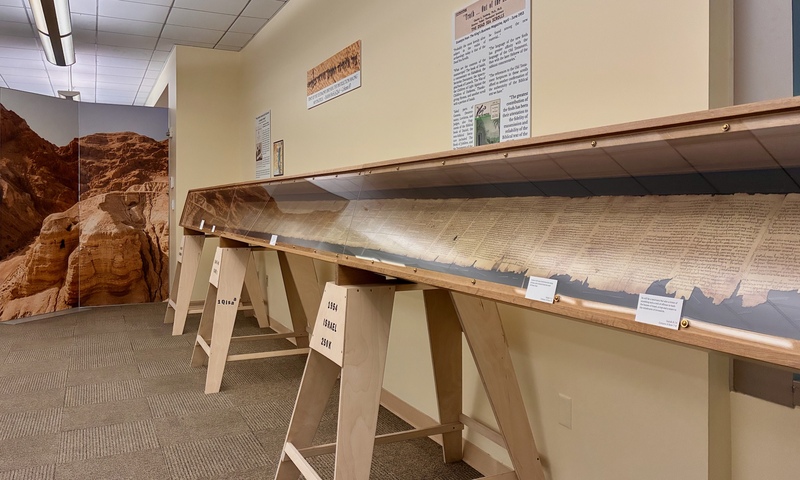
Hosted at the Biola Library - hours here
Lecture series begins Wednesday, September 30, 2026 at 6 p.m. All are welcome.
From the moment that scholars learned of the existence of the Dead Sea Scrolls in 1947, there was both excitement and trepidation about what might be found in the texts. What became clear once the Dead Sea Scrolls were studied is that there are no major textual differences even though there is a 1,000-year gap between the medieval text of the Hebrew Bible and the Dead Sea Scrolls. The Old Testament that Christians have today is the same Bible that ancient Jews read centuries before the time of Christ.
The Dead Sea Scrolls are considered the greatest manuscript discovery in modern history. The exhibit includes world-class facsimiles of several Dead Sea Scrolls, including the 24-foot-long Great Isaiah Scroll, to show how the Bible has remained unchanged for millennia.
The Dead Sea Scrolls and the Bible Exhibit and Lecture Series continue Biola’s long legacy of emphasizing the historic continuity and authority of the biblical manuscripts from antiquity to today. The featured facsimiles were purchased a number of years ago by Legacy Church of Orange County, a nonprofit ministry led by former pastor Scott Moffatt, who teaches History part-time at Biola. Since then, Moffatt and a number of faculty at Talbot have displayed the scrolls and given lectures in churches and Christian schools highlighting their importance for our knowledge of the Bible. Scott and his ministry graciously donated these important facsimiles to Biola’s History Department because he wanted to ensure that they were available for students, faculty and others to see and interact with because of their importance in proclaiming the coming Messiah.
On this point, the Great Isaiah Scroll is noteworthy because of the Messianic prophecies mentioned throughout the text. The original scrolls, being authenticated as written in the second century B.C., provided definitive proof that the Messianic prophecies were written before the life of Christ. The completeness of the original scroll is also exceedingly rare for manuscripts of this type and age, providing strong evidence that Jewish scribes throughout history created reliable copies of the Scriptures. The facsimiles featured in the exhibit, produced in 2007 from photographs taken in 1948 just weeks after the scrolls’ authentication, give today’s visitors an opportunity to see what the scrolls looked like when they were first identified. Facsimile Editions Ltd., who produced the facsimiles, describes them this way, “Every stitch, crack, edge irregularity and sign of age has been painstakingly recreated by hand.” Unfortunately, the original scrolls have darkened to such a degree that they can no longer be read without special tools and lighting.
Biola’s exhibit also includes Roman and Jewish coins that relate to the New Testament and early church, a variety of Roman metal figurines and tools, and various types of pottery dating from 2,000 B.C. through the first century A.D. There are also authentic Bible manuscripts from the 12th through 18th centuries A.D., including a Torah Scroll, a page from the Gutenberg Bible and pages from the first printing of the King James Bible. There are also complete Bibles on display, including Luther’s Bible and Matthew’s Bible, which was based on William Tyndale’s English translation. When viewed together, the scrolls, artifacts, manuscripts and Bibles provide a 1,900-year tour of Bible history that connects the ancient world to the present.
Those who are able to attend the accompanying lecture series will get to hear leading scholars from Biola and beyond. Attendees will hear lectures from Talbot School of Theology faculty Tom Finley, Clint Arnold and Ken Way; faculty from Biola’s newly established School of Arts Letters, Scott Moffatt, Bill Katin, Isaac Blois, Thel Rountree and Darin Lenz; Chuck Koontz, Biola’s archivist and the curator of the exhibit, and special guest Jared Clark, an ancient coin expert who has loaned many of the items from his personal collection for this exhibit. The lectures by this noteworthy group will address various aspects of the Dead Sea Scrolls and what the discovery of these texts at Qumran in 1947 meant for the Jewish people, for Christians and for Biblical scholarship.
Biola faculty have been writing and speaking on the Dead Sea Scrolls since the 1950s, including Talbot’s founding Dean, Dr. Charles Feinberg, whose work is included in the exhibit. Hear his talk, What do the Dead Sea Scrolls Have to do with Christianity? on Biola’s JSTOR site, and read his articles from The King’s Business here:
- "Truth... Out of the Earth" pt.1 (starts p.22), King's Business April 1953
- "Truth... Out of the Earth" pt.2 (starts p.17), King's Business May 1953
- "Truth... Out of the Earth" pt.3 (starts p.17), King's Business June 1953
Also available will be multiple workshops for attendees to get hands-on experience working with reed pens and bottles of ink, learning to do the work that the scribes of Qumran did. Leading these workshops will be artist and Library staff member Julie Mammano. The schedule is still being determined, so check the Library website for updates.
The exhibit, lecture series, and workshops will give visitors a better understanding of the history of our Scriptures, as well as why we can trust the Bibles we have today.