Biola University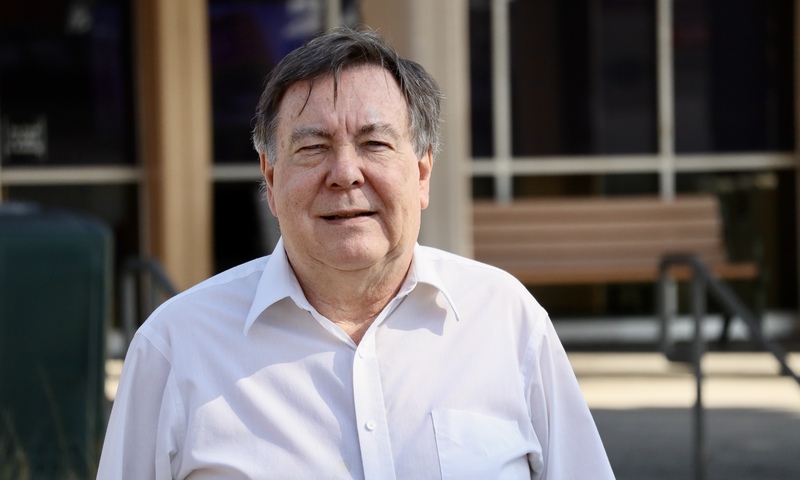
As a young boy, Neil Stipp, Biola University alumnus, celebrating 50 years since graduating (B.M. ’76), would listen to his 45 RPM records so often that his mother had to restrict him to listening only 2 days a week. His love for music prevailed as he began piano lessons at seven years old, and he later found himself at Biola as a music major.
In 1976, Biola looked very different from what it does today. With the La Mirada campus only 17 years old and the Crowell Conservatory of Music building 12 years old, music was filling the new campus, including Stipp’s. Stipp would tell his friends that he wanted to compose music for Christian films, and many of them looked at him in confusion. Although his aspiration did not come to fruition, Stipp found his musical calling. Organ and composition professor Rayner Brown, who taught at Biola for 30 years and retired in 1977, introduced Stipp to the pipe instrument. Enamored immediately, Stipp became an organist.
“I was interested in the organ so much, because it was like an orchestra to your fingertips,” said Stipp. “You had the flute stops and the clarinet stops and the oboe stops, and it was like an orchestra at your fingertips. I was creative, so I really fell in love with that.”
Focusing on composition while studying at Biola, Stipp did not “find his voice” in his compositions until he was around 50 years old. He had earned his master’s in music from USC in 1978 and a doctor of musical arts degree from UCLA in 2003. Realizing that he had been imitating his former teachers in his compositions, Stipp finally found his own voice, creating a neoclassical style of his own. This propelled him into composing sonatas and other works for organ and other instruments, sometimes for voices as well.
“I set goals for myself to make up the time that I had lost, and decided I would write at least 10 scores a year to kind of make up for the time that I had lost,” said Stipp.
Stipp won first prize in an American Guild of Organists competition in 2008. Two of his compositions also premiered at the Kwidzyn International Music Festival in Kwidzyn, Poland. The first was his “Celebratory Overture for Strings,” performed by The Orchestra of the Lviv National Philharmonic, with conductor Wolodymyr Syvokhip, on September 16, 2022. The second was his “String Quartet No. 3,” performed by the NeoQuartet, on September 19, 2022. Stipp attended both performances. When a composer attends premieres, they receive special recognition before the performance. Not only that, but they get to hear their music interpreted by musicians.
“It's amazing when you're sitting there, and you're thinking to yourself, ‘where did this music really come from?’ I mean, it came from me, but where did it come from? It's like it's me up there on stage,” said Stipp. “Of course, musicians will take your music and interpret it the way they think is best. So it's not like when you paint a picture, you see it one time. Your music on the page can be interpreted different ways, and so you hear a part of yourself being displayed differently based on the musician.”
Stipp noted that many of his premieres have only happened in the past five to eight years, slightly smirking as he said it was a lesson to be learned that it’s never too late for a career to take off.
“Don’t give up on yourself, because it’s just been a crescendo,” said Stipp. “I never thought these things would be happening 10 years ago.”
When reflecting on his musical education at Biola, Stipp not only recalls the foundation he received as an organist, but as a Christian.
“The foundational aspects of my education with the Bible was just invaluable,” recalled Stipp. “I still use it a lot. I don't lead any Bible studies, but I sometimes bring out some things in the Scripture that's helpful for others. It's just been so valuable. The 32 units in Bible and doctrine, which we had, was probably more valuable than anything else that I might have learned in music.”
The Conservatory of Music in the School of Fine Arts and Communication is dedicated to providing students with a biblically centered education, training students for excellence in the performing arts and providing a platform for students to discover and express their artistic voice. Learn more and apply for the Fall 2026 semester by March 1.
Written by Sarah Dougher, media relations specialist. For more information, email media.relations@biola.edu.