 Biola University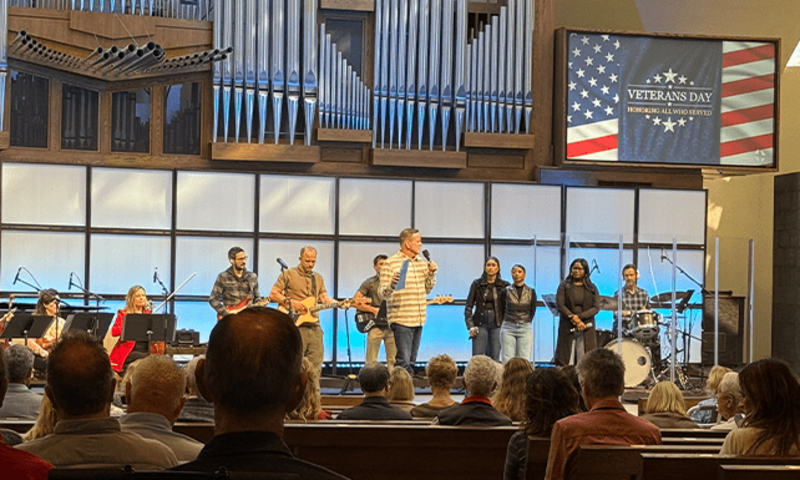
Recently, I enjoyed being with St. Andrews Presbyterian Church in Newport Beach, California, not far from my own home church. I was glad to experience worship with the congregation and to preach at the invitation of the Lead Pastor, Jason Smith, on finding joy in Christ. Jason has served as the Lead Pastor of St. Andrews since 2022, and he is a thoughtful leader and a current Doctor of Ministry student at Talbot School of Theology.
St. Andrews is a prominent congregation within ECO, a Covenant Order of Evangelical Presbyterians. ECO is a conservative, evangelical group of churches that formed out of the Presbyterian Church (USA), as the PCUSA moved further away from evangelical biblical convictions.
The 75-year-old church was pastored for over 30 years by the prominent leader John Huffman, and has a history of impact and influence in Southern California. By the time Jason arrived, the church had experienced some decline, but it is now seeing a revitalization of growth. The church is leaning into its multi-generational vision, growing younger and reaching its community. Recently, the church has embarked on a capital campaign to renew its campus to reach a new generation.
I noticed a couple of things in particular about this legacy congregation when I gathered with them last fall. This is a church that is leaning into the needs of its context while also leveraging creativity for ministry.
Contextualizing Ministry
St. Andrews is embodying the importance of contextualized ministry. For one, the facilities reflect the cultural situation of Southern California. The entire campus aims to optimize for the often-perfect weather in our area (another reason to enroll at Talbot, by the way!). You can see from the pictures of the campus that anyone attending on a Sunday could find a spot outside at any time, and they often do.
The church is also contextualizing by offering both traditional and contemporary worship services, or “classic” and “modern” worship experiences as the church calls them. Having multiple services with varied styles (yet the same substance) has long been a useful tool for many churches to grow and maintain a multi-generational focus.
It was interesting and impressive to see the St. Andrews team quickly transition the worship environment from one style to the other, making it less obtrusive and more unifying for everyone in the congregation. While some have moved away from offering different services with different styles (whether for practical or theological reasons), it’s clear that this strategy makes sense for some churches. St. Andrews serves in such a context, and they have leaned into it.
Creativity in Ministry
In addition to contextualizing ministry, St. Andrews also deploys creativity in ministry, even in the church’s more traditional worship environment. The church partners with the St. Andrews Creative Institute, which serves in a number of ways, such as offering drama and music classes for both adults and children, and even memoir and songwriting workshops.
A good example of this focus on creativity is the church’s worship leader, Brandon Muchow. I enjoyed seeing Brandon and talking to him, especially since I was friends with his dad, Rick Muchow. Rick was a long-time and beloved worship leader at Saddleback before he passed away in 2021. Brandon is carrying on his dad’s legacy, and showing the impact of creative ministry, as the church hosted Brandon’s album recording with over 300 people in attendance.
Another example of creativity preceded my sermon on Philippians 3:7-16, which was part of the church’s sermon series on “Joy.” To bring the text to the forefront, the creative institute worked with a professional actor, Mack Hubbard, who recited the sermon text as a monologue in the character of the Apostle Paul.
As it said in the church’s annual report:
Mack’s nuanced and passionate performances brought a sense of urgency to Paul’s writings and made the apostle’s joy in Christ palpable.
Not only were those in the pews inspired, but Mack’s own faith deepened throughout the process of memorizing and studying the Bible. “Paul and other characters from the Bible, they were as real as you and me,” he said. “They lived, and they had the same questions about God. Being able to step into the mindset of Paul makes it so real.”
I enjoyed getting to experience the impact of this creative initiative firsthand.
Takeaways for Church Leaders
As pastors and church leaders, we can learn some things from this visit to St. Andrew’s. Specifically, we are reminded that we must discern the context of both our church’s internal community and the community we are called to serve. We should develop our ministry strategy in light of these realities, even as we align with the core, non-negotiable elements of a biblical doctrine of the church, or ecclesiology.
We need more ecclesiology for our moment, not less, and part of a missional ecclesiology will account for the needs of the congregation and community for the sake of the gospel. For St. Andrew’s, as for many others, a two-service strategy can be contextualized for and within the community where the church lives and serves.
Whether in church planting situations, revitalizations or smaller or larger congregations, we all must do the work of seeking to show and share the love of Jesus where we actually are. It might be multiple worship services, it might be applying the gospel through the arts, or it might be another form of contextual ministry.
It’s not a question of if we will do these things, but if we will do them effectively, fruitfully and faithfully, for the good of our neighbors and the glory of God.
This post and other writings by Ed Stetzer can be found on Church Leaders.


.jpg)