Biola University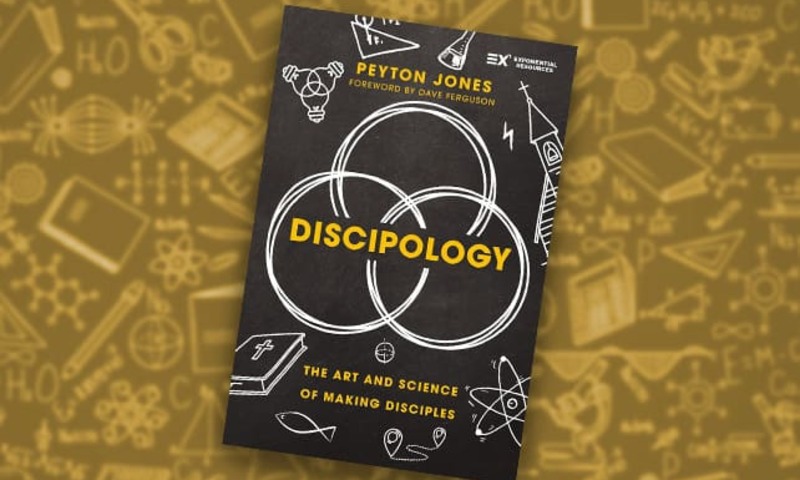
My friend Peyton Jones has a new book. This one is called “Disciplology,” which is not really a word. But he has a habit if making up words. (See his “Church Plantology” book.)
I enjoyed the book and endorsed it as follows:
Some books help us because they teach us truth we need to help us understand what things are true and what things matter. Some books we find to be useful to motivate, because they show us why things matter. Others are helpful because they explain how to put into practice what we know. Rarely do you find a book that does all three on an important idea, but that’s just what we have in “Discipology.” You will understand disciple-making at a new level by reading this important book.
With his permission, I’m sharing 20 truths from the book that you might find helpful.
And, be sure to order the book.
20 Truths From ‘Discipology: The Art and Science of Making Disciples’
“[W]hen we lift the hood on multiplication movements, both throughout church history and across the globe, at the core of all of them is an engine of mobilized people.” (10)
“Mobilization is defined as the Spirit-empowered process of activating ordinary believers into their God-given mission. Whenever mobilization happens, multiplication is the effect.” (14)
“Jesus’s mission strategy prioritized mobilization over multiplication. He knew that mobilization must precede multiplication—just as the Gospels come before the book of Acts.” (19)
“Discipology is built on the overlap of three key rhythms in Jesus’s disciple-making strategy: time, teaching, and tactics. When these three are practiced together, they produce mobilization…” (19)
“The first bottleneck to disciple-making is simple: Most of us don’t know how because it was never done to us. The truth is most Christians have never been personally discipled. According to a 2015 Barna study, only 23 percent of Christians are discipled one-on-one.” (30)
“Somewhere along the way, we confused the terms disciple-making and discipleship as if they are interchangeable. But they’re two different things. We swapped Jesus’s command to make disciples with the safer, more familiar substitute of discipleship, and that has confused everything since…We thought discipleship was what Jesus commanded in the Great Commission, but what he actually said was ‘Go. Make disciples.‘” (36)
“Discipology, then, is the art and science of making disciples. The science of disciple-making is drawn from the specific principles Jesus consistently followed as he made disciples.” (53)
“Each year of Jesus’s ministry emphasized one of the core rhythms—time, teaching, and tactics—forming a deliberate progression in how he made disciples.
Year 1: He spent time with a small group of disciples, getting to know them, helping them to become disciples.
Year 2: He taught them on mission, modeling how to reach others and training them for their ministry to be ‘fishers of people.’
Year 3: He used tactics to send them on mission, going out ahead of him.” (58)
“Entering a disciple-making relationship presumptuously will lead to resentment. The lack of a mental contract or mutual understanding causes what Patrick Lencioni warns about—unshared expectations that lead to shared frustrations. The disciple-making relationship needs to be defined.” (62)
“[T]he Gospels aren’t just stories of grown men following a rabbi; they’re stories of high schoolers flipping the world upside down before they could grow a full beard. It speaks volumes to the value Jesus puts on discipling the next generation.” (73)
“This time pattern of Discipology teaches us that Jesus’s first disciple-making strategy was to pray to his Father. If Jesus’s disciple-making was first and foremost relational, his first relationship was with God. Before Jesus ever preached a sermon, healed the sick, or called a single disciple, he spent forty days in the wilderness with his Father, anchoring himself in that relationship.” (83)
“Henrietta Mears also understood that time was a valuable part of discipleship. On Sunday mornings at her Hollywood home, she would flip her famous blueberry pancakes for scores of eager young students, creating an atmosphere of warmth and welcome before opening Scripture. Those breakfast gatherings—equal parts fellowship and Bible study—became legendary as they ate breakfast, formed relationships, and talked together. From them emerged a generation of leaders who would shape evangelicalism worldwide, including Bill Bright (founder of Campus Crusade for Christ), Dawson Trotman (founder of The Navigators), Richard C. Halverson (chaplain of the U.S. Senate 1981–1995), and even BillyGraham, who considered Mears one of his most important influences.” (89-90)
“So how do you know when a disciple is formed? Simple. It means that they’re ready to make their own disciples. That’s how Jesus left theTwelve. It’s how Paul left Titus, Timothy, and others.” (134)
“Jesus didn’t just spend time with his disciples; he trained them. As the book moves into the Teaching rhythm, we will observe how Jesus moved from friendship to formation. In the second year, his focus on the Teaching rhythm rewired their thinking and prepared them for kingdom mission. He taught with power and modeled truth in action powerfully.” (159)
“Jesus mapped a preaching circuit that would make John Wesley proud. The route that second year was carefully mapped, strategically designed to train his disciples for where he would send them in the second year. Later, Paul adopted a similar approach during his second missionary journey, leaving disciples behind to continue the work throughout Galatia.” (166)
“People weren’t projects to Jesus. His heart broke for people: “When he saw the crowds, he had compassion on them, because they were harassed and helpless, like sheep without a shepherd” (Matt. 9:36). He asked his future field workers to see the field as he did: ‘Open your eyes The harvest is ripe.’ It’s a dangerous prayer to ask God to show you what he sees, because you risk a broken heart.” (217)
“Jesus launched two missions that bookended the third year—one at the start of year 3 (sending the Twelve), and another at the end (sending the seventy-two). These two short- term missions were ‘preparatory’ exercises, ‘a paradigm of permanent mission in the future,’ prototypes of the Great Commission.” (231)
“Sometimes reinforcing vital principles with our disciples seems to take more time than we possess. We expect instant transformation, but Jesus modeled repetition, going at the pace of the learner. If we rush past the pace of the Rabbi, we stop forming disciples and start forging Pharisees—people who adopt practices but bypass the principles.” (248)
“We’ve discussed how Time and Teaching play a part, but what specific Tactics lead to disciples being made? The answer is contained within the Great Commission—the means embedded in the mandate. They would make disciples by doing five specific things:
Mission—’Go’
Evangelism—’Baptizing’
Teaching—’Teaching’
Discipleship—’To obey’
Abiding—’I will be with you’
The Great Commission provides a cohesive framework of disciple-making, helping us navigate the how behind the what.” (258)
“When we decentralize to make disciples, we’re not just bringing ‘church’ to people, we’re bringing an aspect of Christ himself, creating ‘colonies of heaven’—the atmosphere of the kingdom of God on earth. And this atmosphere is kindled by, you guessed it, the five activities of the Great Commission—going, baptizing, teaching, obeying, and abiding.”(303)
This post and other writings by Ed Stetzer can be found on Church Leaders.