Biola University
Hidden away in a quiet corner of the Biola Library basement, kept securely behind a locked door in a climate-controlled room, is perhaps the most important artifact in Biola University’s history.
Most Biolans have never seen it in person. Many don’t even know it exists.
But this fall, for the 100th time, the artifact will be at the center of a ritual that stretches back to the university’s earliest years — a tradition that Biola’s founders considered essential to whether the institution would stand or fall.
The artifact in question is officially known as the “Workers’ Register and Articles of Faith,” words that are stamped in gold on its wine-red cover. But over the years, many have come to call it by a more familiar name: the Big Red Book. Inside, printed across the top of every page, are the words of Biola’s doctrinal statement — 13 “Articles of Faith” — with space underneath for the institution’s leaders to sign their annual affirmation of core evangelical beliefs about God, Scripture, sin and salvation through faith in Jesus Christ.
For a century now, dating back to 1927, the Big Red Book has served one vital, enduring function: to ensure that Biola remains faithful to the central truths and mission upon which it was founded.
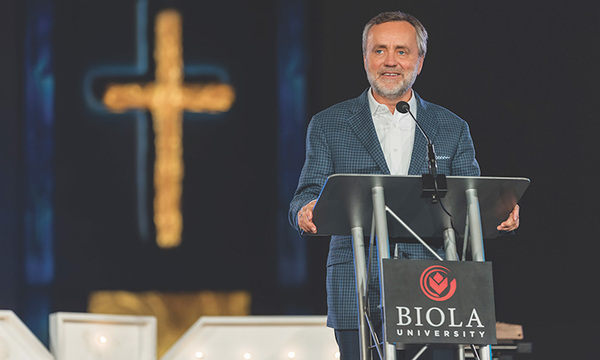
“This [book] is a reminder that the Articles of Faith — our theologically, biblically sound doctrinal statements that were drafted in the early years of Biola — still matter today,” President Barry H. Corey said in a recent video podcast episode where the Big Red Book made a rare public showing. “We haven’t taken our eyes off the mark.”
To understand why the book carries such weight, you have to go back to Biola’s founding.
Making a Statement
The history of the Big Red Book begins about two decades before its first known appearance.
On Feb. 25, 1908, inside the boardroom of the Los Angeles YMCA, a small group of evangelical leaders gathered in prayer to establish the Bible Institute of Los Angeles, with a mission to train men and women for evangelism, missions and church ministry. Within about a month, the group adopted a formal incorporation document, featuring a succinct “Statement of Belief” that would guide the school’s teaching.
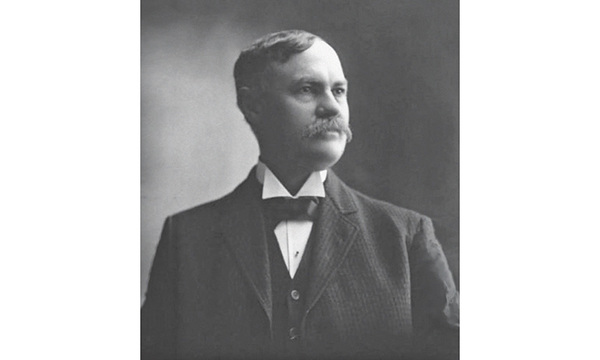
One of the founders, Lyman Stewart, an oil magnate who provided much of the vision and funding for the Bible Institute, determined early on that safeguards should be set in place to ensure faithfulness to its mission.
He had reasons for his vigilance. In recent years, Stewart had seen several once-orthodox seminaries and schools drift away from fundamental Christian doctrines. Occidental College, for one — where he’d been a founding trustee and major contributor — had abandoned its conservative Presbyterian roots within two decades of its establishment.
“He couldn’t get Bible-believing Bible teachers to be hired there,” said Paul Rood, a historian who has spent thousands of hours researching Stewart’s life and Biola’s history. “He kept a pledge to underwrite the cost of the Bible department for 10 years and half of the president’s salary for five years. Nevertheless, Occidental kept trying to hire modernist, soft, philosophical types.”
The Bible Institute of Los Angeles would be different.
Within a few years of its founding, Stewart and other leaders worked to build upon the school’s initial list of basic beliefs and develop a more extensive doctrinal statement. When finalized, he wrote in a 1911 letter, “we would expect to have all members of the faculty and of the Board of Trustees sign an agreement in advance that they accepted these fundamental doctrines, and that should they ever change their views they will at once tender their resignations.”
In July 1912, The King’s Business, the Bible Institute’s monthly periodical, published a final revision to the doctrinal statement, noting that “every officer and teacher will be required to sign [the statement] once a year.” Failure to uphold these truths should be considered grounds for a lawsuit from the school’s donors for “reversal of the money,” the publication said.
The 13 Articles of Faith have remained unaltered ever since.
Over the ensuing 15 years, meeting records indicate that board members, teachers and staff did indeed provide their annual reaffirmation. And yet the process wasn’t as formal — or as historically preserved — as Stewart or others would have wanted, Rood said.
“The administrative process was just loose pieces of paper,” he said. “They didn’t have a standardized format.”

Bound and Determined
The Big Red Book changed that.
Bound in leather and stamped with ornate gold patterns on its cover and spine, the book commands immediate reverence and intrigue. At an imposing 15-by-17 inches, it’s roughly the size of a baking sheet. And its hundreds of pages indicate that its creators anticipated the book — and the signing ritual tied to it — would endure long into the future.
Across the top of each gold-edged page, the full text of the Articles of Faith is printed in three justified columns. Underneath, each page is neatly divided into 20 spaces for signatures, with each space preceded by the words, “I solemnly and sincerely declare my belief in the Articles of Faith appearing upon this page.”
For all the effort that went into its creation, the exact details of the Big Red Book’s debut remain something of a mystery.
While each signature box contains a “Date” field, oddly, none of the original signers bothered to fill it out. At some point, a well-meaning scribe penciled in a faint “1923 or 1924?” on the opening page of signatures. But Rood’s research indicates that the debut came a few years later.
In early December 1926, the institute’s superintendent, Dr. Charles E. Hurlburt, proposed a Dec. 31 “get-together meeting” where Biola’s board members and employees could sign the doctrinal statement for the year ahead. Watch Night services on New Year’s Eve were common for churches at the time, and Biola’s original building — with its auditorium and two dormitory towers full of residents — would have been a natural place for such a celebration. So it’s at least possible that Biola rang in the New Year of 1927 with the signing of a newly created Big Red Book, although there’s no hard proof that Hurlburt’s proposed get-together actually took place, Rood said.
Based on a close examination of meeting records and the book’s first signatures, Rood said it’s almost certain that the book’s official debut came a couple of months later, at an annual board meeting on Feb. 24, 1927, held a day before Biola’s 19th birthday.
Notably, the first set of signatures includes three of the founders who had been at the original 1908 meeting and served on its board of directors from the start: T.C. Horton, William E. Blackstone and S.I. Merrill. (Stewart, who had advocated so strongly for a formal doctrine-affirming ceremony, passed away in 1923.)
Ever since that day in 1927, the signing of the Big Red Book has remained an annual tradition, with each of Biola’s presidents and board members reaffirming their commitment each year.
Consistent with Stewart’s vision, the signing process has helped to ensure the institution’s commitment to its founding doctrines, said Rood, whose grandfather, Paul W. Rood, signed the book during his tenure as Biola’s president from 1935 to 1939.
“It’s almost like a relic — one of the few relics that we have at Biola — and the fact that it’s a relic that attests to our statement of faith is amazing,” Rood said. “The symbolism of the signatures, the attestation annually, and the generation-to-generation commitment to this: that’s what makes it so special. For others who are signing today to look back at those who signed nearly a century ago — many notable, godly men and women — adds to its importance and value.”
Living History
For the men and women on Biola’s Board of Trustees who continue to sign the Big Red Book each year, the ritual serves as a reminder of Biola’s rich legacy — and the responsibility they bear for keeping the university on course.
“Every time I have the privilege of signing the book, it feels like I’m touching history,” said Carol Hawkins, a Biola trustee since 2005. “It’s like linking arms through the decades with godly men and women of faith, and we have the same goal in our hearts of ‘equipping men and women in mind and character to impact the world for the Lord Jesus Christ.’”
Hawkins has a special connection to Biola’s history. Her great-grandfather was Lyman Stewart’s baby brother. And while Stewart didn’t live long enough to sign the book, his wife, Lula May Crowell, did.
“It is special when I’m able to find her signature in those early pages,” Hawkins said. “It does feel like there’s a connection in the spiritual realm, and it is humbling to be able to affix my signature to the Articles she too felt so strongly committed to.”
Likewise, Hannah Lee recalls her first time signing the book as an “extremely reverential, weighty and solemn moment.”

Her parents, Fook Kong Li and Irene Li, immigrated from China and Hong Kong in the 1940s and each went on to serve on Biola’s board. After Lee followed in their legacy by joining the board in 1998, she was moved when Biola’s then-president Clyde Cook flipped back through the book to point out her parents’ signatures.
“I don’t think there is a single Biola trustee who leaves our meetings without thanking God for his faithfulness in keeping this institution spiritually on course and aligned with our Statement of Faith and doctrinal statement,” Lee said. “This does not happen without great intentionality from the top down.”
While many other institutions have drifted from their biblical foundations, Biola’s careful scrutiny in its selection of trustees and hiring of employees — with particular attention to agreement with the doctrinal statement — “is without doubt the primary reason Biola has been able to stay directionally true to what the founders intended, with God’s hand of blessing on Biola,” Lee said.
Although only board members sign the physical book, the Articles of Faith continue to play a central role for all employees of the university. Every faculty and staff member must sign an agreement as a condition of employment. In recent years, the university has implemented an annual online reaffirmation process, requiring each employee to attach their digital signature to both the Articles of Faith and to an accompanying Statement of Biblical Principles.
This alignment with the doctrinal statement doesn’t stop at mental assent; it shapes curriculum, policies, activities and students’ everyday experiences, both in and out of the classroom, President Corey emphasized.
This integration is part of why Biola was recently ranked as the No. 1 university for putting its faith into action, as determined by a team of Baylor University researchers in the book Christian Higher Education: An Empirical Guide. In an evaluation of several concrete measures of Christian identity — including mission statements, faith requirements, Bible classes, chapels, conduct codes and more — Biola scored 26 out of 27 possible points, the highest of the 562 Christian colleges and universities in the United States and Canada.
“It’s one thing to hold to what we believe to be true in language,” Corey said. “It’s another thing to hold it to be true in practice.”

A Centennial Celebration
This September, the Big Red Book will again emerge from its climate-controlled vault — this time for the most public and celebrated appearance in its history.
To celebrate the 100th time that Biola’s Board of Trustees gathers to sign its pages, university leaders are exploring a special commemoration ceremony involving the entire community — including the creation of a custom one-time insert that all faculty and staff will physically sign.
It’s just the sort of gathering that Lyman Stewart would have hoped for all along, Rood said.
“I think he’d want an assembled ceremony, and I think he would want it celebrated as much as possible,” Rood said. “I think anything the board does to celebrate [the statement signing] and bring awareness to it would gratify him.”