Listening is important, a basic and vital action for learning, communicating, and fostering healthy relationships. When we don’t listen, our relationships suffer and unravel.
Tim Muehlhoff’s post in Christian Scholar's Review provides insight on how to winsomely and compassionately address another person's deepest convictions.
In this segment of “Getting Up To Speed,” leading scholar Dr. Julia Wood joins Tim and Rick to discuss the topic of feminism. They discuss the three waves of feminism, key figures and prominent issues in each wave as well as common misperceptions, including debunking the emblematic act of bra-burning in the second wave.
In part 2 of a discussion with Preston Sprinkle, Tim and Rick ask Preston for insight on how Christians can be hospitable in disagreement without compromising on important matters of biblical conviction.
Dr. Preston Sprinkle (Ph.D.) joins Tim and Rick to discuss one of the more pressing issues facing the Church and Christian conviction – sexuality and gender.
Can a group of men who are racially diverse discuss taboo topics with respect and humility? Yes, and it’s happening at a local park in the heart of Texas.
Tim and Rick resume the discussion on “rhetorical trash” and consider four types of words that litter our rhetoric: words of outrage, exaggeration, glee, and despair.
Tim and Rick discuss the idea of “rhetorical trash” and the dangers of not addressing it. In part 1 of a 2-part discussion they highlight two practices for picking up the trash: truth-telling and not treating our rhetoric like New Year’s resolutions.
How easily do those outside the Christian community think we are offended? Are we seen as people devoid of the ability to laugh at ourselves? Or, laugh at all?
We don't hear many people these days aspiring to "be gentle." Being gentle is often seen as weak and impractical, especially in harsh and abrasive times.
What practical changes can we make to be a little more charitable, civil and compassionate in our approach to others? Tim and Rick consider six challenging yet doable resolutions we can take toward cultivating winsome conviction this year.
We have made some progress on race in America, but we have so much farther to go, especially in regards to the ways racial inequity is perpetuated in cultural representations and social, political, and economic systems. Tim and Rick resume the conversation with James White and draw out a helpful metaphor for thinking about these issues on race: groundwater.
Tim, Rick, and James discuss their different and complex upbringings and draw out the importance of the backstory for acquiring perspective. Putting yourself in another person’s shoes and assuming their point of view is difficult and often resisted.
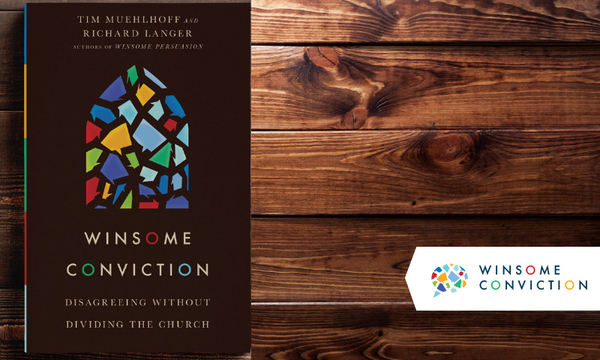
The book offers a guide to help Christians navigate disagreements with one another. In today's polarized context, Christians often have committed, biblical rationales for very different positions.
Dr. Joy Qualls, an expert in political and religious rhetoric, joins Tim and Rick to discuss how polarized news sources contribute to making us polarized people.
C. Christopher Smith, senior pastor of Englewood Christian Church (Indianapolis, IN), describes early attempts to bring diverse people in his church together to talk as a “hot mess.” Yelling and sarcasm were default modes as members gathered Sunday nights to discuss potentially volatile issues. Out of sheer stubbornness, Smith and church leadership stayed with it as trust among conversationalists slowly developed. Out of that determination and years of experimentation comes a book that serves as a reliable guide to those wanting to follow their example.
“Where do I fit politically?” That’s a question more Christians are asking as faith convictions feel at odds with party affiliations and partisan mindsets. Feeling at home with one particular political party is met with increasing discontent.
The 2020 election cycle has been one of the most contentious and divisive elections in living memory. Animosity and disdain for those whose views differ from our own have tarnished not only our public square but also our churches and families. But when the election is over, we are still members of the same nation, living shoulder to shoulder in the same communities, and worshiping in the same churches. We need to find ways to move forward together.
Votes for the next president have been cast and one thing is certain—somebody will be happy, and others disheartened. Can a friendship or workplace relationship be preserved with someone who voted differently and holds vastly different beliefs?