Biola University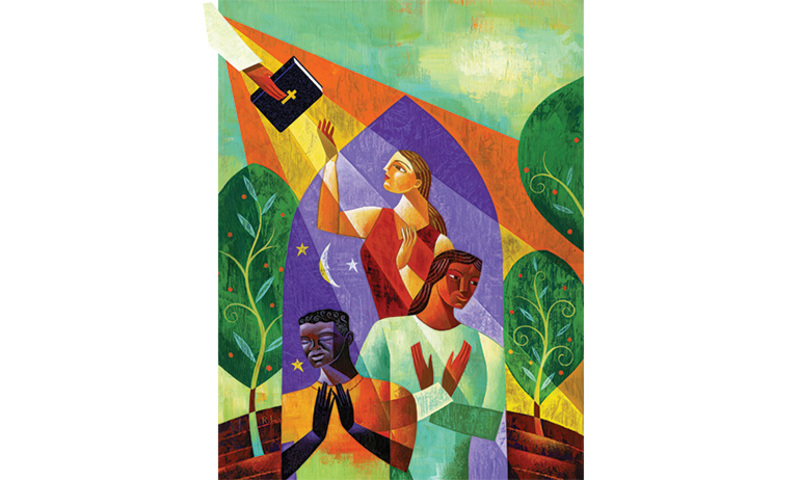
It’s a new year — which, for many people, means it’s time to resolve to read the Bible more consistently.
More than half of Americans say they want to read the Bible more often than they do, according to a 2025 study from the American Bible Society. And yet, most find it challenging to prioritize Scripture as a regular habit; the same research found just 12% of Americans read the Bible four or more times per week.
Biola professor Uche Anizor wants to help.
In his newest book, The Goodness of God in the Gift of Scripture: 20 Meditations (out Jan. 13 from Crossway), Anizor aims to help readers discover genuine delight in Scripture and “recapture the conviction that God’s word to us is a gift given for our earthly and eternal happiness.”
With Psalm 119 as his guide, Anizor — professor of theology at Biola’s Talbot School of Theology — explores Scripture as “the gift that keeps on giving,” identifying 20 individual gifts that God offers to readers of his word, ranging from blessedness to nourishment to joy. In the process, he hopes to help people approach the Bible with a greater sense of eager anticipation, rather than seeing it as a chore to check off a to-do list.
Biola Magazine recently connected with him to explore the benefits of Bible reading, the obstacles that often get in the way, and practical advice for making Scripture a priority.

Dr. Anizor, surveys consistently show that most Christians don’t read the Bible as often as they want to or know they should. Why do you think that’s the case? What are the most frequent obstacles that you’ve seen prevent people from spending time in Scripture?
There are mundane reasons why people don’t read their Bibles, like not setting aside time or being too busy. Others simply find it boring or difficult to understand, and for them the Bible feels irrelevant to their daily lives and reading it feels like a chore. For others, the Bible feels limiting and repressive; it’s a book filled with laws and rules that sometimes rub us the wrong way. But whatever the reason, there is a failure to see the value of Scripture — a failure to see it as something that really is for our good.
You open your new book with an interesting thought experiment — inviting readers to choose a single word to describe the Bible. What are some of the common (maybe less-than-ideal) ways that we tend to think about Scripture? And why do you think “gift” should be one of the first things that comes to mind?
We can tend to view Scripture in ways that are true but incomplete characterizations of what it truly is. For example, we might see the Bible as a collection of stories, seemingly random commands or undecipherable mysteries. All of these are true (or at least mostly true) of the Bible, but they don’t capture the heart of what it is. At its core, Scripture is God’s personal communication of who he is, what he does and what he desires, so that people can live in a covenant relationship with him. Through Scripture God wants to bless us with all the good things that come from being in relationship with him. So, fundamentally, the Bible is a gift — a gift through which God wants to give many other gifts: joy, hope, fruitfulness, life and more. The idea of Scripture as a gift communicates that God wants to do good to us in giving us this book — if we would avail ourselves of the gift.
What are some of the benefits we experience from regularly reading and dwelling on God’s word? Or put another way, what do we risk missing out on when we neglect it?
I’ve found that one of the main benefits of regular engagement with Scripture is that it roots you in ultimate reality. Every day we are being told what is important, what to value, who we are and who we should be. Small things are made into a big deal, and important things are downplayed. Regular Bible reading reminds us of what’s really true and meaningful; it reminds us of who we are and what is ultimately valuable. Consistent Scripture engagement roots us when we’re feeling blown about by all the cultural or emotional winds we encounter. The Bible brings us face to face with the ultimate reality — God himself — and nothing is as grounding and perspective-giving as meeting God and his grace.
As you reflected and wrote on the many different benefits we receive from reading the Bible, were there “gifts” of Scripture that surprised you — any you hadn’t fully appreciated before?
There were several gifts of Scripture that stood out to me as especially moving. I write about the gift of warnings and how it is not immediately apparent that dire warnings are gifts. But when we think about the function of warnings generally and especially warnings in Scripture, we can see that they’re always meant to help us avoid harm. Even the early gospel preaching in the book of Acts is always accompanied by a warning. The word of caution is meant to help hearers feel the seriousness of their situation so that they can experience life (by fleeing from sin and embracing Christ). So, warnings are gift from a loving Father who knows his children are prone to wander.
How has the process of researching and writing a book about Scripture as a gift changed your own expectations or posture when you read the Bible?
I’ve been wanting to write something like this book for a while because I’ve always been perplexed and amazed by Psalm 119. I’ve always seen it as odd and inspiring that the longest psalm praises God’s law. Yet, I always felt like what the psalmist was praising was true to my experience over the years. So, writing the book just gave me greater clarity and conviction about the breadth of gifts God offers us in the Bible. I am better able to articulate how much of a gift Scripture is.
Sometimes we open our Bibles and feel like God is silent. What can we remember or do in those moments when we don’t sense anything “happening”?
I’ve wrestled with the question of God’s “silence” in Bible reading for some time, and I’ve come to two conclusions. The first is that God isn’t, in fact, silent if we understand what Scripture is. If the Bible really is divine speech — his word — then God speaks whenever I engage with it. He communicates his will and ways whenever I read it. He is present, both in his word and by his Spirit, every time I do my devotions, whether I feel something or not.
The second thing I’ve learned is that we often have unrealistic and unhelpful expectations about what should happen when we read the Bible. We might feel like we should “get something” or gain new insights most of the time. But I’m not convinced that is the primary way Scripture is used to shape us. Instead, I think we should view Bible reading as having the long-term effect of shaping our hearts, values, convictions and loves. This long-term shaping will sometimes be accompanied by flashes of insight, but often it will not. Yet, the Spirit’s work through the Bible reading is no less real because we didn’t feel something happening during our devotions. God’s call to his people is often “remember” rather than “gain something new.” This should inform our expectations.

The start of a new year is a natural time for people to want to re-establish healthy habits. What practical advice do you have for someone starting 2026 with a resolution to read the Bible daily — especially if they’ve struggled with consistency in the past?
My counsel is simply to make a plan that is realistic. Think about your actual life, not your ideal life, and figure out when and where you can take 15 to 30 minutes a day to reflectively and prayerfully read the Bible. Be ambitious, but not unrealistic. Prioritize Bible reading, but find a place for it that you have a higher probability of being able to repeat. The bottom line is: plan. Schedule it in, or it will likely not happen.
What have you learned over time about the difference between reading for information versus reading for formation? How might someone structure their time in the Word to experience both head and heart transformation?
Reading for information has its place in the Christian life, if by that we mean reading in order to understand the contours and details of the Bible’s teaching on this or that issue. In fact, reading for information can be deeply formational if we invite the Lord into our study of Scripture. However, there still is a subtle difference between reading for information versus formation. When we read for formation in a deliberate way, we really are trying to interact with the God of Scripture in a personal way. We are reflecting on our relationship to him and our service to him. We’re reflecting on his grace and how it intersects with our daily lives. In other words, we are deliberately trying to read the Bible as personal communication from God, as food for our souls, and as a mirror that helps us see ourselves clearly. The key is personal, slowed-down reflection. Apart from this, it’s hard for Scripture to take root in our souls.
ABOUT THE EXPERT
Dr. Uche Anizor, professor of theology and chair of the undergraduate theology department in Biola’s Talbot School of Theology, is the author of The Goodness of God in the Gift of Scripture: 20 Meditations (Crossway, January 2026). His previous book, Overcoming Apathy: Gospel Hope for Those Who Struggle to Care, earned Christianity Today’s “Book of the Year” award in 2023. He has a Ph.D. in systematic theology from Wheaton College.
Illustrations by Rafael Lopez