Biola University
These days, I’ve got no shortage of reasons to be excited about my work. In my role as dean, I’m surrounded daily by hundreds of students who are conducting innovative research, landing competitive internships, harnessing cutting-edge equipment, and preparing for impactful and in-demand careers in science, technology and health.
But amid all the momentum and milestones — including a gift of more than $40 million toward our technology division — one of the highlights of my year has been surprisingly low-tech.
This past summer, I observed our first-year graduate student clinicians from the speech-language pathology graduate program hosting Camp Biola, a dynamic, play-based camp designed to enhance social communication skills in children. Over the course of five days, these graduate students welcomed 33 campers with autism and 33 typically develop.ing peers. These two groups were matched to facilitate peer modeling in a fun camp environment.
Each day featured two camp sessions, incorporating rotating stations where the graduate clinicians facilitated activities designed to build meaningful connections through shared play. The camp’s structure enabled students to directly apply the clinical skills they had acquired during their first year of study, while providing a supportive and joyful environment for children to grow socially and emotionally.
Rooted in the mission “to help others learn how to be a friend through friendship with Jesus,” the camp centered on a daily Bible story that highlighted a different quality of friendship: respect, listening, helpfulness, kindness and generosity. Stories like Jesus and Zacchaeus (Luke 19), Jesus and the woman at the well (John 4) and Jesus feeding the 5,000 (Matthew 14) provided a biblical foundation for each lesson. Campers were reminded daily that Jesus is the best friend we could ever have, with the final day focusing on explaining the gospel.
The clinicians not only guided the campers through engag.ing activities but also led thoughtful, Bible-based lessons that included interactive communication opportunities — such as pretending to climb a tree with Zacchaeus, making waves with their arms to symbolize “living water,” or hugging themselves as a reminder of God’s love for children. These lessons helped reinforce the social themes in a meaningful and memorable way.
As I toured the camp, I found both the students’ and campers' enthusiasm infectious. After the camp, I had lunch with the graduate students, and they commented on what an amazing experience the camp had been. One student, Kristen Abellar, shared that this experience “was so much more than just building social communication skills; it brought together laughter, collaboration and meaningful connection through every activity. Watching the kids proudly shout the camp cheer at the end and seeing them share the love of Jesus was an absolute joy and something I’ll always carry with me.”
Parents consistently report that this camp is incredibly beneficial and enjoyable for their children, offering both a sense of belonging and genuine opportunities to practice social skills in a supportive setting. The camp is a beautiful example of community collaboration. It brings together families, children and graduate students in a unique, purpose-driven setting that models inclusion, spiritual growth and therapeutic learning — all while having a blast.
As the camp cheer echoed through the building each day — “F-R-I-E-N-D-S … Jesus wants to be our friend!” — it was clear to me that something special was happening at Biola.
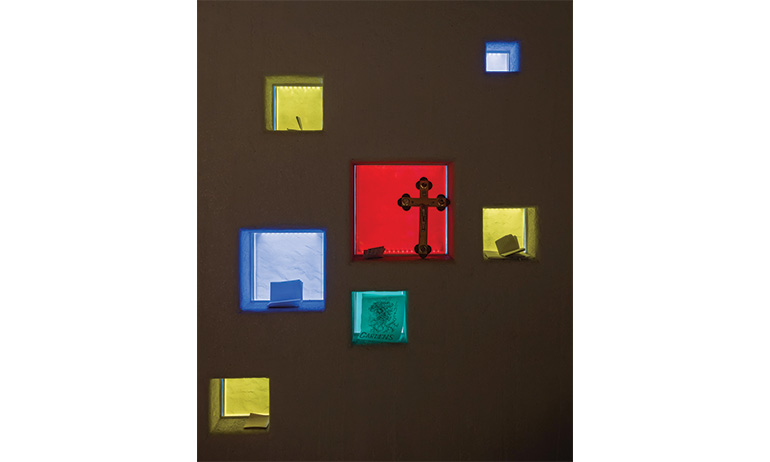
Written prayers sit illuminated in the walls of the Fred and Ruth Waugh Prayer Chapel, a popular place for Biola students to spend time alone with God.