The Reading List
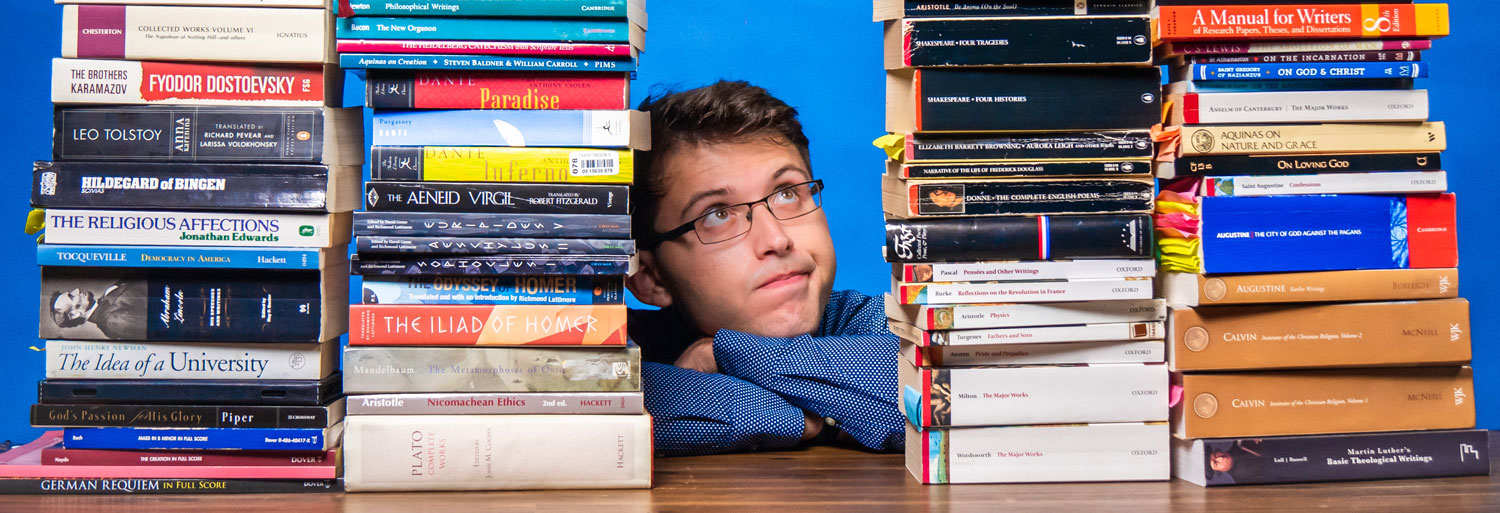
The Heart of Our Work
In Torrey Honors, we have the opportunity to step into a great conversation that stretches from the writers of the Old Testament and the ancient philosophers to the thinkers and authors of the modern day. We read and discuss enduring works that push us to think harder, grow in humility, deepen our faith and practice love.
We read the majority of the Old Testament and the entirety of the New Testament and readings from luminaries like...
Homer
Plato
Aristotle
Augustine
Dante
Martin Luther
William Shakespeare
Jane Austen
Alexis de Tocqueville
Fyodor Dostoevsky
Frederick Douglass
Christina Rossetti
Lorraine Hansberry
G.K. Chesterton
C.S. Lewis
Read Beyond the Curriculum
With hundreds of great books to choose from, we know we can’t fit in everything we want to read. That’s why we developed other academic opportunities for students to study books outside the curriculum. Upperclassmen in Torrey Honors can take an elective course, called a “Meta-Torrey,” to study ideas, authors, and genres in greater depth. Here are examples of past Meta-Torrey classes:
Global Greats
In this course, students read and discuss great books that typically fall outside the Western tradition—from South and East Asia, the Middle East, Latin America, and Africa. In addition to cultivating the virtue of cultural humility, we come to appreciate the global character of the Christian tradition, its riches and complexity.
View Course Reading List
- Confucius: The Analects
- Lao Tzu: Tao Te Ching
- The Bhagavad Gita
- Shūsaku Endō: Silence
- Ephrem the Syrian: Hymns on Paradise
- Al-Ghazali: Deliverance from Error
- Ibn Tufayl: Hayy Ibn Yaqzan
- Bartolomé de las Casas: A Short Account of the Destruction of the Indies
- Sor Juana Inés de la Cruz: Selected writings
- Gabriel García Márquez: One Hundred Years of Solitude
- Athanasius: The Life of Antony
- Olaudah Equiano: The Interesting Narrative of the Life and Adventures of Olaudah Equiano or Gustavus Vassa, the African
- Chinua Achebe: Things Fall Apart
Living Traditions
In this course, students read contemporary literature alongside classic literature. By juxtaposing the old and the new, we see how the enduring questions and conversations still pertain to contemporary American culture.
View Course Reading List
- Cormac McCarthy: The Road
- Shakespeare: Romeo and Juliet
- The Royal Ballet: Romeo and Juliet
- Augustine: Confessions
- Wendell Berry: Jayber Crow
- Psuedo-Dionysius: Complete Works
- Annie Dillard: Pilgrim at Tinker Creek
- Bible: Genesis
- Film: Tree of Life
- Douglass: Narrative of the Life
- Coltrane: A Love Supreme
- Marilynne Robinson: Gilead
American Literary Renaissance
This class centers on the American Literary Renaissance, featuring nationally formative American literature of the nineteenth century. These works signify a period of intense transformation and identity formation in the United States, during which the country’s literature became distinctly American.
View Course Reading List
- Edgar Allan Poe: Selections
- Emerson: Nature & Selected Essays
- Hawthorne: The Scarlet Letter
- Stowe: Uncle Tom's Cabin
- Brown: Clotel; or, The President's Daughter
- Thoreau: Walden
- Greenberg: The Confessions of Nat Turner
- Whitman: Leaves of Grass
- Douglass: My Bondage and My Freedom
- Melville: Bartleby and Benito Cereno
- Dickinson: Final Harvest: Poems
- Jacobs: Incidents in the Life of a Slave Girl
Christianity & The Qur'an
Traditionally, Muslim commentators have ignored the Qur'an’s debt to biblical literature and Christian culture, but this class explores how the Qur'an grew out of the rich Christian tradition of the Middle East and also worked to separate itself from that same tradition.
View Course Reading List
- St. Ephrem the Syrian: Hymns of Paradise
- St. Cyril of Alexandria: On the Unity of Christ
- Brock and Harvey, ed: Holy Women of the Syrian Orient
- St. Isaac of Nineveh: On Ascetical Life
- The Qu'ran
- Timothy I and Al-Mahdi: The Patriarch and the Caliph: An Eighth-Century Dialogue between Timothy I and al-Mahdi
- Theodore Abu Qurrah: Theodore Abu Qurrah
- Abd al-Jabbar: A Critique of Christian Origins
- Tarif Khalidi: The Muslim Jesus: Sayings and Stories in Islamic Literature
Create Your Own Torrey Course
Each year, Torrey Honors students propose small elective courses called "MicroTorreys," where students create the reading list. Examples of past MicroTorreys include C.S. Lewis's Space Trilogy, Korean Literature, The Lord of the Rings, Patristics and Wendell Berry.